
Pinned

🔥
22h •
Challenge Day 4: #Breaking News 🗞️
Teach or share a quick tip. Create a NEW POST with a bite-sized piece of wisdom related to your expertise - something that could help your ideal community member. After sharing your tip, invite people to check out your group for more. You may want to do this one as a video (optional) in order to build trust and authority. This is not the time for AI generated oatmeal. Don't forget to comment on three other posts after you make your post. No posting and 👻 in this challenge!

Pinned
🔥
Aug '25 •
HOW IT WORKS - READ THIS FIRST
Ever wonder how you can let people know about your Skool community? Feel like you have so much to offer but don't know how to get people involved? Wish there was somewhere you were actually allowed to promote yourself and talk about your offer? Look no further! The Skool Classifieds are the place where you are not only allowed to promote yourself, but you are actually encouraged to do so! Like the Classifieds section of your local newspaper or the Community Message Board at the gym, this is the place to let people know what you do and what you offer. Here's how it works: 1. Invite other Skoolers you know to join the group using your invite link. The more people join, the more people there are to promote to! 2. You can post once a day only. This is to keep the group from getting spammy. If it's spammy, people won't read and you won't get noticed. Post as many days in a row as you want, but please do not post the same thing day after day - mix it up! 3. Make sure you add your post to the appropriate group/heading. Please see below for a description of what each group is for. If you don't see a group that is appropriate, message me. 4. Self-Promotion is what this group is all about, but please do not DM people with your offers. You will be removed from the group for doing this. 5. Introduce yourself in this thread, and then scroll up and find someone you have something in common with. Reach out. There are some really amazing people here! 😉 This is a place for us to support each other for our mutual benefit. Hate speech, offensive language, or general negativity will be deleted, and you will be removed from the group. *Please check out this post for more tips on how to get great results from your posts. And also this post by one of our own community members who has had great success growing his group through the CLASSIFIEDS. To learn How to Make Your Classifeds' Posts Work Harder for You, check out this masterclass by one of our moderators, @Faith Adebayo


🔥
3m •
7-Day Content Reset Challenge for Creators
This isn't about carving out a perfect hour every day. It's about building one system — piece by piece — using whatever pockets of time you've actually got. Each day unlocks one task that moves you toward that system: mapping your workflow, batching content, building something reusable. Complete it, check it off, move on. Build one simple system. Get real time back. No lives, no Zoom calls, no pressure — just DIY. Join Creator Connections to start the challenge today!
0
0


3m •
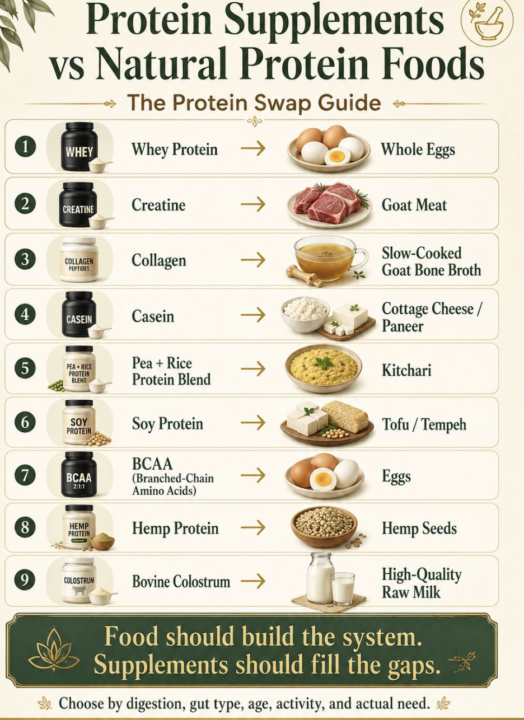
Protein Supplements vs Natural Protein Foods
The Protein Swap Guide Supplements are convenient. But convenience should not replace food wisdom. A scoop may give you an isolated nutrient. A real food gives you protein along with a natural matrix of fats, minerals, cofactors, satiety, and better biological context. So before reaching for the tub, ask: Can my body digest, absorb, and use this well? Here are simple protein supplement swaps to remember: Whey Protein → Whole Eggs A complete, highly bioavailable natural protein source. Creatine → Goat Meat A natural food source that supports strength and muscle nourishment. Collagen → Slow-Cooked Goat Bone Broth A traditional way to support joints, connective tissue, and deeper nourishment. Casein → Cottage Cheese / Paneer A natural slow-digesting milk protein option. Pea + Rice Protein Blend → Kitchari A simple traditional combination that gives a more balanced plant protein profile. Soy Protein → Tofu / Tempeh A whole-food plant protein alternative. BCAA — Branched-Chain Amino Acids → Eggs A natural source of leucine, isoleucine, and valine in a complete food form. Hemp Protein → Hemp Seeds A whole-food source of plant protein, fiber, and healthy fats. Bovine Colostrum → High-Quality Raw Milk A traditional nourishment-based alternative where suitable, safe, and well tolerated. Food should build the system. Supplements should fill the gaps. Because protein that is not digested will not build muscle. Collagen that is not assimilated will not repair tissue. And even the best supplement cannot replace poor digestion. Choose according to your digestion, gut type, age, activity, and actual need. We help you with that at https://www.skool.com/dhow-wellness-circle-5091/about
0
0

🔥
20h •
#Breaking News: Not Every Baby Animal Needs to Be Rescued
One of the biggest mistakes well-meaning people make is assuming every baby animal they find has been abandoned. Many mothers leave their babies alone while they search for food. Deer, rabbits, and many birds do this every day. If the baby isn't injured and isn't in immediate danger, the best thing you can often do is watch from a distance and give the parents a chance to return. Sometimes the kindest thing we can do is simply let wildlife be wild. If you'd like more simple tips like this, along with inspiring animal stories and trusted organizations making a difference, I'd love to welcome you to Empowering Animals.

1-30 of 14,573

skool.com/classifieds
The #1 public place to advertise your Skool, learn how to promote your group and collaborate with Skoolers. Real connections & growth without spam.
Leaderboard (30-day)
1

🔥
+644
2

🔥
+631
3

🔥
+404
4

🔥
+302
5

🔥
+299
Powered by