

User
Write something
Group Coaching - (VIP) is happening in 6 hours
🚨 This Unlocks Your Handstand (And Almost No One Trains It)
You can practice wall holds. You can drill shoulder taps. You can kick up a hundred times. But if you don’t know how to fall out of a handstand, progress will always stall. This is one of the biggest milestones in handstand training. Not strength. Not balance. Not consistency. Confidence. And confidence comes from knowing you can miss safely. If your brain thinks falling = danger, it will shut everything down no matter how strong or consistent you are. Why Learning to Fall Is Non-Negotiable • It removes fear • It allows real balance attempts • It unlocks freestanding time • It stops over-reliance on the wall • It prevents panic bails (the most common cause of wrist/shoulder tweaks) You don’t “graduate” to falling later. You train it early and often. How to Practice Falling Out of a Handstand (Step by Step) 1️⃣ Quarter-Turn Cartwheel Bail (Most Important) This is your default exit. How to practice: • Kick up lightly (or start from chest-to-wall) • When you feel overbalanced, turn your hips sideways • Let one leg come down first • Follow it with a small cartwheel motion 👉 Practice this on purpose, not by accident 👉 Do it both directions (yes, both) This should feel calm, controlled, and repeatable. 2️⃣ Wall Push-Away Drill This teaches you to leave the wall before panic kicks in. How: • Start chest-to-wall • Shift weight slightly forward • Gently push away with the hands • Immediately turn and step down into the cartwheel bail Goal: Teach your brain that leaving balance is safe. 3️⃣ Down Dog Kick-Up & Twist Out Great for beginners who aren’t comfortable upside down yet. How: • Start in Down Dog • Kick up softly • As soon as balance feels off, twist the hips and step out • Think “exit early, exit smoothly” This builds early awareness, not last-second saves. 4️⃣ Cartwheels Attempts (Yes, they can be bad) Reduces height and fear. How: • Hands on floor sideways • Jump to the other side of your hands • Practice stepping or turning out
🚨 This Unlocks Your Handstand (And Almost No One Trains It)
Training
Belief carried me when my body hesitated. Built by belief. Proven by work.
Training
🎥 Answering Your Questions: What Do You Need Help With Next
You ask your questions. I record a video answering them in detail. Then on Sunday, if you join the live call, we go even deeper together. If you cannot make it, the replay will be posted so you still get the full breakdown. Summary Of Video: 1. How to Keep Your Heels Down in a Squat Your heels lifting isn’t always an ankle-mobility problem — it can also come from tight hamstrings or hips. You need to identify the real limiter. Three practical fixes: - Progressive box/target squats - Mobility work to find the weak link - Ankle-specific mobility if needed Rule of thumb: Don't chase 12-exercise physio routines — pick 1–2 effective mobility drills and stick to them. 2. How to Structure Training When You Have Too Many Goals The big issue isn’t lack of ability — it’s trying to train everything every day, which creates anxiety and kills sustainability. Key Framework Split training into Strength Days and Skill/Movement Days. Strength Days - Focus only on strength. - 2–3 sessions/week is enough for actual progress. - Workouts should be ~30 minutes with no more than 6 exercises (supersets help). - Handstands and similar skills = optional “sprinkle” work (a few mins before or after), not required tasks. Skill/Movement Days - Lower intensity: mobility, animal movements, technique work. - 5–10 min mobility warm-ups are enough — don’t overdo it. - Handstands/headstands can go here if you want frequent practice. Weekly Structure Example - Mon: Strength - Tue: Skills/Movement - Wed: Strength - Thu: Skills/Movement - Fri: Strength - Sat: Light mobility or a favorite skill - Sun: Rest (or playful practice if you just enjoy it) 3. Dealing with Anxiety About “Missing” Skills Skill progress feels fragile, but it isn’t. You don’t need to practice every skill every day to maintain it. Why: - To improve something: ~8/10 effort. - To maintain it: ~2/10 effort. Once you reach a baseline (e.g., handstand against the wall, a basic muscle-up), maintaining it becomes easy — you don’t lose it overnight.
🎥 Answering Your Questions: What Do You Need Help With Next
🦇 ONLY FOR PEOPLE WHO REFUSE TO STAY AVERAGE.
This one is personal. I grew up watching superheroes, anime characters, and video game heroes who could move freely, climb anything, jump rooftops, and use their bodies without limits. And somewhere along the way, we’re told that’s just fantasy. I still remember the first time I trained parkour outside. I was awkward. Not smooth. Not impressive. People stared. Some laughed. And I felt it. I remember telling people I wanted to do Ninja Warrior as an adult and getting that polite smile. “You mean… on TV?” “That’s nice.” You know the one. The kind that really means “That’s not realistic.” But here’s the part they don’t talk about. Most adults don’t stop dreaming because they don’t want it. They stop because they’re afraid to look silly. Afraid to fail publicly. Afraid to be judged for wanting more than a box, a routine, and comfort. Yet deep down, when they see someone training skills, hanging, flipping, balancing, trying something hard, something clicks. They think, “I wish I could do that.” And guess what... I did do that. I created a community in a hometown for parkour that got over 100 members to start moving. I started coaching to top athletes in Ninja Warrior to win international competitions I got to compete against Ninja Warriors that were on tv and win I got to start Awesome Ninja Fitness to help hundreds of people learn handstands and get stronger There were too many things to list that I was proud of. This community exists for people who hear that voice and refuse to ignore it. For adults who want to be stronger, more capable, more free in their body. Not to impress anyone. But to feel alive again. If you’ve ever felt out of place for wanting more. If you’ve ever been told to be realistic. If you’ve ever felt called to move, train, explore, and test yourself. You’re exactly where you belong. Who has decided they didn’t want to stay average anymore?
🦇 ONLY FOR PEOPLE WHO REFUSE TO STAY AVERAGE.
Handstands
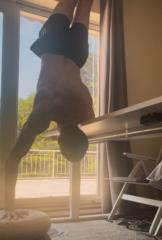
Here is where I'm at with handstands. Working towards 60s. I work on all the basic shapes and pressing.
Handstands
1-30 of 125
Awesome! Hybrid Calisthenics
skool.com/awesome-ninja-fitness
Master bodyweight strength, skills like handstands & muscle-ups. Build strength, movement, and control while unlocking your full potential! 💪🔥
Leaderboard (30-day)
Powered by