Activity
Mon
Wed
Fri
Sun
Mar
Apr
May
Jun
Jul
Aug
Sep
Oct
Nov
Dec
Jan
Feb
What is this?
Less
More
Memberships
Superior Students
18.4k members • Free
The Off Grid Collective
293 members • Free
Plan Your Tech
111 members • Free
The Electricity Lab
162 members • Free
DIY Solar Alliance
49 members • Free
The Solar Network
32 members • Free
Energy Passive Income Academy
29 members • Free
Oil and Gas Australia
25 members • Free
Best Job Ever Career Club
69 members • Free
25 contributions to Energy Economics & Finance
2d •
Round2 Interview Question
In the interview , for a company (energy investments / commodities) a panel of 3 interviewers asked me the following during a discussion . Panel: Let's talk about some important Python details. It's ok if you don't remember things. Just an approximate answer will be fine for us. So, in Python, what is the difference between a List comprehension and a Generator expression. In a few words... Correct answer: A generator expression is like a list comprehension, except that it doesn't store the list in memory. Panel: Give some example . Write here in the tablet. Answer: list comprehension: simulated_returns = [price * volatility for price in historical_data] portfolio_value = sum(simulated_returns) generator: simulated_returns = (price * volatility for price in historical_data) portfolio_value = sum(simulated_returns)

1 like • 56m
@Babette Pascal Same worked for me. By just typing the code that you see on screen, really makes my mind to absorb it. It is weird but really works. Trust the process! It works with all of us. Just type the code, and as you type always try to focus on what the code means e.g. dont just think about other things, but think about the code. Just 1-2 hours a day , you will see.

20h •
Energy Storage Arbitrage: 2 common Interview Questions
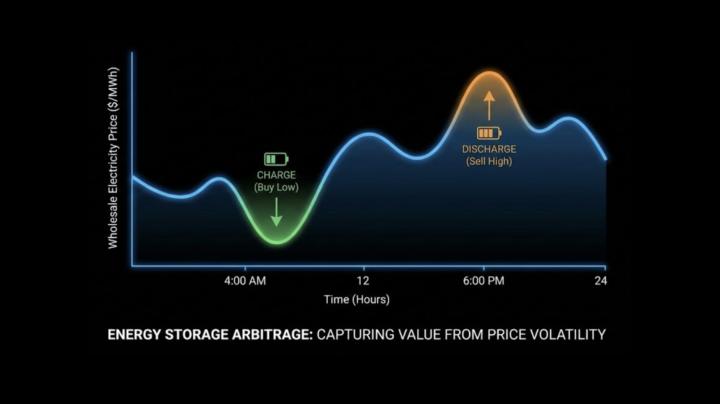
A new online course is being prepared about Energy Storage Trading using optimisation, machine learning (including reinforcement learning) , beginner-friendly ( no prerequisites ). This course will explain what energy storage trading is, what energy storage arbitrage is, etc - also all developed in Python. This is a topic that all energy companies are interested in, so there is very high probability that a relevant interview question will be asked . Even if you're not looking for jobs at the moment, you may look soon, so it is definitely useful to know this terminology. Here are two common interview questions: Interview Question1: What do we mean by Energy Storage Arbitrage? Interview Question2: What is the difference between Financial Arbitrage and Energy Storage Arbitrage? ================== Answer to Question1: It is when an Energy Storage unit buys electricity when the electricity price is low, and sells it when the electricity price is high. This operation generates economic profit by exploiting this price volatility over the course of a day, as shown in the attached slide. Answer to Question 2: The main difference is between space and time. Financial arbitrage exploits price differences between two different locations (e.g. New York and London) at the same moment (i.e. we buy a financial asset in New York and immediately we sell the same asset in London at a slightly higher price e.g. $100 versus $100.1 ). While Energy Storage arbitrage exploits price differences at different times within the same location (electricity market) e.g. the same storage unit (same location) buys electricity when its price is low, and sells it when the price is high. VIDEOS: Also, in the Classroom/6.3 I have uploaded 2 videos, each for these two questions (they provide some extra analysis). These two videos will also be part of the new course (in a few days).
1 like • 18h
so, financial arbitrage is about 'where' while battery arbitrage is about 'when'.
6d •
New Report on Small Nuclear Reactors
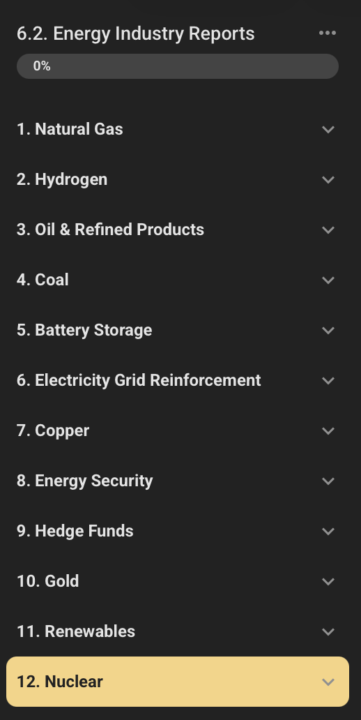
A new report on energy trends has been published and can be found by clicking on 'Classroom' and navigating to Section 6.2 (See the attached screenshot). You can use this report and the visualisations it includes, in your own projects, work, or studies, without limits. This report is about Small Nuclear Reactors and current trends by February 2026. Big technology companies like Amazon and Google are racing to find reliable electricity to meet the massive energy demands of new AI data centers. Their primary long-term solution is investing in Small Modular Reactors (SMRs) which are smaller nuclear plants that provide steady "zero-emission" electricity. However, because SMRs take about 8 years to build, these companies are also restarting and upgrading existing nuclear plants to bridge the gap. The report includes lots of diagrams and flowcharts that provide context, and also a list of relevant sources that were used to complete this report. These sources are from the Financial Times, Wall Street Journal, the Economist and Investors Chronicle (all sources are available inside the report). Your subscription in this Skool community gives you access to paywalled energy-economics articles from these publications (Financial Times etc) indirectly through these reports. I have also included some explanations and additional text that explains some details. The text is written in beginner-friendly, easy-to-understand language. Reading these reports is helpful for interviews, panel discussions , presentations, networking, and public speaking. Strongly recommended.
0 likes • 6d
It is interesting to see Big Tech effectively acting as utility companies. They are securing their own supply chains.

9d •
LLMs Best Practices
Hey everyone, I’m asking this because LLMs weren’t really part of our workflow before, but now that they’re available it’s difficult not to leverage them given their productivity benefits. How are you using LLMs in data science workflows, and what best practices should I be aware of? Also, from a manager’s perspective, what expectations or concerns do you have about their use? PS: I am one of those that do not use it much especially for work or academia and looking for the correct ways to integrate it.
0 likes • 8d
@A Khan Fully agree

9d •
Energy Transition : Adding instead of Replacing
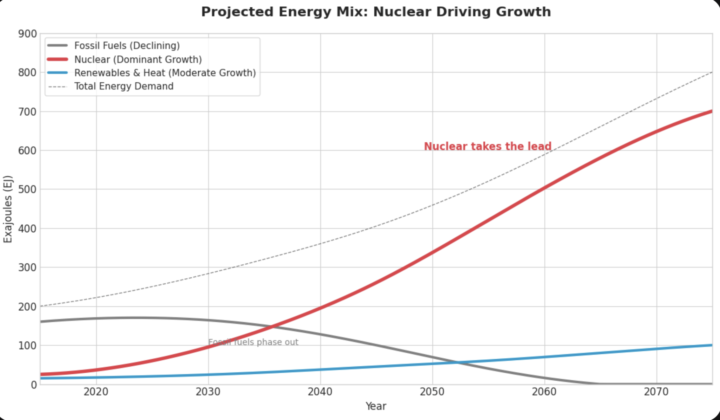
Below is part of some consultancy work I completed recently and sharing a few key ideas: Renewable energy is growing but fossil fuels are still growing too, so the system is adding rather than replacing. Oil and gas will remain important for a long time, so new investment in fossil‑fuel supply and infrastructure (pipelines, power plants, refineries, and other big long‑lasting equipment) will still be needed. If clean energy supply grows faster than total demand for long enough, clean energy first covers new demand and then starts replacing fossil fuels. If clean energy supply keeps outgrowing demand by a few percentage points for decades, fossil fuels will eventually be squeezed out. Real replacement of fossil fuels, not just adding clean energy, is not guaranteed. Most likely we will see 'addition' and co-existence of fuels. This is because the demand is keep rising more and more eg due to AI etc. See the plot .
0 likes • 8d
Yes since the demand is increasing, I fully agree, we are adding sources of energy.
1-10 of 25
@ronan-murphy-8621
Technical Consultancy in Energy, with focus on Power/LNG/Hydrogen
Active 41m ago
Joined Nov 15, 2025
ISTP
Dublin/IR