User
Write something
Pinned
📌 START HERE: Exclusive Benefits for Subscribers
Welcome! I created this community with one specific goal: to help you build true expertise in energy economics and secure a high-paying quantitative role in the energy sector. Whether you are a complete beginner or a professional looking to advance, we don't just focus on theory here. We focus on building real-world models and optimizing your career strategy. If you are serious about landing your next role, upgrading to Premium unlocks my direct mentorship and our complete career system: - Personalized Curriculum: Message me your current skill level, and I will personally unlock the specific online courses that align exactly with your profile and goals. - Download All Files: Everything included in your personalized curriculum (Python, GAMS, Excel files, etc.) is available to download and keep. - Daily Mentorship: You will never get stuck. Ask questions every day, and I will answer them. - Full Career Support: Get targeted, expert feedback on your CV and cover letters, access our deep database of real Interview Q&As, and discover curated job ads. - Executive Industry Reports: Access easy-to-understand summaries of key energy trends every week. - Research Insights: Get simplified, actionable summaries of academic and industry research papers. 🎓 The Ultimate Goal: The Capstone Certification. Once you complete your personalized curriculum, you can take on The Applied Energy Data Science Certification. I will act as your "client" for a complex, real-world energy challenge. Pass the project, and you earn a signed, official certificate. 🚀 Subscribe here: https://www.skool.com/software-school-for-energy-7177/plans Best, 🏛️ Dr. Spyros Giannelos | PhD in Energy, Imperial College London ✉️ Email: [email protected] 📊 Research: Google Scholar (45+ publications, 1300+ citations)
⚡ Networks grids & Storage — Part 1/...
🗺️ Where it started To better understand energy networks and their geographic topology, I dove into open source data — specifically OpenStreetMap and GridKit — to map transmission nodes and lines across Europe and the UK. There are already plenty of courses on grids and storage. So instead of passively consuming content... I decided to build something. 🎯 Project Goals Technical side: - Sharpen my Python + mapping skills (Folium / GeoPandas) - Experiment with Vibe Coding (rapid iteration, AI-assisted prototyping) Knowledge side: - Understand the role of energy storage and load balancing in modern grids - Identify the critical materials and minerals behind storage technologies (lithium, cobalt, vanadium, manganese...) - Map out the key players in the sector — utilities, pure-play storage companies, and emerging startups 💡 Open questions — your ideas welcome! Some threads I'm already pulling on: - Where are the bottlenecks in European transmission networks? - How is the storage mix evolving — short-term (batteries) vs. long-term (hydrogen, pumped hydro)? - What business models are emerging around grid flexibility? What would you add to this project? 👇 Series in progress — more in the next post 🔄
⚡ Networks grids & Storage — Part 1/...
Challenges about career path
I am currently struggling a bit with my future career path. Because job opportunities in the energy sector are limited in my country, I am trying to identify alternative routes. However, I do not want to stop working on energy markets and the sector itself. For me, it seems somewhat easier to enter the finance industry. Which department within finance would best support this long-term goal? I have been thinking that starting in a treasury department might be helpful, since it is directly related to monetary conditions and financial management. What do you think about this? If there is no direct path into energy markets, how should I build an alternative route that would still move me toward that objective?
New Report on Energy Macroeconomics
A new report on this topic has now been published in Classroom, at the very end under “Energy Industry Support” , a special section featuring reports that explain the current status and key trends in the energy sector. The report is written in simple language, includes illustrative graphs, and draws on official and respected sources such as Financial Times, Bloomberg, Wall Street Journal, The Economist, Forbes, and Investors Chronicle. War in the Middle East can trigger a global economic chain reaction by disrupting energy supplies and pushing oil and gas prices higher. Investors worried that rising energy costs would increase inflation, reduce company profits, weaken consumer demand, and force central banks to keep interest rates high for longer. As a result, both stocks and bonds came under pressure, while markets became increasingly concerned about a prolonged period of slow growth combined with rising prices. This report can be freely used in your projects, work, or studies. It may also be especially useful for interviews, presentations, networking, and broader industry understanding, so it is strongly recommended that you read it and download it for future use. See the attached screenshots for a quick look. Sources: Financial Times: https://www.ft.com/content/3f4a6ad4-9216-4b5c-830f-11854787bb52?syn-25a6b1a6=1 Bloomberg: https://www.bloomberg.com/news/articles/2026-03-18/stock-market-today-dow-s-p-live-updates-? The Economist: https://www.economist.com/finance-and-economics/2026/03/09/the-iran-energy-shock-reverberates-across-financial-markets? Wall Street Journal:https://www.wsj.com/livecoverage/stock-market-today-dow-sp-500-nasdaq-03-19-2026/card/traders-brace-for-longer-natural-gas-crisis-AxkRbptlfWnH2nUO5kzc
New Report on Energy Macroeconomics
New Online Course: Kernel Density Estimation
A new online course has been published in Classroom. It is course 118. Its title is "Kernel Density Estimation". Kernel Density Estimation (KDE) is a highly effective statistical method used in the energy sector. It allows you to take an existing dataset and generate new, realistic values that follow the exact same underlying patterns. This is perfect for when you need to simulate multiple scenarios. Specifically, in this course: - we look at a smart building with uncertain electricity demand, using 8760 hourly values (one year of data). - we want to simulate 1000 unique days where the demand is different but strictly follows the "logic" of our original dataset. - we walk through generating KDE-based data and using it to solve Monte Carlo and two-stage stochastic optimization models. These methods are absolute standards in the energy sector. Best of all, this is a highly applied course. I show you exactly how I used these exact techniques in a real-world energy project, so you can move past academic textbook exercises and start applying this to actual problems. The attached screenshots show the step-by-step process of how KDE is applied in industry. And also the differences between using KDE and non-KDE approaches ; KDE is more realistic. Non-KDE approaches are easier to model but lack realism.
New Online Course: Kernel Density Estimation
1-30 of 210
powered by
The Energy Data Scientist
skool.com/software-school-for-energy-7177
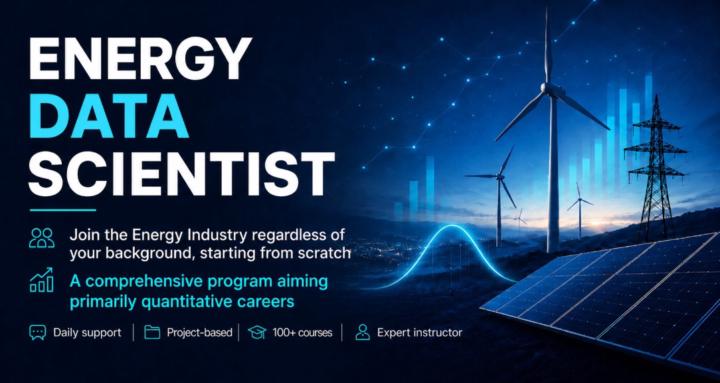
Launch your quantitative energy career with a personalized curriculum, daily mentorship, and the full career support needed to get hired.
Build your own community
Bring people together around your passion and get paid.
Powered by