Activity
Mon
Wed
Fri
Sun
May
Jun
Jul
Aug
Sep
Oct
Nov
Dec
Jan
Feb
Mar
Apr
What is this?
Less
More
Memberships
Software Dev in the AI Era
289 members • Free
AI Automation (A-Z)
152k members • Free
Financial Freedom Formula
281 members • Free
Skool of Finance
588 members • Free
Financial Analysis in Business
323 members • Free
Finance & Leadership Academy
132 members • Free
Financial Management Academy
71 members • Free
BeyondTheBottomLine
70 members • Free
Money Acquisition
12 members • Free
24 contributions to The Energy Data Scientist

27d •
Challenges about career path
I am currently struggling a bit with my future career path. Because job opportunities in the energy sector are limited in my country, I am trying to identify alternative routes. However, I do not want to stop working on energy markets and the sector itself. For me, it seems somewhat easier to enter the finance industry. Which department within finance would best support this long-term goal? I have been thinking that starting in a treasury department might be helpful, since it is directly related to monetary conditions and financial management. What do you think about this? If there is no direct path into energy markets, how should I build an alternative route that would still move me toward that objective?

2 likes • 27d
I recommend that you follow the “burn the boats” approach. This means : you make your choice today, and keep going along this path. Time flies. You cannot wait and doubt. Make a choice and go ahead. But how do you make a choice: a) what did you study in bachelors/postgraduate? then do that! why change? you already have a network of people (the other students who studied with you and the professors) b) where do you have skills already? excuse me but what is your finance knowledge? ok they will give you a job lets say. Do you have the skills to do the treasury job? or you plan to learn ? so they will pay you to learn? will they really do this? c) How many CVs have you already sent to energy companies? why do you say 'it is more difficult than energy' ? did you read it somewhere or is this your experience? d) you have so much support here. Courses etc. If you get a quantitative job in evergy, you know it already . You have all the support here. This makes 'energy' the easier path just because of the support you have
0 likes • 22d
So, Mustafa, in energy sector, this role in treasury is combined with tasks like managing the costs of building power plants or eg hedging against the constant fluctuation of fuel and electricity prices. You can easily combine it. eg you use financial optimization (python) to balance upfront investments in technology, such as solar panels and batteries, with long-term operational savings. So, it is a vital function for energy projects to stay profitable .

Mar 14 •
New Report: Oil Price, Bonds & USD
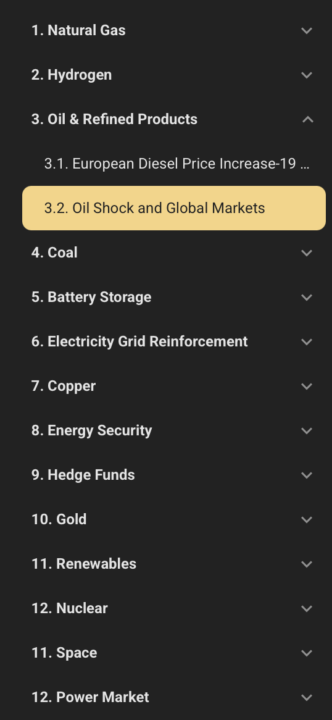
Rising oil prices from Middle East conflict spread quickly through the global economy. They have: a) increase dinflation, b) pushed up short term bond yields, c) strengthened the US dollar, d) raised costs for oil importing countries. A new report on this topic has now been published in Classroom, at the very end under “Energy Industry Support”, a special section featuring reports that explain the current status and key trends in the energy sector. The report is written in simple language, includes illustrative graphs, and shares official sources from the Financial Times, Bloomberg, Wall Street Journal, The Economist, Forbes, and Investors Chronicle. It can be freely used in your projects, work, or studies. It may be especially useful for interviews, presentations, networking, and broader professional development. It is strongly recommended to read it and download it for your use. See the attached screenshots.
0 likes • Mar 14
Very interesting and thank you . One recent detail supports the report almost perfectly. Reuters reported that Brent then fell sharply on March 10, at $87.80 after comments pointing to possible de-escalation. That is a good reminder that oil reacts not only to real supply loss, but also to changing expectations. The whole report is really about that.well.

Feb 23 •
Interview with Chevron: Challenges & trends
Recent interview question in Chevron. Happy to have some inputs. Thanks . - Department: Corporate Strategic Planning, interviewing jointly with Chevron New Energies (the division responsible for lower-carbon investments like hydrogen and carbon capture). - Target Role: Senior Quantitative Energy Economist - Interview Stage: Final Round / Executive Panel Presentation. You would likely be standing at a whiteboard in front of 3 to 4 senior directors. - 2 February 2026. - Format: the recruitment coordinator takes your mobile phone, laptop, and smartwatch. There is no AI, no internet, and no Python to run your simulations. You are led into a quiet focus room. On the desk is a printed piece of paper containing "The Carbon vs. Capital Conundrum" prompt, a basic scientific calculator, a notepad, and a pen. You are given exactly 45 minutes to digest the prompt, formulate your economic models from memory, and structure your recommendation.After 45 minutes, you are escorted into the boardroom to face the senior directors. You have nothing but your handwritten notes, a whiteboard, and a marker. Interview Question: " You are presenting to our executive investment committee. We have a strict capital expenditure (CapEx) limit for the upcoming fiscal year and can only fully fund one of two mega-projects. You must recommend which one we choose: Project Alpha (Deepwater Oil & Gas) - Location: Offshore West Africa - Financials: Spectacular projected Internal Rate of Return (IRR) of 20% with a very fast payback period. - Risks & Downsides: The host country is experiencing growing political instability. Furthermore, the project has a massive carbon footprint that will push our corporate emissions well over our stated public reduction targets for the decade. Project Beta (Carbon Capture & Hydrogen Hub) - Location: US Gulf Coast - Financials: The economics are extremely tight. The baseline IRR is only 7%, which barely clears our corporate hurdle rate (minimum acceptable return). - Benefits: It operates in a highly stable geopolitical region, secures massive government tax credits, and practically guarantees we hit our corporate net-zero pledges.
0 likes • Feb 23
I agree . To solve this, you first lower the oil project's 20% profit estimate down to around 12% by subtracting the future costs of carbon taxes and political risks. And then, you boost the clean energy project's 7% return closer to 10% by factoring in government tax credits and cheaper loans. In the end, you recommend building the oil project but immediately selling off a 40% stake to a partner, using that cash to safely fund the clean energy hub.
Feb 20 •
New Online Course: Monte Carlo in Energy
A new online course is now available in the Classroom section: "115. Monte Carlo Simulations in Energy". Because we are building directly on our previous work, please make sure you have completed the prerequisite course, "114. Deterministic Optimisation in Energy," before diving into this one. In the real world, sunlight and electricity demand fluctuate constantly. Relying on a single "perfect" forecast leaves power systems highly vulnerable to unexpected costs or failures. This course teaches you how to handle that uncertainty using a Monte Carlo Simulation. We will take our deterministic model and run it 1,000 times, applying random, normally distributed variations to both the electricity demand and the solar output. By analyzing the 1,000 optimal costs through statistics and risk metrics like VaR (Value at Risk) and CVaR, we observe how to observe how sensitive are the economics to uncertainty. Mastering this technique is crucial in the energy sector because it allows to mathematically quantify risk and predict financial stability of energy systems.
0 likes • Feb 20
So 115 is a continuation to 114. Thank you.

Feb 13 •
Random Forest (ML) for Energy Trading
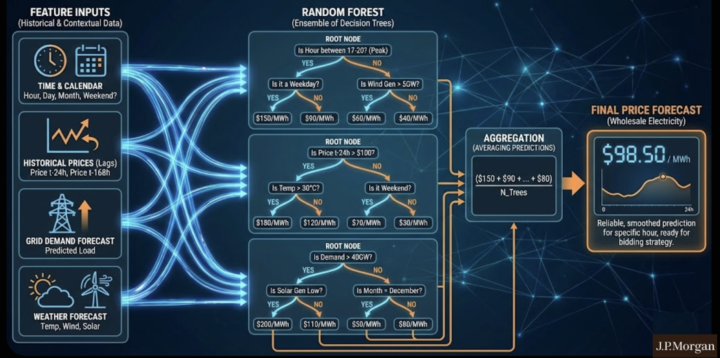
I was in a project collaboration (Enel, EDF, JP Morgan, Universities etc) on algorithmic trading, and the use of Machine Learning for electricity price prediction. I am sharing one slide. Why are trading desks using Random Forest so much ?
1 like • Feb 13
Yes I agree. So they dont like using deep learning because it is like a "black box" . Ie they dont understand how it works. Too complex. But random forest has an explicit node structure as shown above in your image and this allows traders and analysts to interpret the "why" behind a forecast.
0 likes • Feb 13
@Dr. Spyros Giannelos yes indeed
1-10 of 24
@babette-pascal-9215
Energy engineering student focused on building energy finance models (Intern EDF)
Active 19h ago
Joined Nov 18, 2025
ESFJ
Canada