Activity
Mon
Wed
Fri
Sun
Nov
Dec
Jan
Feb
Mar
Apr
May
Jun
Jul
Aug
Sep
What is this?
Less
More
Bedrock Nation
177
Free
49 contributions to Bedrock Nation

Jun 18 •
The Real Reason We Can't Stop Scrolling
Hint: It's Not Dopamine. If you've spent any time on social media lately, you've probably heard people talk about "dopamine addiction." Dopamine detoxes. Dopamine overload. Dopamine fasting. Dopamine being the reason we can't put our phones down. But what if dopamine isn't the problem? What if we're blaming one of the body's most important systems for a problem it never created? Dopamine isn't bad. In fact, dopamine is one of the most remarkable systems God designed into the human body. Without dopamine: • You wouldn't pursue goals. • You wouldn't feel motivated. • You wouldn't experience anticipation. • You wouldn't enjoy learning. • You wouldn't strive for improvement. • You wouldn't seek meaningful connection. Dopamine is part of the system that helps move us forward. It was designed to reward behaviors that help us survive, grow, learn, connect, and fulfill our purpose. So if dopamine isn't the problem... Why can't we stop scrolling? Because modern life has learned how to trigger the reward without requiring the growth. For most of human history, dopamine was tied to effort. You learned a skill. You built something. You solved a problem. You worked toward a goal. You spent time with people you loved. You served others. You deepened your faith. You accomplished something meaningful. And dopamine reinforced those behaviors. Today, we can access the reward without the process. A notification. A like. A comment. A reel. A short video. A purchase. A swipe. A scroll. The brain receives a reward signal, but often without the growth, purpose, or fulfillment that was originally meant to accompany it. Over time, that disconnect can create imbalance. But I think there's an even deeper question worth asking. Why do some people scroll for ten minutes and put the phone down... While others lose three hours? Why can one person enjoy social media without becoming dependent... While another feels compelled to check every notification? The answer is usually much bigger than dopamine.


0 likes • 6d
Thank you i needed to hear this
Jun 18 •
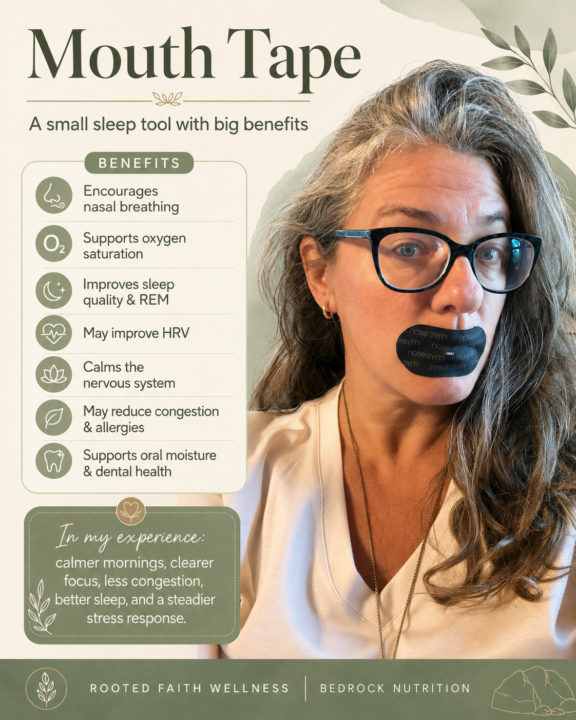
Mouth Tape: A Simple Sleep Tool That Starts With Better Breathing
Mouth tape is one of those wellness tools that sounds almost too simple to matter. A tiny strip of tape over the mouth at night? Really? But for many people, the impact can be surprisingly noticeable: deeper sleep, less dry mouth, fewer nighttime wake-ups, improved oxygen saturation, better HRV, calmer mornings, clearer thinking, and less of that “wired but tired” stress response. I’ve experienced this personally. Using mouth tape has helped me with sinus congestion, allergies, sleep quality, REM sleep, oxygen saturation, HRV, and even my anxiety and stress response. I wake up feeling calmer, clearer, more focused, and more rested. So let’s talk about why something this simple may have such a meaningful effect. Mouth Breathing vs. Nose Breathing The mouth is a backup airway. The nose is the primary breathing organ. When we breathe through the nose, air is filtered, warmed, humidified, and regulated before it reaches the lungs. Nasal breathing also supports nitric oxide production, which plays a role in airway tone, blood flow, oxygen delivery, and immune defense. Mouth breathing bypasses much of that system. During sleep, chronic mouth breathing can contribute to dry mouth, bad breath, snoring, disrupted sleep, airway irritation, and in some cases, worsening sleep-disordered breathing. This matters because sleep is not just about being unconscious for 7–8 hours. Sleep is when the body repairs, detoxifies, regulates blood sugar, balances hormones, restores the nervous system, and consolidates memory. If breathing is disrupted, sleep is disrupted. What Mouth Tape Actually Does Mouth tape does not force better breathing. It gently reminds the body to keep the mouth closed so nasal breathing can become the default. That distinction matters. Mouth tape is not a cure for sleep apnea, chronic congestion, airway restriction, or poor sleep. But for people who can breathe through their nose and simply fall into nighttime mouth breathing out of habit, it may be a helpful training tool.
1 like • 6d
When i first saw this i just laughed. Now with regular back sleeping and knees over triangle pillow. The mouth hangs...soo I'll be trying these soon as i buy them
Jul 18 •
11 Summer “low to no-cook” meal options to beat the heat!
☀️ Anyone else NOT enjoy cooking and making the house even hotter when it’s 97° outside? Or is it just me? 😅 Summer is one of those seasons where I want meals that are: ✅ High protein ✅ Ancestral-inspired ✅ Budget-friendly ✅ Low effort ✅ Low (or no) cooking required Here are some of my favorite go-to summer dinners. Use them as inspiration and make them your own! 🥩 1. Steak Bites & Summer Veggies Quick-seared sirloin with zucchini, mushrooms, garlic, butter, and fresh sliced tomatoes. 🍗 2. Rotisserie Chicken Snack Plate Rotisserie chicken with cheese, cucumbers, olives, pickles, hard-boiled or deviled eggs, and fresh fruit for anyone not eating keto. 🥓 3. BLT Protein Bowls Chicken or turkey, crispy bacon, tomato, avocado, a little lettuce for crunch, and homemade ranch or avocado mayo. 🐟 4. Blackened Salmon Pan-seared salmon with buttered green beans and cucumber slices with olive oil, lemon, and sea salt. 🌮 5. Taco Bowls Seasoned ground beef topped with cheese, avocado, salsa, sour cream, jalapeños, olives, and a little shredded lettuce. 🍤 6. Garlic Butter Shrimp Shrimp sautéed in garlic butter with zucchini noodles or ribbons and a sprinkle of Parmesan. 🍳 7. Breakfast for Dinner Eggs, bacon, sausage, avocado, and fresh tomatoes. Simple. Filling. Always a win. 🧀 8. Keto Snack Board Cheese, summer sausage, rotisserie chicken, olives, pickles, raw veggies, hard-boiled eggs, and ranch dip. 🫑 9. Philly Cheesesteak Skillet Thin-sliced beef with peppers, onions, mushrooms, and melted provolone. 🥒 10. Greek Chicken Bowls Rotisserie chicken, cucumber, tomato, feta, olives, olive oil, lemon, and tzatziki. Fresh, light, and packed with flavor. 🥬 11. Burger Bowls Ground beef, bacon, cheese, tomatoes, pickles, avocado, homemade burger sauce, and just enough lettuce for texture—without feeling like another burger night. The best part? These are all just starting points. Swap proteins. Add seasonal vegetables. Change the herbs and spices. Mix and match ingredients based on what’s on sale or already in your refrigerator.

0 likes • 6d
Love the chart thanks Making most already but see new ones I'm going to try
Aug 12 •
Peptide Spotlight: PT-141 - Intimacy
Intimacy | Desire • Arousal • Connection PT-141 is one of the more interesting peptides in this series because it approaches sexual wellness differently than most people expect. When people think about libido support, they often immediately think: Hormones. Testosterone. Estrogen. Blood flow. All of those things absolutely matter. But sexual desire also begins in the brain. And that is where PT-141 becomes particularly interesting. First: What is PT-141? PT-141, also known as bremelanotide, is a synthetic peptide that activates receptors within the body's melanocortin system. The melanocortin system is involved in far more than sexual function. It participates in pathways related to: • Appetite and energy regulation • Pigmentation • Stress signaling • Inflammation • Autonomic nervous-system activity • Sexual motivation and arousal PT-141 was developed from research involving Melanotan II, another melanocortin peptide that became known partly because of its effects on skin pigmentation. Researchers noticed something unexpected during those studies: Participants weren't only becoming more pigmented. They were also reporting increased sexual arousal and spontaneous erections. That observation ultimately helped lead to the development of PT-141 as a more targeted melanocortin-based sexual-health therapy. How is this different from Viagra? This is probably the easiest way to understand why PT-141 is interesting. Drugs such as sildenafil primarily work by improving vascular blood flow to erectile tissue. PT-141 works much more centrally. It activates melanocortin receptors in the central nervous system, particularly pathways involving MC4 receptors associated with sexual motivation and arousal. The exact mechanism is still not completely understood, but the FDA-approved form of bremelanotide is recognized as a melanocortin receptor agonist acting within these CNS pathways. So rather than simply asking: “Can the tissue respond physically?” PT-141 potentially addresses another question:

0 likes • 6d
Very interesting and informative
Aug 17 •
ASTHMA: THE LUNGS MAY BE WHERE YOU FEEL IT—BUT THE TERRAIN GOES MUCH DEEPER.
This one is personal for me. I was diagnosed with asthma when I was 7 years old. For most of my childhood and young adulthood, asthma was simply part of my identity. Inhalers. Steroids. Respiratory infections. Bronchitis. That familiar tightness in my chest. And the assumption that this was simply something I would always have to manage. Then at 34 years old, I changed the way I ate. I went Paleo. Real food. No ultra-processed garbage. No constant refined carbohydrate. No inflammatory junk foods. No Seed Oils. No Grains. A completely different nutritional environment. And within a matter of months... my asthma attacks stopped. They didn't gradually become a little less annoying. They disappeared. And they have never returned. I stopped needing steroids. I stopped using inhalers. And that experience fundamentally changed the way I look at the human body. DID PALEO “CURE ASTHMA”? That's not the claim I'm making. My experience is MY experience. Asthma is a heterogeneous chronic inflammatory airway disease, and different people have different triggers, genetics, immune patterns and environmental exposures. But here's what my experience made impossible for me to ignore: Changing my food dramatically changed the way my immune system and lungs behaved. That should make us curious. Because if asthma were simply a permanently defective set of lungs... why did changing my FOOD change my lungs? THE LUNGS ARE WHERE I FEEL MY WEAKNESS. Even today, I understand something very clearly about my own biology: My lungs are still my weak spot. If I get run down... If I'm exhausted... If my immune system gets overwhelmed... If I'm exposed to something my body doesn't tolerate... the respiratory system is usually where I'll feel it first. If I get sick at all, I'm much more likely to develop an upper-respiratory infection or pneumonia than some completely unrelated problem. But I don't look at that as: “My body is broken.” I look at it as information. My body has told me:

1 like • 6d
Going paleo, thanks to you, fixed my asthmatic issues spring and fall when allergies act up
1-10 of 49
Active 6d ago
Joined Dec 25, 2025