
Write something
Pinned

Jun 18 •
Why Our Approach Is Different
Why Our Approach Is Different One of the biggest challenges in health today is that most people are looking for a quick fix. A magic pill. A miracle supplement. A new protocol. A trendy gadget. A shortcut. And honestly, I understand why. When you're exhausted, in pain, struggling with your weight, dealing with digestive issues, autoimmune symptoms, hormone problems, brain fog, poor sleep, or simply feeling frustrated by a body that isn't cooperating, relief can't come fast enough. That's exactly why the health industry continues to market products as if they're the holy grail. Every week there's a new supplement. A new superfood. A new biohack. A new promise. And while many of these products may have value, most are presented without context. Without purpose. Without intentionality. Without customization. Without evidence that they're the right fit for the individual using them. The truth is that no supplement works in isolation. No product is one-size-fits-all. And no health solution has the exact same answer for every person. That's why so many people spend years chasing promises. They buy another supplement. Try another diet. Follow another influencer. Purchase another program. And eventually find themselves more tired. More frustrated. More confused. More hopeless. Not because they're failing. But because they've never been taught how the body actually works. That's where our approach is different. At Bedrock, we aren't looking for the fastest solution. We're looking for the most sustainable solution. We're not interested in temporary symptom relief if the underlying problem remains untouched. We're interested in helping people create permanent change. That means we focus on: ✓ Purpose ✓ Intentionality ✓ Customization ✓ Evidence ✓ Education ✓ Long-term sustainability We help people understand why they're taking something. What it's supporting. How it works with other nutrients. How it fits into the bigger picture. And most importantly... How to adapt as their body's needs change over time.
5
0
Pinned
Jan 2 •
The Bedrock Health Matrix: Our philosophy and services
Welcome to Bedrock Nation! This document explains The Bedrock Health Matrix—our faith-rooted, evidence-based approach to healing and the services we offer. Inside you’ll see: our Faith • Function • Foundation philosophy, the 7 pillars of health, the Matrix framework (assessment, genetics, labs, lifestyle + coaching), and the Bedrock Roadmap that guides your journey from discovery → design → develop → thrive. Start here to understand how we personalize care, why we “test, don’t guess,” and how our community supports long-term change. When you’re done reading, drop a comment with: 1) your #1 goal, and 2) your biggest obstacle right now.
Pinned
Nov '25 •
Welcome to Bedrock Nation
We are so glad you are here! This is your space to learn, grow and connect - free from Facebook's distractions and censorship. Start Here: 1. Take your Free HIPAA Compliant Health Assessment and schedule a free 15 minute consultation by phone with one of our team. https://adobe.ly/41cHOYw (upon receipt of your assessment one of our team will contact you to set this up) 2. Download our 20 Truths to Better Health Guide (attached) 3. Introduce yourself in the comments and tell us what "Getting back to your Bedrock (Foundation)" means to you!
Aug 4 •
What Are Peptides—and What is the Bedrock Take on Them?
You may have heard the word peptides everywhere lately. They are being discussed in relation to metabolism, tissue repair, muscle development, sleep, cognitive performance, immune function, healthy aging, sexual wellness, and more. But what exactly are they—and where do they fit within the Bedrock approach? What are peptides? Peptides are short chains of amino acids. You can think of amino acids as individual letters and peptides as short words created from those letters. Proteins are the much longer sentences and paragraphs. Your body naturally produces thousands of peptides. Many act as biological messengers, helping cells communicate with one another and coordinating processes such as: • Hormone signaling • Immune activity • Inflammatory responses • Tissue repair • Metabolism • Sleep and circadian rhythms • Cognitive function • Growth and recovery In other words, peptides do not simply “make” the body perform a particular function. They often work by delivering a message. That distinction is important because it aligns with something we have always taught at Bedrock: The body already knows what to do. Our job is to identify what may be interfering with that communication and provide the body with the raw materials, environment, and appropriate signals it needs to do its work. What does “buccal” mean? Buccal refers to the inner lining of the cheek. With buccal delivery, a dissolving strip is placed inside the mouth so its ingredients can potentially pass through the oral mucosa rather than first traveling through the entire digestive tract. This is different from simply swallowing a capsule. Peptides can be difficult to deliver orally because digestive enzymes may break them apart and their larger molecular structures can limit absorption. The oral mucosa provides another possible route, with access to a blood-rich tissue surface and partial avoidance of gastrointestinal degradation and first-pass metabolism. However, absorption can still vary substantially depending on the specific peptide, its molecular properties, the formulation, the dose, the delivery technology, and the individual using it.

Mar 29 •
Corns & Calluses
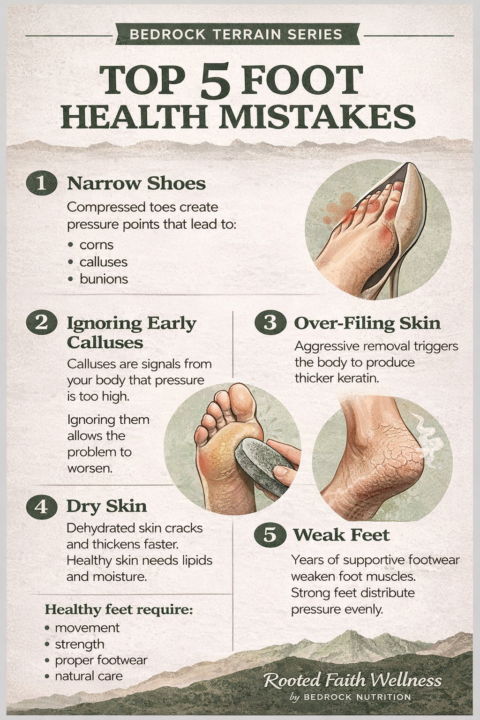
What they are, why they form, and how modern footwear contributes Most people think of corns and calluses as cosmetic annoyances. In reality, they are a protective biological response. Your skin is incredibly intelligent. When it experiences repeated pressure, friction, or mechanical stress, it responds by thickening the outer layer (keratin) to protect deeper tissue. This thickening is what we call: • Calluses – broader areas of thickened skin • Corns – smaller, concentrated areas of hardened skin with a central core Both are forms of hyperkeratosis, meaning the skin produces extra keratin in response to mechanical stress. They are signals from the body that something about your movement, posture, or footwear is creating excessive pressure. The Difference Between Corns and Calluses Calluses are generally protective. Corns tend to form when pressure becomes concentrated in a very small area. Why Corns and Calluses Develop The root cause is almost always mechanical stress on the foot. Common contributors include: 1. Tight or Narrow Shoes Shoes that compress the toes force the foot into unnatural shapes. This creates pressure points where the skin begins to thicken. 2. Elevated Heels Even small heels shift body weight forward onto the ball of the foot, increasing friction. 3. Toe Spring Many modern shoes lift the toes upward. This prevents normal toe engagement and increases pressure on the forefoot. 4. Limited Toe Box Traditional shoes narrow at the front, compressing the toes. This leads to friction between toes and between toes and the shoe. 5. Abnormal Foot Mechanics Examples include: • flat feet• high arches• overpronation• bunions• hammertoes These alter pressure distribution during walking. 6. Reduced Foot Mobility Weak intrinsic foot muscles or limited ankle mobility can shift load to small areas of the foot. Why Modern Shoes Make the Problem Worse The human foot contains: • 26 bones• 33 joints• over 100 muscles, tendons, and ligaments It was designed to spread, flex, and grip the ground.
1-30 of 255
powered by
skool.com/bedrock-nation-8489
Free wellness community for faith based living, functional health and real connection - off social media, rooted in purpose - learn, grow and heal.
Suggested communities
Powered by