User
Write something
Pinned
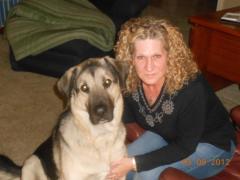
SIMCHA'S LEGACY
Some of you may ask why this community carries Simcha’s name. The truth is, his legacy is woven into every part of this work. Simcha was a gentle giant, 150 pounds of calm, steady presence. He was my son’s service dog, and after my son died, he became totally my dog. He moved through the world with a softness that didn’t match his size: gentle with humans, dogs, cats, and children, but fiercely protective of the two people he considered his purpose. My son and I. He taught me more about animal physiology, intuition, and the quiet language of a dog's body than any textbook ever could. But there were textbooks. Recently, I lost him to Degenerative Myelopathy, a progressive neurological disease often called “doggy ALS” because it mirrors human ALS. There is no cure, only a slow letting‑go of the body while the spirit stays bright. Simcha stayed bright and loyal until the end. This community exists because of him, because of what he showed me about connection, biology, resilience, unconditional love and loyalty, and the way animals speak long before the symptoms begin. It exists to help other pet owners read the signals before the symptoms begin. His legacy is the heartbeat of this work. This work is looking at animals through the eyes of Functional Medicine.
SIMCHA'S LEGACY
Pinned
Pet Memorial Wall
Please post pictures of pets that you have lost. Memorialize them here.
Wednesday: Two Dogs: Two Declines. One Truth No One Warned Me About
The Quiet Slow‑Motion Storm: What Actually Happens in Age‑Related Cognitive Decline in Dogs Most people think they can see when a dog is declining. I used to think that too. Then I lived through two completely different declines, one quiet, one catastrophic, and realized something no one in the pet world talks about: Dogs don’t decline the way you think they do. And by the time you notice it, you’re already too late. Let me tell you a story. Actually, two. Dog #1: Simcha: The One Who Hid Everything He was massive, 150 pounds of gentleness and loyalty. The kind of dog who made you feel safe just by breathing next to you. When his body began to fail, he didn’t show it. He compensated. He adapted. He protected us from his own suffering. By the time I realized what was happening, the disease had already taken over. That dog taught me this: Some declines are silent. And silence is not safety. You know Simcha. Let me introduce you to Judah Dog #2: Judah: The One Who Lost His Map Judah was trained by the police department. The second dog didn’t decline quietly. He declined quickly and dangerously. His brain stopped orienting him. His instincts flickered out. His internal compass, the one every dog is born with, collapsed. One day, he went outside like always, and disappeared. Not because he was old. Not because he was weak. But because his brain could no longer protect him. Judah taught me this: Some declines are quick and quiet. And quick and quiet can be lethal. The Quiet Slow‑Motion Storm: What Actually Happens in Age‑Related Cognitive Decline in Dogs Most people think cognitive decline in dogs begins when their dog starts pacing at night or staring at walls. That’s the final chapter. The story starts years earlier, in the places no one is looking. Judah didn’t show the “classic” signs. No pacing. No house‑soiling. No nighttime agitation. Just one thing: He stared. Blankly at times. Like he was looking through the world instead of at it. That was it. That was the only clue his brain was losing its map.
Wednesday: Two Dogs: Two Declines. One Truth No One Warned Me About
Tuesday The Quiet Cries: Chronic GI Inflammation
Before the diarrhea. Before the vomiting. Before the ‘allergies.’ There were whispers.” Most dogs don’t suffer in silence. They suffer in subtlety. And nowhere is that more true than with chronic GI inflammation, one of the most common, most misdiagnosed, and most quietly devastating conditions in dogs today. Today’s Quiet Cry is one almost every dog parent has seen, but almost no one has been taught to interpret. THE QUIET CRY The dog who licks their paws at night, not during the day. Not obsessively. Not dramatically. Just quietly. Rhythmically. Predictably. Often after dinner. Often after midnight. It looks harmless. It looks like “quirk.” It looks like “allergies.” But this is not a skin problem. This is not boredom. This is not a habit. This is a physiological timestamp. WHAT THE BODY IS ACTUALLY SAYING Night‑time paw licking is a histamine‑circadian clue, a whisper from the gut‑immune axis. Here’s the physiology in plain language: - Histamine naturally rises at night as part of the body’s circadian rhythm. - If the gut lining is inflamed or permeable, histamine load rises even higher. - That histamine doesn’t stay in the gut, it circulates. - The skin becomes the overflow valve. - The paws become the outlet. - Licking becomes the coping mechanism. This is the gut saying: “My inflammation is highest at night. I’m struggling. Please notice.” WHY IT’S MISSED Because the dog looks “fine” during the day. Because the paws aren’t always red. Because the stool might look normal. Because the dog still eats. Because the symptoms don’t scream, they whisper. And because we’ve been trained to believe: - paw licking = allergies - allergies = antihistamines - itching = skin problem But the earliest cry of chronic GI inflammation is timing, not severity. THE DEEPER PHYSIOLOGY Chronic GI inflammation creates: - micro‑tears in the gut lining - immune activation - mast cell priming - cytokine release - vagal tone disruption - tryptophan pathway shifts - neuroinflammation that changes behavior
Tuesday The Quiet Cries: Chronic GI Inflammation
Degenerative Myelopathy: The Nervous System’s Slow Unraveling
The Hidden Lessons Inside It Canine Degenerative Myelopathy (DM) is a progressive, incurable neurological disease similar to human ALS (Amyotrophic Lateral Sclerosis or Lou Gehrig's disease). The Disease That Teaches Us How the Nervous System Speaks (and the one that took Simcha, which is exactly why we’re studying it) Most explanations of DM stay at the surface: “Progressive.” “Incurable.” “Doggy ALS.” But if you stop there, you miss the entire point. DM is not just a disease. DM is the nervous system revealing its architecture, piece by piece, as it fails. And when you understand what’s actually happening, you stop seeing DM as “mysterious decline” and start seeing it as predictable physiology with predictable signals. Let’s go deeper. 1. DM Begins Long Before You See Anything By the time a dog is wobbling, the physiology has been shifting for years. DM starts with: - micro‑glial activation - oxidative stress inside the spinal cord - immune confusion around the SOD1 protein - slow, silent stripping of myelin This is the part no one talks about because you can’t see it. But the body always knows first. DM is not sudden. It is slow erosion of communication fidelity. 2. The Real Villain: Signal Latency Everyone focuses on muscle weakness. But the muscles aren’t the problem. The problem is latency, the delay between brain - spinal cord - limb. When myelin thins, the signal slows. When the signal slows, proprioception falters. When proprioception falters, the dog compensates. When the dog compensates, the gait changes. When the gait changes, the muscles weaken. DM is not a muscle disease. It is a timing disease. Simcha taught me this in real time, the way he would “miss” where his foot should land by a fraction of a second. That fraction is the whole story. 3. Why DM Looks Like ALS (and Why That Matters) Both DM and ALS share: - SOD1 gene involvement - oxidative stress - immune‑mediated myelin damage - progressive motor neuron degeneration
Degenerative Myelopathy: The Nervous System’s Slow Unraveling
1-8 of 8
Simcha Hub of Pet Physiology
skool.com/simcha-hub-of-pet-physiology-5304
Understand your pet through physiology. Learn the gut - immune - neuro patterns that shape behavior, mood, and resilience long before symptoms appear.
Leaderboard (30-day)
Powered by