Activity
Mon
Wed
Fri
Sun
Aug
Sep
Oct
Nov
Dec
Jan
Feb
Mar
Apr
May
Jun
Jul
What is this?
Less
More
Owned by Dr. Peninah
Helping people optimize health, energy, mindset, and wellness by addressing root causes through Functional, Nutritional and Holistic Medicine.
Understand your pet through physiology. Learn the gut - immune - neuro patterns that shape behavior, mood, and resilience long before symptoms appear.
Memberships
Olympus Academy
102 members • Free
Skooligans
140 members • Free
Empowering Animals
50 members • Free
Root Cause Fatigue
233 members • Free
🇮🇱 Israel IRL
8 members • Free
Claude Code Club
7.1k members • $9/month
Grow My Skool
256 members • Free
Remote Income Blueprint
59 members • $27/month
Promotion Hub
84 members • $5/month
175 contributions to Simcha Hub of Pet Physiology

🔥
2d •
One Connection. Two Species. One Powerful Message
HAPPY FRIDAY! Did you know that one of the most fascinating areas of health research today is something both humans and animals have in common? It's called the gut-brain connection. The gut and brain are in constant communication through the nervous system, hormones, immune signals, and the trillions of microbes living in the digestive tract. Researchers continue to explore how gut health influences digestion, brain function, immune function, mood, behavior, and overall well-being in both people and pets. More than 2,000 years ago, Hippocrates, the Father of Medicine, is credited with saying: "All disease begins in the gut." Today's research increasingly highlights the central role the gut plays in diseases, mental health, overall health and why maintaining a healthy gut is so important. That's why our August issues are dedicated to this incredible topic! Simcha Healthcare Digest: Feature Story:The Gut-Brain Connection: How Your Gut May Influence Mood, Behavior & Overall Well-Being. Simcha Pet Physiology Digest: Feature Story:The Gut-Brain Connection: How Your Pet's Gut May Influence Mood, Behavior & Overall Health. Whether you have two legs or four, understanding the gut-brain connection may change the way you think about health forever. Would you like to be featured in the upcoming issue? I'm looking for health professionals, veterinarians, businesses, innovators, nonprofits, animal rescues, animal trainers, community leaders, and inspiring individuals who are making a difference. Whether you'd like to share your expertise, highlight your organization, spotlight your community, advertise your products or services, or tell your story, I'd love to hear from you. Coming this August! Two magazines. One powerful message. Educate. Empower. Enrich.

🔥
1 like • 16h
@Dusty Commons that's my goal.
🔥
3d •
Thursday Nugget: Is "Enough" Really Enough?
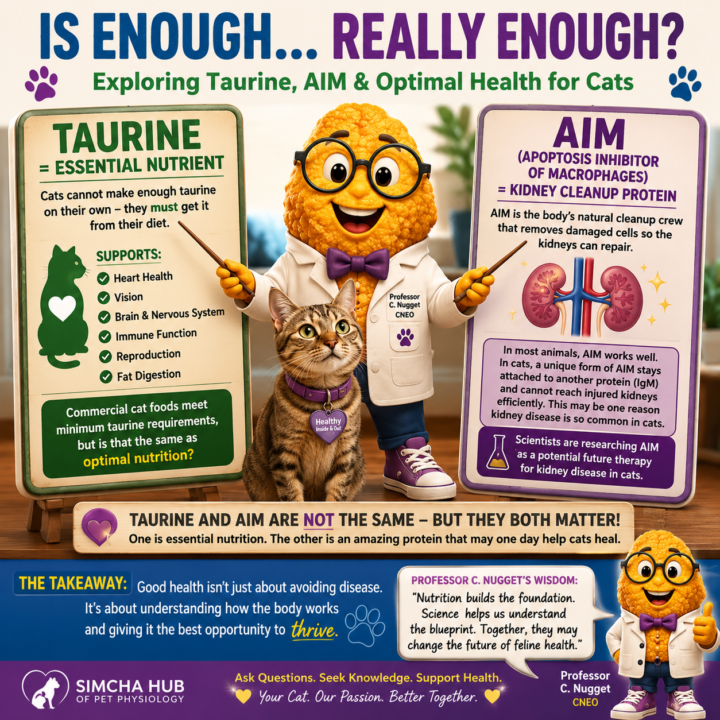
When it comes to your cat's health, "meeting the minimum" may not always be the same as thriving. Taurine is an essential nutrient that cats must get from their diet. Without enough, they can develop serious heart and eye diseases. Commercial cat foods are formulated to meet established taurine minimum requirements, but researchers continue to explore what optimal nutrition looks like beyond simply preventing deficiency. Then there's AIM (Apoptosis Inhibitor of Macrophages) - a naturally occurring protein that acts like the kidneys' cleanup crew. In most animals, AIM helps remove damaged cells after kidney injury. Cats, however, have a unique form of AIM that doesn't separate efficiently from another blood protein, limiting its ability to reach injured kidneys. BECAUSE Cats have a unique biological problem. Their AIM protein stays tightly attached to another blood protein called IgM. Because it can't detach, AIM never reaches the damaged kidney where it's needed. The result is: - Dead cells accumulate. - Tubules become clogged. - Inflammation continues. - Kidney damage progresses. Scientists believe this may help explain why chronic kidney disease is so common in cats and are actively researching AIM as a potential future therapy. Researchers believe this defect may help explain why chronic kidney disease (CKD) is so common in older cats. The takeaway? Taurine and AIM are not the same thing, but they both remind us of an important lesson: Good health isn't just about avoiding disease. It's about understanding how the body functions and giving it the best opportunity to optimally thrive. At Simcha Hub of Pet Physiology, I'm committed to exploring the science behind pet health, from essential nutrition to groundbreaking discoveries that may shape the future of feline medicine. Question of the Day: If science could help cats repair their kidneys instead of only slowing kidney disease, would you want that treatment available?
🔥
1 like • 2d
@LM Sharron my pleasure! And your test kit is on backorder. I meant to tell you that yesterday.
🔥
1 like • 2d
@LM Sharron I got so busy yesterday, it slipped my mind.


🔥
1 like • 2d
@Dusty Commons 🤣🤣🤣
🔥
4d •
Wednesday Wellness Nugget: Epilepsy in Dogs
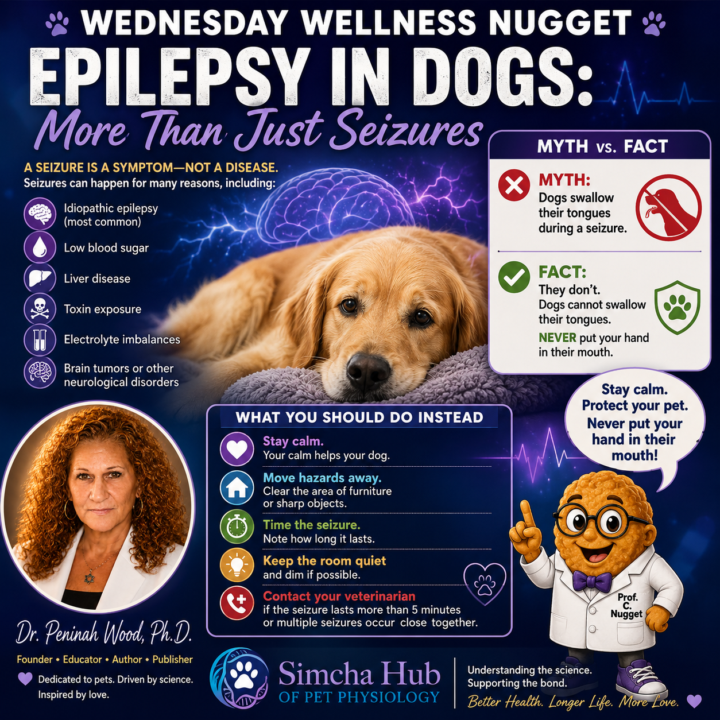
More Than Just Seizures Did you know that a seizure is a symptom, not a disease? While idiopathic epilepsy is the most common cause of recurrent seizures in dogs, seizures can also be triggered by underlying health conditions such as: - Idiopathic epilepsy - Low blood sugar (hypoglycemia) - Liver disease - Toxin exposure - Electrolyte imbalances - Brain tumors or other neurological disorders - Gut-brain axis issues Finding the underlying cause is an important part to develop the best treatment plan for your dog. Could Your Dog's Gut Influence Seizures? Emerging research suggests the gut-brain axis may play a role in neurological health. While diet alone won't cure epilepsy, supporting a healthy microbiome is an important part of a comprehensive treatment plan. Myth vs. Fact MYTH: Dogs swallow their tongues during a seizure. FACT: Dogs cannot swallow their tongues during a seizure. Never put your hand or any object into your dog's mouth. Even the gentlest dog may bite unintentionally while seizing. What You Should Do Instead - Stay calm, your dog needs you to remain composed. - Move furniture or other hazards away to help prevent injury. - Time the seizure, knowing how long it lasts is valuable information for your veterinarian. - Keep the environment quiet and dim if possible. - Contact your veterinarian if the seizure lasts longer than five minutes, if multiple seizures occur without full recovery between them, or if it's your dog's first seizure. Remember, witnessing a seizure can be frightening, but knowing how to respond can make all the difference. Professor C. Nugget Says: "Don't panic, protect your pet. Knowing what not to do can be just as important as knowing what to do." Knowledge is one of the greatest gifts we can give our pets.
🔥
1 like • 2d
@Dusty Commons yes, they are very different.
1-10 of 175
🔥
@peninah-wood-2002
Dr. Peninah Wood, Ph.D, is the founder and CEO of Simcha Healthcare. She has a Doctorate in Functional, Nutritional, and Holistic Medicine.
Online now
Joined Apr 19, 2026
Kentucky
Powered by