
🔥
Apr 20 • Early Clues & Signals
Degenerative Myelopathy: The Nervous System’s Slow Unraveling
The Hidden Lessons Inside It
Canine Degenerative Myelopathy (DM) is a progressive, incurable neurological disease similar to human ALS (Amyotrophic Lateral Sclerosis or Lou Gehrig's disease).
The Disease That Teaches Us How the Nervous System Speaks
(and the one that took Simcha, which is exactly why we’re studying it)
Most explanations of DM stay at the surface: “Progressive.” “Incurable.” “Doggy ALS.”
But if you stop there, you miss the entire point.
DM is not just a disease. DM is the nervous system revealing its architecture, piece by piece, as it fails.
And when you understand what’s actually happening, you stop seeing DM as “mysterious decline” and start seeing it as predictable physiology with predictable signals.
Let’s go deeper.
1. DM Begins Long Before You See Anything
By the time a dog is wobbling, the physiology has been shifting for years.
DM starts with:
- micro‑glial activation
- oxidative stress inside the spinal cord
- immune confusion around the SOD1 protein
- slow, silent stripping of myelin
This is the part no one talks about because you can’t see it. But the body always knows first.
DM is not sudden. It is slow erosion of communication fidelity.
2. The Real Villain: Signal Latency
Everyone focuses on muscle weakness. But the muscles aren’t the problem.
The problem is latency, the delay between brain - spinal cord - limb.
When myelin thins, the signal slows. When the signal slows, proprioception falters.
When proprioception falters, the dog compensates.
When the dog compensates, the gait changes.
When the gait changes, the muscles weaken.
DM is not a muscle disease. It is a timing disease.
Simcha taught me this in real time, the way he would “miss” where his foot should land by a fraction of a second. That fraction is the whole story.
3. Why DM Looks Like ALS (and Why That Matters)
Both DM and ALS share:
- SOD1 gene involvement
- oxidative stress
- immune‑mediated myelin damage
- progressive motor neuron degeneration
But here’s the deeper truth:
Both diseases reveal how fragile the communication network is, and how much the body depends on clean electrical signaling.
DM is the canine version of watching the wiring of a house slowly fray while the lights still try to stay on.
4. The Cruel Paradox: The Mind Stays Sharp
This is the part that breaks people.
The dog still:
- knows you
- wants to play
- wants to work
- wants to move
- wants to be themselves
The personality stays intact. The physiology does not.
This is why DM is emotionally devastating, not because of the decline, but because of the disconnect between spirit and structure.
Simcha lived this paradox with dignity. And I learned to read the difference between “can’t” and “won’t.”
5. The Hidden Early Signals No One Recognizes
Most people miss the earliest signs because they look like:
- clumsiness
- aging
- laziness
- slipping on floors
- “funny” gait changes
But these are neuro‑proprioceptive failures, not quirks.
DM teaches you to read:
- toe drag as a spinal cord signal delay (knuckling)
- knuckling as proprioceptive loss
- hind‑end sway as motor neuron fatigue
- difficulty rising as communication breakdown
This is where this community becomes literate, not in disease, but in the language of the nervous system.
6. The Deeper Lesson: DM Is a Teacher of Systems, Not Symptoms
DM forces us to understand:
- how nerves talk
- how the immune system can misinterpret its own proteins
- how oxidative stress erodes communication
- how muscles depend entirely on signal quality
- how movement is a symphony, not a single instrument
DM is not chaos. It is pattern.
And once you see the pattern, you can never unsee it.
7. Why This Belongs in the Simcha Hub of Physiology.
Because this is not a vet‑clinic conversation. This is a physiology literacy conversation.
DM is the perfect example of:
- early‑signal detection
- nervous‑system stewardship
- immune‑neuro cross‑talk
- movement as communication
- dignity in decline
- the difference between treating disease and understanding physiology
Simcha didn’t just die from DM. He taught DM.
And now I'm teaching the world what he showed me, not as a community creator but as someone who reads physiology like a language.
Is There a Test for Degenerative Myelopathy?
Yes… and also no. And the “no” is the part that matters.
DM is one of those conditions where people think there’s a test — because there’s a gene test — but the gene test does not diagnose the disease.
Let’s break it down cleanly.
1. The SOD1 Gene Test (the one everyone talks about)
This is a genetic risk test, not a diagnostic test.
It tells you:
- A/A = at‑risk genotype
- A/G = carrier
- G/G = low risk
But here’s the nuance:
- Many A/A dogs never develop DM
- Some G/G dogs do develop DM
- The gene explains risk, not disease
- It cannot confirm DM
- It cannot rule out DM
Risk doesn't = diagnosis.
2. Neurological Exam (the real starting point)
A neurologist looks for:
- proprioceptive loss
- delayed paw placement
- hind‑end ataxia
- upper motor neuron signs
- progression over time
But again, this is pattern recognition, not a test.
DM is diagnosed by physiology, not by a single lab value.
3. MRI (the rule‑out test)
MRI does not show DM.
What it does show is everything DM can be confused with:
- disc disease
- spinal tumors
- stenosis
- cysts
- trauma
- infections
If the MRI is clean and the dog has the DM pattern, DM becomes more likely.
MRI is a process of elimination, not confirmation.
4. CSF (spinal tap)
Sometimes used to rule out:
- meningitis
- infection
- inflammation
- cancer
It does not confirm DM.
5. The Only Definitive Test (and why no one talks about it)
The only way to confirm DM is:
post‑mortem histopathology of the spinal cord.
Meaning: You can only diagnose it with 100% certainty after the dog has died.
This is why DM is considered a clinical diagnosis, based on pattern, progression, and exclusion of other causes.
So what do we actually rely on?
A combination of:
- clinical signs
- progression over months
- clean MRI
- SOD1 genotype
- neurologist evaluation
- ruling out everything else
DM is a pattern, not a positive test result.
And this is exactly why your physiology‑first teaching is so needed: DM forces people to understand communication failure, not “a number on a lab report.”
Degenerative Myelopathy: The Nervous System’s Slow Unraveling (and Why Big Dogs Pay the Highest Price)
Most people think DM is random. It’s not. DM has a type, and that type is the big dog.
German Shepherds.
Bernese Mountain Dogs.
Boxers.
Chesapeake Bay Retrievers.
Great Pyrenees.
Corgis (the outlier that proves the rule).
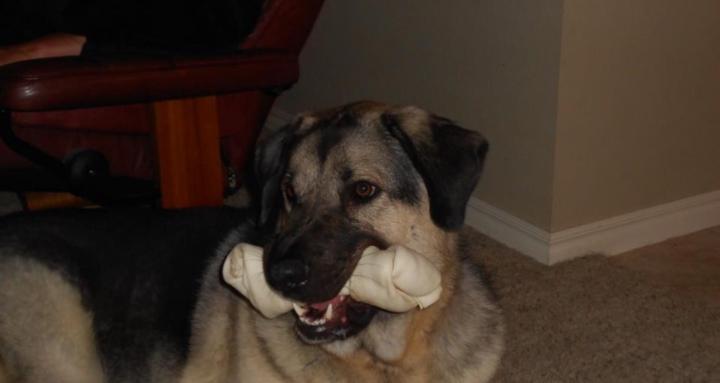
And yes, the gentle giants like Simcha, who was part German Shepherd and part Newfoundland.
This isn’t coincidence. It’s physics + physiology.
Why DM Is Primarily a Big‑Dog Disease
DM shows up in large and giant breeds because:
1. Big dogs have longer spinal cords
More length = more myelin to maintain. More myelin = more surface area for oxidative stress and immune misfires.
2. Their nervous system has a higher “signal load”
Moving a 100–150 lb body requires:
- stronger signals
- faster conduction
- more precise proprioception
When conduction slows even slightly, big dogs show it first.
3. Their hind‑end carries enormous mechanical demand
Every step is physics. Every rise is leverage. Every turn is torque.
When the spinal cord begins to fail, big dogs can’t “hide it” the way small dogs can.
4. The SOD1 mutation is more common in large working breeds
German Shepherds, Berners, Retrievers, the breeds built for work, carry the mutation at higher rates.
DM is a disease of genetics + size + load.
Simcha wasn’t unlucky. He was a big dog living inside big‑dog physiology.
Why This Matters for Your Community
Because when people understand that DM disproportionately affects big dogs, they stop blaming:
- age
- laziness
- slipping
- “he’s just getting older”
- “she’s clumsy”
And they start recognizing neurological whispers.
This is where this community becomes priceless.
Because early‑signal literacy in big dogs saves money, saves panic, and saves months of confusion and heartache.
Big dogs decline faster when signals fail, but big‑dog owners can also spot the earliest signs sooner when they know what they’re looking at.
DM is not just a neurological disease. It’s a big‑dog physiology story.
It teaches us:
- how size changes vulnerability
- how load changes signal demand
- how long spinal cords age differently
- how big dogs reveal neurological decline earlier
- how genetics interacts with biomechanics
And it teaches us something else:
Simcha wasn’t just a big dog. He was a big teacher.
His physiology is now this curriculum so that other dogs do not suffer.
Thank you, Simcha!
1
5 comments
Degenerative Myelopathy: The Nervous System’s Slow Unraveling
skool.com/simcha-hub-of-pet-physiology-5304
Understand your pet through physiology. Learn the gut - immune - neuro patterns that shape behavior, mood, and resilience long before symptoms appear.
Leaderboard (30-day)
1

🔥
+62
2

🔥
+27
3

+16
4

🔥
+13
5

🔥
+4
Powered by