

Jan 6 •
🧠 How to Subdivide Land (Simple Checklist)
☐ Confirm zoning + minimum lot size ☐ Verify legal access for every parcel ☐ Check utilities (or confirm off-grid viability) ☐ Price out survey + plat map ☐ Identify minor vs major subdivision ☐ Validate end-buyer demand + pricing ☐ Choose your exit before you buy ☐ Underwrite for a 6–9 month timeline Rule of thumb: ☐ Post-split value ≥ 1.8× total costs → move forward Subdividing isn’t risky. Guessing is. Comment “Done” if you’ve already completed a subdivide deal, or “Learning” if this would be your first one.🚀👇🏻
Mar 3 •
Levi went from 26 low-ticket deals to $90K in pipeline profit in 2 weeks
I want to tell eveyone about @Levi Luhnow. He's 22 years old. Co-owns a land business. Before he started working with us he'd closed 26 deals. Sounds good on paper. But every single one was low ticket. High volume, and thin margins. He knew it wasn't scalable. He just didn't know what to change. We got on one call. One hour. I looked at his business. Found the bottleneck. Gave him a framework specific to exactly where he was. He got his texting stack dialed in. Started running it. Two weeks later: 5 deals under contract. ~$90,000 in pipeline profit. That's what most people get wrong. They think they need more information. More YouTube videos. More podcasts. More free content. What they actually need is someone to look at their specific situation and say: here's what to fix. Here's the system. Now go. Last week on the Monthly Brief we broke down what's working in land right now. The deals, the data, the market signals. Now it's time to execute. On March 9th I'm running the Landman Challenge + Fast Track. Almost 10 hours of live training with me. Not a course you watch and forget. We build your land business together in real time. Marketing. Acquisitions. Underwriting. Dispo. Systems. Funding paths. The goal is simple: lay the foundation for a six-figure land flipping business in weeks, not months. The Challenge is included free when you join the Fast Track. The whole bundle is one price. This is the first time we've done this. 20 Fast Track seats. When they're gone, they're gone. Starts March 9th. Levi's first step was this same 4-week Challenge. Weeks later he joined the Deal Engine and put $90K in pipeline profit. Almost every operator I work with now started with this same foundation. Claim your spot here: https://landman.io/challenge-fast-track-register-now?utm_source=skool&utm_medium=community_post&utm_campaign=mar9_challenge&utm_content=challenge_fast_track
4d •
Joe Is Great! Joe Is Also Why You're Stuck.
Growth follows one rule: Spend time with people better than you and you get better, spend time with people worse than you and you get worse. There's no third option. Gravity doesn't care how you feel about it. Most guys reading this have closed 5, 10, maybe 30 deals. You're not stuck because you can't find a deal or run comps. You're stuck because everyone you talk to about land is at your level or below. Your altitude is capped by the room you're standing in. The buddy, some guy called Joe, who keeps texting you about his $6K assignment fee has to go. Not because you don't like him, but when he's the loudest voice in your week, the guy doing $1M a year never gets a turn to speak into it. Loyalty to people dragging you down isn't a virtue, it's a cost. We're launching our pod structure inside Deal Engine, and it changes this fast. Here's how it works. When you join, you don't get dropped into a course library to figure it out alone. We onboard you and match you into a pod, a small, facilitated group of operators at your level. Not a Facebook group or faceless forum, but a standing room that meets on a rhythm, where the same faces show up week after week and actually know what you're working on. What you can't find alone is a room where you're heard, understood, and held accountable by people who've lived through the exact problem you're stuck on. Somebody in your pod already solved your exact title cloud, your exact builder negotiation, your exact stalled listing. We've opened up limited spots in Deal Engine for the Pod Launch, two are already taken. If you're honest enough to admit the room you're standing in is the ceiling on what you do next, then it's time to change the room Book a Call with me here: Call Booking Link We'll see if the Pod Structure is the right move for where you're at.
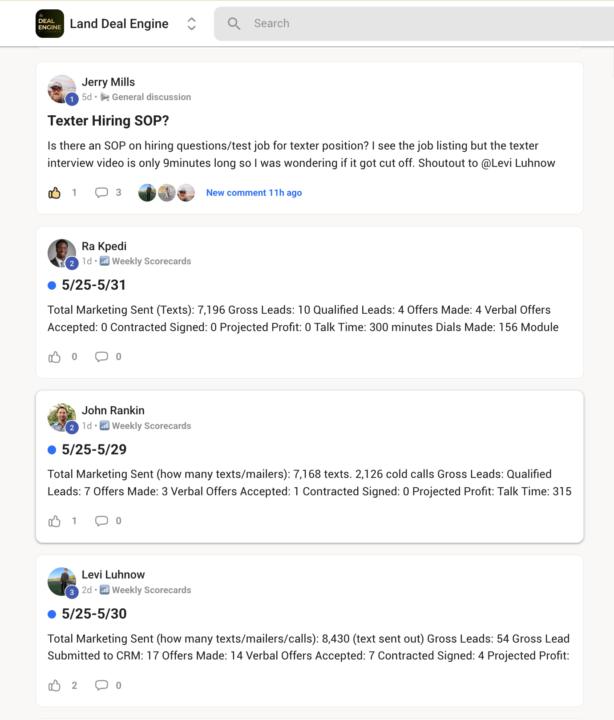

4d •
Volume Negates Luck
Hey guys, I wanted to share something that was sort of mind blowing, but at the same time, can really be that simple. What I mean is: more input = more output. The last few months, I've been capped out around 5 contracts per month. Which I can't say I'm mad about, but wanted to push it and see if I can start increasing that number. Since I've been tracking my KPIs, I know that I've been hovering around 35-40 offers per month to leads I speak with. That is yielding on average 4-5 contracts a month. So to push it, I decided, what if I just increase the amount of calls I make to leads, and make more offers (Keeping the marketing spend the same). Long behold, in the month of June I made 74 offers which yielded 9 contracts. More Input = More Output. Sometimes it really is that simple. Just thought I'd share this because it's one of those things we all know, but it doesn't really click until you experience it for yourself. At least, that's how it was for me.
3d •
When should you Double Close?
You just got off the phone with a seller, the deal's great. Now you're weighing four ways to structure the exit. Pick wrong and you either leave money on the table or create a compliance headache you didn't need. Double closing isn't your default move. It's a tool for a specific situation. Protect your spread. In a straight assignment, the seller can see your fee on the closing statement. This was something I learned early on. A seller saw the assignment fee, hesitated and by the time it fell apart they were outside the closing period. That deal cost $65,000 in profit. A double close keeps the resale price private, because you're not assigning a contract, you're buying the property and selling it again. Get around assignment restrictions. Some states are cracking down on wholesaling contracts and treating assignment fees as a licensing issue. Taking title, even for a few hours, keeps you compliant. Only when your buyer is real. Double closing needs transactional funding, short-term capital that covers your point A to B purchase and gets repaid hours later from the point B to C sale. That funding runs 2-4% of the deal. If your buyer isn't close to locked in, you're paying for capital you don't need yet. List it first. Double close once the buyer is confirmed. Skip it if your spread is under $20K, your buyer's lender gets nervous about simultaneous closings, or your title company has never handled one. Any of those, go with a straight assignment or a day-apart close instead. Double closing solves a privacy problem and a compliance problem. It doesn't solve "I can't find a buyer" or "my margin is too thin." Know which problem you actually have before you pick the tool. We're spending July inside Deal Engine on the full exit matrix, when to cash flip, owner finance, subdivide, or double close, so every parcel has a decided exit before you close. If you've been closing first and figuring out the exit after, it's time to fix that. See the Deal Engine Program Here

1-30 of 323

skool.com/landman-community
Welcome to the Landman Community. 🚀
Free community to learn about land the right way, through real deals, real numbers, and real execution.
Leaderboard (30-day)
1
+10
2

+10
3

+8
4

+7
5

+7
Powered by