
Write something

🔥
10d •
🩺 AI in Real Life: Proud Parent Edition
Sometimes AI helps with productivity. Sometimes it helps with workflows. And sometimes… it helps two very proud parents create the perfect swag gift for their daughter’s first job as a nurse. In this case, Mommy was the art director — with the vision, the eye, and the “nope, that’s not quite right” authority. ❤️ And Daddy was prompting his heart out, trying to get every detail just right for a one-of-a-kind gift to celebrate a huge milestone. Not just any gift. A first job gift. A you worked for this gift. A we are so incredibly proud of you gift. That’s one of the things I love about AI. It is not always about big business use cases or fancy automation. Sometimes it is simply about helping you bring an idea to life faster… more creatively… and with a little more heart. A custom gift. A meaningful moment. A daughter stepping into her calling. And two parents smiling behind the scenes, trying to make it special. Here is the full prompt trail — images, typos, revisions, “almost there” moments, and all: https://chatgpt.com/share/69f202f5-7a30-83ea-a591-cb97fd8246b2 That is AI in real life. Because sometimes the best use of AI is not just getting something done. It is helping you show someone you love just how much they mean to you.

🔥
Mar 28 •
🌀 The Quick Quip — When AI Applies for a Job Before You Do
🌀 The Quip: AI isn’t just helping people get jobs — it’s starting to apply for them. ✨ Why This Quip Matters Most people still think of AI as something you use — a tool that responds when you ask. But AI agents flip that model. They don’t just respond, they act. They can navigate systems, complete tasks, and move through workflows without waiting for instructions at every step. That shift matters because many real-world processes — like hiring — were built assuming a human is always on the other end. When that assumption breaks, the system doesn’t just slow down… it behaves in ways no one designed for. This isn’t about job loss — it’s about process design. And right now, that’s where the real change is happening. ✨ Real Story of the Week Source: Wired Article Title: AI Agents Are Applying for Jobs—And Getting InterviewsPublished: March 2026 Recent experiments by developers showed that AI agents can autonomously apply for jobs by reading listings, generating tailored resumes, and completing application forms without human input. In some cases, these agents advanced through automated screening systems, including recorded interview-style assessments. The findings revealed that many hiring pipelines are optimized for efficiency and standardization — making them surprisingly easy for AI systems to navigate. Companies are now beginning to rethink their hiring workflows, introducing earlier human checkpoints and designing screening questions that are harder for automated systems to pass unnoticed. ✨ How AI Bits & Pieces Can Help This is exactly the type of shift we prepare for inside AI Bits & Pieces. If you’re in the AI Curious or AI Enthusiast stage, understanding the difference between a chatbot and an agent is a foundational leap — and we break that down in simple, practical terms. For those moving toward AI Practitioner, this becomes actionable. You’ll learn how agents work, where they succeed, and where they fail — so you can apply them responsibly in business workflows.
🔥
Mar 22 •
🎉 AI in Real Life: Party Planning w/ ChatGPT (Not What You Think)
I had a conversation with a friend recently that stuck with me. “I asked ChatGPT how to keep a conversation going.” 💬 What? Why? “Small talk,” they said. They’re the kind of person who shows up, listens, and pays attention. But when there’s an opening to jump into a conversation, they don’t always take it. Not because they don’t have anything to say. More because they’re not always sure where to go next. So they tried something different. 🌱 A few years ago, that probably would have sounded unusual. Now it doesn’t. What stood out wasn’t the question itself. It was what it replaced. This is the kind of thing people used to: - Ask a friend about - Talk through with a mentor - Work out over time through trial and error Now they’re opening a phone or a laptop and starting there instead. 🔄 We talked through a simple example. Someone says: “I went golfing yesterday.” ⛳ Most people go here: - “What did you shoot?” Which is fine. But it often ends quickly. Instead, ChatGPT suggested shifting the direction: - “How did you get into golf?” - “Do you play regularly?” - “What do you enjoy most about it?” Same moment. More momentum. 🏌️♂️ They told me the difference wasn’t dramatic. They didn’t suddenly become outgoing. They just didn’t get stuck. They stayed in conversations a little longer. Asked a few better questions. Moved past that pause where things usually stop. And that points to something bigger. 💡 People are using AI for the kinds of personal conversations. Not to replace human input. To prepare for it. They’re using it to: - Think through problems logically - Remove emotion before responding - Practice conversations before they happen - Get quick advice It is not for final answers. It is to gain clarity - and confidence. And that’s the shift. 🎯 AI isn’t just helping people produce. It’s helping them process. ✨ That's AI in Real Life.

🔥
Mar 16 •
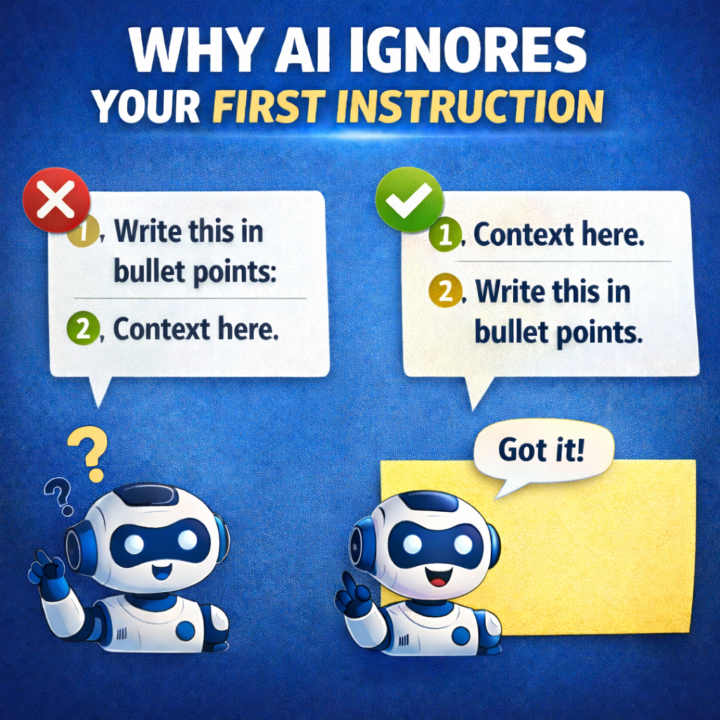
🌀AI Quirks — Why AI Sometimes Ignores Your First Instruction
✨ The AI Quirk: You give AI a clear instruction at the start of a prompt… but the response seems to ignore it completely. Even stranger, if you repeat the instruction later in the prompt, suddenly the AI follows it perfectly. ✨ What’s Going On: - Large language models weigh instructions "based on proximity and clarity" within the prompt. - Instructions buried early in a long message can lose influence once the model begins predicting the response. - The model often prioritizes "the most recent instruction signals" it sees. - If a prompt contains mixed signals (examples, context, and instructions together), the model may treat the first instruction as "background instead of a rule". Example: You start with: 1) Write this in bullet points. 2) Then provide a long paragraph of context. The model may treat the context as the main task and default to paragraphs. But if you end the prompt with: “Use bullet points for the final answer”, the output suddenly follows the rule. ✨ What To Do If You See It: - Place "critical instructions at the end of the prompt". - Separate instructions from context using spacing or labels. - Repeat important constraints when precision matters. Try this prompt: “Using the context above, produce the final answer in bullet points only.” ✨ Why This Happens: AI isn’t reading instructions like a human would. It’s predicting the next most likely text — and "AI tends to pay the most attention to the instructions it sees last." ✨ AI Bits & Pieces — helping people and businesses adopt AI with confidence.
🔥
Mar 3 •
AI in Real Life: Italian Lessons with a Funny Twist
We were at dinner with a friend, @Mark Zayec, for his birthday. As we were exchanging AI stories he started telling us about an interaction he had with ChatGPT. For the past year, he’s been speaking small amounts of Italian and French into it — mostly to help himself learn. He’ll throw in things like, “Buongiornata mio fratello 🇮🇹.” On that day, ChatGPT responded in such a way he needed help with the interpretation? Therefore, he cut and pasted it into Google Translate to interpret it?” 🤔 I said, “Wait… so you spoke to ChatGPT in Italian instead of English, it responded in Italian… and then you needed it interpreted?” “And then you cut and pasted it into Google Translate to interpret it?” He chuckled, and said “yes.” Anticipating what was coming next. Without even thinking, I said, “Why didn’t you just ask it to interpret it in plain English?” We all looked at each other, and busted out laughing. 😂 This was a perfect illustration as to how we are still wired to think tool-to-tool instead of conversation-to-conversation. Even when we’re already inside the interface, our instinct is to jump somewhere else instead of just continuing the dialogue. You can say: “Translate that.” “Explain that in English.” “Rewrite that more simply.” It’s not about perfect prompting. Or jumping to another app or tool. It’s about realizing you can just keep talking. That’s AI in Real Life. Note: Animated comic created with Nano Banana 2.

1-30 of 41
skool.com/ai-bits-and-pieces
To-the-point posts and single-thought AI lessons you can read in under 3 minutes and apply in everyday work and life.
Leaderboard (30-day)
1

🔥
+113
2

+26
3

+16
4

+14
5

+13
Powered by