Activity
Mon
Wed
Fri
Sun
Mar
Apr
May
Jun
Jul
Aug
Sep
Oct
Nov
Dec
Jan
Feb
What is this?
Less
More
Memberships
The Grow Skool
683 members • Free
Earth 2.0 Community
1k members • Free
6 contributions to The Grow Skool

22d •
Imagine a world
Imagine a world where the grocery store serves as the frontline of healthcare. Where every meal nourishes rather than harms. Where our food system is designed to keep people healthy, not sick. That future is achievable with Grow. But it can only happen if farmers, processors, food companies, healthcare leaders, and investors collaborate. Let's Grow!

0 likes • 14d
Amen! 🙌🏼
17d •
The Real Divide: Extraction vs Regeneration
The real divide today isn’t left vs right. Not plant-based vs meat. Not growth vs no growth. It’s extractive systems vs regenerative systems. Extractive systems are built around one question: How much can we take? They optimise for speed, scale, and short-term output. They strip out redundancy. They externalise costs. They consume soil, people, culture, and meaning until something breaks. Regenerative systems ask a different question: What allows life to continue? They work with cycles instead of against them. They value relationships over raw efficiency. They invest in foundations, not just results. They accept friction, limits, and time as part of the process. Extraction looks productive until it collapses. Regeneration looks slow until it lasts. And that’s exactly why Grow can look slow to some people at first glance. Because we’re not building a quick win. We’re building a regenerative and resilient ecosystem designed to endure. Fast systems optimise for momentum. Regenerative systems optimise for resilience. So we move with intention, and we take the time to put foundations in place: standards, verification, governance, real utility, real partners. Because speed without structure is how ecosystems break. You can see this pattern everywhere: • In agriculture • In organisations • In economies • In communities • In our own lives When systems are disconnected from life, they rely on control. When systems are rooted in life, they rely on relationship. The shift we need isn’t about choosing the “right” product or adopting the “perfect” lifestyle. It’s about redesigning the systems beneath our choices. Because you can’t fix an extractive system with better intentions. And you can’t regenerate land, people, or culture inside structures designed to take rather than to care. This is what Grow is here to do. We’re bridging tradition with technology: the lived wisdom of producers and land stewards who know what works in the real world, paired with modern tools that protect sovereignty, prove outcomes, and unlock new value without handing control to middlemen. Regeneration isn’t an alternative. It’s the opposite logic. Slow to start. Built to last. That’s not a delay. That’s the design. And the future will be shaped by which one we choose to build.
1 like • 17d
1. In my work and life, I show up by designing systems that honor the body, the land, and human potential instead of extracting from them. Through CODE Health, we’re reimagining healthcare from the ground up. Instead of symptom suppression and dependency, we focus on restoring communication, coherence, and balance in the body using non-toxic, bioenergetic information. The goal isn’t quick fixes. It’s long-term resilience. One impact I’m most proud of is seeing families replace their medicine cabinets, full of chemicals and side-effect tradeoffs, with tools that support the body’s innate intelligence. Watching children, parents, and even pets thrive using gentle, regenerative solutions reminds me daily that healing doesn’t have to come at a cost to the body. 2.One of the clearest examples of extractive systems breaking down is modern healthcare. We’ve built a model that optimizes for speed, scale, and pharmaceutical dependency rather than prevention, resilience, and true healing. Patients become recurring revenue streams. Symptoms become billable events. And health becomes something managed, not restored. The result is a system overflowing with chronic illness, burnout, and rising costs, for both patients and practitioners. A regenerative healthcare system would flip the logic. Instead of asking “How do we suppress symptoms?” it would ask: “How do we restore communication, coherence, and vitality in the body?” In practice, that means: - Prioritizing prevention over intervention - Supporting cellular communication, nervous system regulation, and metabolic health - Using technology to enhance the body’s natural intelligence, not override it - Empowering individuals with simple, safe tools they can use daily - Measuring success by long-term wellbeing, not short-term symptom control

1 like • 27d
#HungryandHumble…. I love that! Thank you for this message Neil 🫶🏼

Nov '25 •
Where are you from?
I’ll start😊 I’m from Portland,Victoria , Australia I’m really excited to be here in this group and I hope to make a difference in my community locally to get their hands on the grow produce 🙌
3 likes • Dec '25
Hello everyone! I’m from the Tampa Bay Area in Florida (a suburb called Land O Lakes) 🇺🇸
Dec '25 •
Thrive with Grow
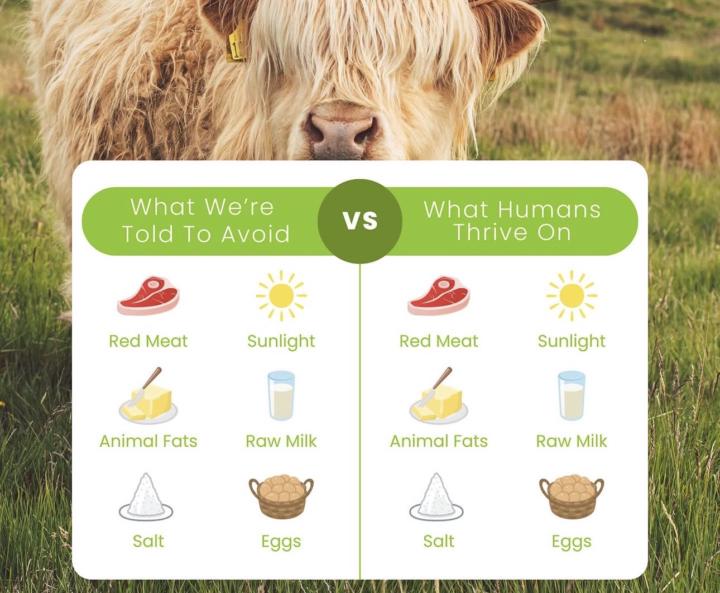
Ever notice how the conversation about food sounds like two different films… depending on which side of the checkout you live on? Consumer: “I keep hearing red meat is basically a crime.” Producer: “Mate… it’s literally food. From an animal. On grass. Under the sun.” Consumer: “Animal fats? Aren’t those… evil?” Producer: “They’re just fats. Your great-grandparents didn’t have a ‘seed oil aisle’ and somehow they survived.” Consumer: “Sunlight? I’ve been told to avoid it like it’s an ex.” Producer: “We’ve reached the point where humans are indoors all day, then surprised we feel rubbish. Bold strategy.” Consumer: “Salt? Eggs? That’s controversial, right?” Producer: “Only in a world where a neon ‘protein bar’ is ‘wellness’, but a real egg needs a PR team.” And then there’s raw milk, which is exactly where the real gap shows up: Consumers want “natural”. Producers know “natural” still needs standards, safety, and common sense (and yes, laws vary by region). Here’s the missing piece: transparency. Because right now, the consumer is basically expected to trust: - a label - a marketing slogan - and a brand promise While the producer is thinking: - “If you saw how we actually raise this, you’d relax.” That’s where blockchain transparency gets interesting, not as “crypto hype”, but as a practical tool: an immutable record of what happened, where, and when across the supply chain. So instead of arguing about food on the internet, we can verify claims in the real world: origin, handling, audits, welfare, inputs, and standards. So no, this isn’t “producers vs consumers”. It’s confusion vs clarity, and we can close that gap with better conversation and better infrastructure. Let’s translate. 🤝🌱🔗 #Blockchain #Traceability #FoodTransparency #RegenerativeAgriculture #FoodSystems #SupplyChain #ConsumerTrust
1 like • Dec '25
Love this! Well said!
1-6 of 6

@wendy-cohn-osborne-2468
Co-Founder/Owner of CO of CODE Health. Co-host C3 Podcast: CODE Conscious Conversations| www.codehealthshop.com | @codehealthshop |
Active 14d ago
Joined Aug 29, 2025
Powered by