Activity
Mon
Wed
Fri
Sun
Apr
May
Jun
Jul
Aug
Sep
Oct
Nov
Dec
Jan
Feb
Mar
What is this?
Less
More
Memberships
Your Truth Amplified
43 members • Free
Pocket Singers Free
17.1k members • Free
Key Learners Piano Club
1.5k members • Free
Piano by Abel
155 members • Free
Song Writing Hub
57 members • Free
Songwriting Secrets
136 members • Free
Focus Revolution (FREE)
837 members • Free
ADHD Harmony™
3.8k members • Free
Drum and Chi
3 members • Free
25 contributions to ADHD Harmony™

4d •
Staying connected - Suggestion
I know we have all been commenting on each other's posts, giving insight s. Sharing humor etc. I am unable to join the 6 week program and mentally fell into a bit of a rut and I started telling myself some negative stories. I was feeling a but sorry for myself and was just going to drop off the radar as everyone was going ahead and leaving me. I reflected on how I felt during the challenge and connecting with this community. and it felt so good to have a space where I felt seen & understood and that I was not alone. I know a connected with a few other people that I communicated with via posts etc Suggestion: Maybe we can start a message thread to stay connected in the community, check in etc. Hoping to make some lasting connections.

5 likes • 4d
Hi - I did the 5 day challenge at the last minute. I haven’t signed up for the 6 week thing but I do want to make full use of the blueprint. Finding it a bit overwhelming! Would be happy to be part of something.
1 like • 9h
@Renee Van keulen I’ve just messaged hi. Thanks!

⭐
16h •
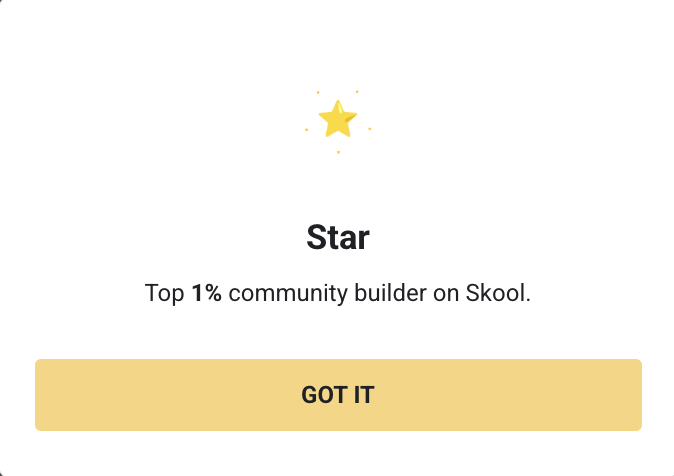
⭐ Woke up to this little star this morning
Recently, I’ve shared LOTS of free value, and in return, I asked you to actively engage, support one another, and take your check-ins seriously. And many of you have actually done just that. And... as a result, we’ve moved up from 34th to 29th place in the “self-improvement” category on Skool. The top 30. That means I’m now among the top 1% of community builders on the platform, what a huge dopamine hit this morning when I woke up to see the star emoji. But let's be real... that badge is just as much yours as it is mine. Every like, comment, check-in pushes us up. Which means more people with ADHD can now find this place and get the help they need. You're all incredible. Thank you. 🙏
4 likes • 9h
That’s exciting!
4d •
Who else is feeling overwhelmed? (Not part of the paid programme)
Hi - I am constantly fatigued, currently exhausted, and have other things occupying my time. I think it could take me a while just to read the “before you start” section let alone actually start week 1. Has anyone made any plans/a schedule? (Not my strong point!!) I keep telling myself that getting started is the main thing, not waiting until everything feels doable. Perseverance not perfection. I wish there was a post category for people not in the programme.
2 likes • 3d
@Corinne Clements Already commented on their post earlier. Thanks

0 likes • 4d
Because Jim has unlocked it for those that completed the 5 day challenge AI report. If you did, then you should have an email with an invitation to Join this group. Click the button to join even though you already are a member and it will unlock the blueprint. If you didn’t complete it, then you can try again next month. New 5 day challenge starts 27th April. If you used a different email address to complete the AI report then you can contact Jim to sort it out.

4d •
Just want to share Insight from AI Harmony. I've just started using it.
The Neuroscience of Habit Formation 1. Understand the Mechanism, Not Just the Checklist As Dr. Andrew Huberman puts it, when you understand why something works, you gain flexibility to customize it for yourself [Source 1]. There are endless "top 10 habit" lists online, but understanding the brain science behind them is what makes them stick. It gives you the ability to adapt when life throws curveballs, rather than rigidly following a script. 2. Dopamine Is the Currency Your brain runs on dopamine, and it doesn't distinguish between "good" and "bad" sources. When you grab a burger, scroll TikTok, or hit snooze, you get a quick dopamine hit that lasts about five minutes, followed by a crash and shame. That's a dopamine deficit [Source 7]. The reframe: train yourself to recognize that the "bad" option gives ~5 minutes of pleasure, while the "good" option builds something lasting. Over time, healthy habits generate their own dopamine through a sense of accomplishment and momentum. 3. Your Breaks Matter as Much as Your Work This is a huge one. Huberman highlights that if you struggle to focus or start a task, there's a very good chance your breaks were too stimulating [Source 5]. He advocates for "boring breaks" and silence before and after bouts of focused work. If you're doom-scrolling between tasks, you're essentially flooding your dopamine system and making the next task feel impossible by comparison. 4. The 1% Rule and Habit Stacking Improving just 1% daily makes you 37 times better in one year. The ADHD Harmony framework recommends habit stacking: chain habits together so they flow automatically [Source 3]. Example: Wake → one liter of water → five minutes of movement → deep work. Attach new habits to existing anchors. Write the stack on your mirror. Externalize everything. 5. Systems Over Willpower This is the core truth for ADHD brains: willpower is not the answer [Source 4]. It might work for a week or two because you can force it, but long-term success comes from:
1 like • 4d
Interesting. The thing about boring breaks is a good idea!! The sources are mentioned but not listed.
1-10 of 25

@nik-williams-3695
South coast England. Mother. Art and singing are my hobbies, as well as dipping into various crafts and deep dives into my latest interest.
Active 3h ago
Joined Feb 9, 2026
England
Powered by