Activity
Mon
Wed
Fri
Sun
May
Jun
Jul
Aug
Sep
Oct
Nov
Dec
Jan
Feb
Mar
Apr
What is this?
Less
More
Memberships
ConstruPRO
365 members • Free
AI Creative Builders Hub
112 members • Free
SQL Answers - Data & AI
271 members • Free
n8n KI Agenten
9.9k members • Free
Python Developers
1.1k members • Free
Data Innovators Exchange
710 members • Free
Career Change Collective
157 members • Free
Data Analysis with R
458 members • Free
Mechanical Engineering Mastery
307 members • Free
26 contributions to The Energy Data Scientist

23d •
New Online Course: Kernel Density Estimation
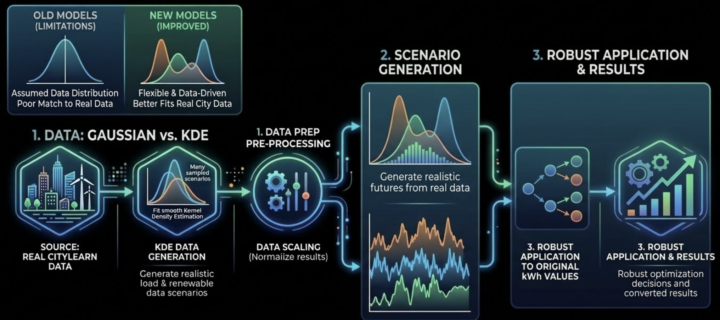
A new online course has been published in Classroom. It is course 118. Its title is "Kernel Density Estimation". Kernel Density Estimation (KDE) is a highly effective statistical method used in the energy sector. It allows you to take an existing dataset and generate new, realistic values that follow the exact same underlying patterns. This is perfect for when you need to simulate multiple scenarios. Specifically, in this course: - we look at a smart building with uncertain electricity demand, using 8760 hourly values (one year of data). - we want to simulate 1000 unique days where the demand is different but strictly follows the "logic" of our original dataset. - we walk through generating KDE-based data and using it to solve Monte Carlo and two-stage stochastic optimization models. These methods are absolute standards in the energy sector. Best of all, this is a highly applied course. I show you exactly how I used these exact techniques in a real-world energy project, so you can move past academic textbook exercises and start applying this to actual problems. The attached screenshots show the step-by-step process of how KDE is applied in industry. And also the differences between using KDE and non-KDE approaches ; KDE is more realistic. Non-KDE approaches are easier to model but lack realism.
1 like • 23d
Yes very often used in power systems, gas, oil , commodities etc. In commodities trading, instead of assuming that prices for assets like oil or wheat follow a predictable bell curve, we use KDE to capture their true history of sudden market spikes and crashes. KDe is great for traders in energy. It just allows traders to simulate thousands of highly realistic future price scenarios so this way they stress-test their trading strategies against actual, real-world risks.

26d •
Interview question
I share a recent interview question asked by Baringa (this is a consulting company focused strongly on energy, utilities, and the energy transition). From a student forum / database (for internship). The question was: 'Why do some renewable power plants continue generating electricity even when electricity prices turn negative? and when do prices become negative ? do you know any example? '
1 like • 25d
@Lara Cagigal Tomico True, yes . In the wholesale market, a negative price means the generator is effectively paying to stay online, rather than being paid for each MWh sold. But that is not always the full commercial picture. A plant may still earn money overall because of subsidies, certificates, capacity payments, or a PPA that protects its revenue. So in some cases, continuing to generate still makes economic sense. In markets such as Germany, the UK, and parts of Spain, renewables may keep generating even during negative prices. This can happen because of subsidies, GOOs, or PPAs that protect revenues. So, in those cases, negative prices do not always mean it is better to switch off.
Feb 24 •
New Online Course: Stochastic Optimization
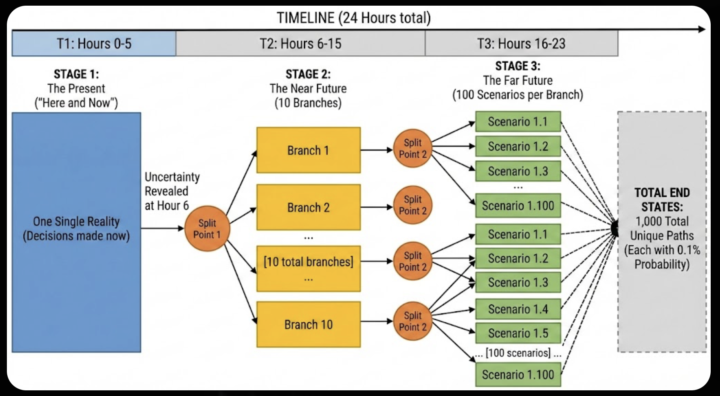
Inside the 'Classroom' , there is a new course (116) , which shows how to develop, in Python, a 2-stage and a 3-stage stochastic optimization model. The code is available for download, and it is explained through a video of about 1 hour in total. The prerequisites are courses 115 (deterministic optimization) and 116 (Monte Carlo). Stochastic Optimization is used a lot in energy, economics and finance. Anytime we have something uncertain, we use scenarios to describe how the future may play out. For example, the electricity demand tomorrow can be 100 kW, 50kW, 20kW. So we have 3 scenarios. We can have as many scenarios as we think is reasonable. For example in the code we build a 'scenario tree' consisting of 1000 scenarios. And we then assign a probability to each of these scenarios. Then, we have an objective function, which includes probabilities. We have constraints. And this is like any other optimization model. We call it 'stochastic' because it has probabilities in the objective function and because it has scenarios. It is like any other optimization model. So , the jargon may sound a bit intimidating , but it is very simple actually. We apply stochastic optimization to a smart building, which has a solar Photovoltaics unit and also it has residents who consume electricity (electricity demand). And we want to minimize the daily cost of operating this smart building in the future. Since we want to 'minimize' something' we speak about 'optimization'. And also we have uncertainties: the electricity demand is uncertain. Also, the output of the solar PV unit is uncertain. See the two screenshots attached for some extra context.
1 like • Feb 24
Definitely very very useful course. Thanks a lot.

Feb 24 •
Power Market Modelling Consultant
Hi, im new here, and recently taking the course to understand energy analytics. Ive been having a look around on linkedin at some jobs as a junior can get into. theres a role for "Power Market Modelling Consultant" - Here is a snippet of their requirements.. What You’ll Be Doing - Building and running market models to explore price evolution, dispatch patterns, capacity dynamics, and policy impacts. - Applying tools such as PLEXOS, Python, R, and advanced spreadsheet modelling to deliver evidence driven insights. - Supporting economic and regulatory assessments, including evaluating future energy scenarios and system wide implications. - Communicating complex findings clearly to internal teams and external stakeholders. - Working with multidisciplinary colleagues on projects for government, industry, and energy ecosystem organisations. About You - A good understanding of UK or European electricity markets, system operation, and market drivers. - Experience using PLEXOS or similar modelling environments, plus familiarity with scripting or statistical tools. - A background in energy modelling, forecasting, simulation, economics, or related analytical fields. - Excellent communication skills, collaborative mindset, and the ability to translate complex modelling outputs into clear messages. can someone just explain what type of knowledge i would require for a job like this? i have general python, sql, excel knowledge so trying to transfer into energy analytics. or can someone recommend some junior analyst roles i can do instead or what the job spec will look like? im just trying to understand, what type of things i should be focusing on. Would really love everyones input.
2 likes • Feb 24
Thank you for sharing this! ! Energy is the best sector right now. Extremely resilient against layoffs, against AI, against economic crises. 'Energy' = oil + gas + electricity + LNG etc. Transitioning into energy analytics is a smart move and your background in Python and SQL gives you a huge advantage dear Raheema. Yes. For a modeling consultant role you need to understand how weather and government rules change the way we produce electricity. It is all about simulating different "what if" scenarios for the power grid using the tools you already know.Also a Junior Operations Analyst at a renewable energy firm is great too. You could focus on learning the difference between wholesale and retail power markets to really stand out. You have totally got this!
Feb 18 •
New Online Course: Deterministic Optimisation in Python
A new course, "Deterministic Optimisation in Python", is now live in the Classroom (see screenshot attached). It is course number 114. This is a beginner-level course (no need to even know Python) with no prerequisites. Optimisation is used when we want to minimize or maximize something. In most cases we want to minimize some cost. Here we have a smart building and we want to minimize its daily operational cost. The simplest form of optimisation is "deterministic' , which means that all the data are known, and they are given to the Optimisation model. There is no 'uncertainty'. When an optimisation model is not 'stochastic' then by default it is 'deterministic'. So we typically do not use the word 'deterministic' because in 90% of the cases, it is implied. In reality there is always some uncertainty. For example, we may not know the electricity demand every hour. So, the smart building has residents who consume electricity. We do not know how much this electricity will be tomorrow. Instead of modelling this uncertainty using some advanced method (in which case, we would speak about 'stochastic optimisation') , we use 24 values for the demand, and 24 values for the renewable output, and this makes the model 'deterministic'. We use Gaussian (Normal) distribution and from this distribution we randomly select ('sample') 24 values for the electricity demand, and 24 values for the renewable output. In most of the energy projects we use deterministic optimisation with known data i.e. some official source will give us the data. In the event that they won't give us the data, we can make assumptions e.g. like in this course we make the 'Gaussian assumption' i.e. we assume the demand follows the Normal distribution. We will walk through the entire process step-by-step: from setting up the Python environment and generating synthetic data using numpy, to formulating the mathematical model in Pyomo and analyzing the results with pandas and matplotlib. This course provides aa very good practical experience, which is popular in real-world projects.
0 likes • Feb 19
Deterministic is opposite to stochastic definitely. Great course to catch up again!
1-10 of 26
Active 23d ago
Joined Nov 2, 2025
ESFP
Lisbon area