Activity
Mon
Wed
Fri
Sun
Jun
Jul
Aug
Sep
Oct
Nov
Dec
Jan
Feb
Mar
Apr
What is this?
Less
More
Memberships
Castore: Built to Adapt
892 members • Free
7 contributions to Castore: Built to Adapt

Dec '25 •
Is Anyone Here Personalizing Their Lifestyle Nutrition Peptide Supplement Protocols Based on Their DNA?
Has anyone here actually paired their peptide or supplement protocols with their genetic profile? I see a ton of conversations about peptides, supplements, fasting, lifestyle stacks, etc, but way fewer people talk about whether any of that lines up with their actual genome. We all respond differently at the cellular level, and it makes me wonder how many people are running protocols that help them… or maybe even work against their biology. Has anyone used any of the deeper DNA services to map out things like: • mitochondrial efficiency • inflammation pathways • methylation function • detox / redox capacity • growth factor signaling • longevity-related SNPs (FOXO3, SOD2, APOE, MTHFR, etc.) • recovery and injury-related genes (COL1A1, VEGF, ACTN3, etc.) I’m asking because I recently pulled my own gene set and I’m trying to understand how to match it with: • peptide choices (GH secretagogues, mitochondrial peptides, repair peptides, etc.) • supplements (AKG, PC, ALA, NAD+, polyphenols, etc.) • lifestyle (fasting windows, training style, sleep strategies) • nutrition (carb tolerance, fat metabolism, inflammation triggers) Basically, shouldn’t our protocols be customized rather than copy-and-paste? What works amazing for one person might be useless for someone whose FOXO3 is upgraded, or whose SOD2 or MTHFR pathways struggle, or who has variations affecting GH/IGF-1 signaling. Here’s my own list of gene variants if anyone here has insight or has gone down this rabbit hole. I’d love to hear from anyone who’s mapped peptides or supplements to their genome in a structured way.
2
0
Nov '25 •
Interpreting HbA1c When It Conflicts With Metabolic Data
I’m looking to sanity-check something I’ve been running into and would love input from anyone who’s dug into glycation physiology beyond surface-level HbA1c interpretation. My HbA1c consistently comes back around ~5.3%, which on paper looks higher than expected. However, this conflicts with nearly every other metabolic signal I have: CGM data over 2 weeks glucose 71mg/dl, low post-prandial excursions, blood work fasted insulin .4uIU/ml and 74mg/dl fasted. Lipoprotein insulin sensitivity markers: small LDL-P low, favorable particle size Body composition: lean, physically active, resistance + cardio trained Diet: controlled calories, high protein, moderate carbs (primarily peri-workout), low sugar intake Lifestyle: time-restricted feeding, consistent training, good cardiovascular markers In short, nothing else suggests impaired glucose handling. Question: How much weight should HbA1c carry in isolation when red blood cell (RBC) lifespan, turnover rate, or glycation kinetics may differ from population averages? Are there mechanistic or clinical arguments for longer RBC lifespan (or slower clearance of glycated hemoglobin) contributing to a falsely elevated A1c despite low ambient glucose exposure? How often do you see discordance between A1c and CGM / insulin sensitivity markers in metabolically healthy, highly active individuals? In these cases, what secondary markers do you personally trust more: CGM averages & glucose Fasting insulin I’m not trying to “explain away” data. Just trying to figure out whether A1c is reflecting true glycemic exposure in my case, or whether RBC biology is skewing the signal. Would love thoughts, papers, or real-world clinical experience where A1c didn’t tell the full story. Also for more context. I was using Mots-c 5mg 3 times a week, slupp-332 250mcg for 6 weeks. Also continues retatrutide 1mg once a week.
1 like • Nov '25
@Anthony Castore thank for the clarification. Based on the research that I've been doing this helps confirm some of my suspicion!

Oct '25 •
Mitochndrial pep question
Hello everyone, this is my first post here, and i am highly impressed with all the information I am seeing and learning. So like everyone else here, I am planning on trying some of these peptides for my own personal health and wellness, prior to recommending them to anyone else. So, a little about me i am currently 47 years old, over 300 pounds, but i have a fair amount of muscle mass. ( i still can bench over 400 and squat over 500.) My issue is my metabolism, I can clean up my diet and increase cardio for extended periods of time, but only see minimal results. After a cheat meal or two, i am almost back to square one. My training is consistent at 4 weight training sessions and 2-3 cardio sessions per week. My diet is primarily low carb, with supplements focusing on controlling insulin, (fish oil, magnesium and the like.) I think i would like to try adding ss-31 and GHk-cu or glow as an intervention. I am thinking on working up to 5mg of ss-31 2times per week, and not sure about ghk or glow yet. In addition, i am considering the following supplements, Natural source vitamin c- redox MAgnesium- general health and hydration Coq10- Mito function and further assist redox Uroltihin a- mitophogy fish oil- insulin and inflammation Probiotic with L. Gasseri_ digestion and proper signaling. Chlorella- Mitochondrial membrane health Greens powder- overall health Ketone ester- overall health At first, I think i should keep my weight training and energy systems work the same to properly asses if the interventions are working. As far as nutrition is concerned, i prefer eating lower carbohydrate with a high vegetable count. So those are my thoughts feel free to tell me if they sound like i am pointed in the right direction, or headed down a really bad path. Thank you all! Best Mike
2 likes • Oct '25
@Mike Hoban what specifically are you looking to target with the mitochondria? You're right in thinking to try and get the mitochondria operating at a high level, before just throwing in peptides. Some of which could be beneficial depending on the issue in question.
3 likes • Oct '25
@Mike Hoban Mitochondria are the metabolic engines of nearly every cell. They generate ATP via oxidative phosphorylation. Also regulate fatty acid oxidation, glucose metabolism, amino acid turnover, maintain redox balance and control ROS signaling. When mitochondria don't function properly it leads to hallmark metabolic issues! Insulin resistance, glucose intolerance, obesity-related inflammation, and type 2 diabetes. As @Anthony Hicks mentioned labs would definitely help. @Anthony Castore has some real helpful information on mitochondria. I know when people ask specifically what your looking to target with mitochondria it can be confusing. I've definitely been there and still learning everyday. But when it comes to metabolic dysfunction what comes to mind is inner membrane and complex I. They control electron flow, NAD⁺ balance, and ROS production. When they fail, nutrient energy can no longer be efficiently converted to ATP, triggering a cascade of redox imbalance, insulin resistance, and systemic metabolic failure. So where to potentially start based on what your wanting to target? 1-MNA- This compound enhances endothelial function, supports nitric oxide signaling, reduces platelet aggregation, and improves vascular tone. It also boosts NAD+ economy by preserving energy currency inside the cell and supports SIRT1 activation, making it a cornerstone in redox balance, recovery, and mitochondrial resilience. Ketone Ester – d-Beta-Hydroxybutyrate with 1,3-Butanediol- This combination bypasses glycolysis and provides immediate mitochondrial fuel without increasing oxidative stress. BhB supports ATP production through Complex II, helps regenerate NADPH for antioxidant recycling, reduces inflammation via NLRP3 inhibition, and acts as an HDAC inhibitor to promote gene expression related to brain function and energy metabolism. Phosphatidylcholine (BodyBio PC), DHA, phosphatidylethanolamine- This provides structural phospholipids needed for rebuilding mitochondrial and cellular membranes, especially in the liver and brain. It supports bile flow, liver detox, and helps repair lipid rafts essential for insulin and receptor signaling. It also restores cardiolipin, a critical lipid that stabilizes mitochondrial structure and enzyme function.

Oct '25 •
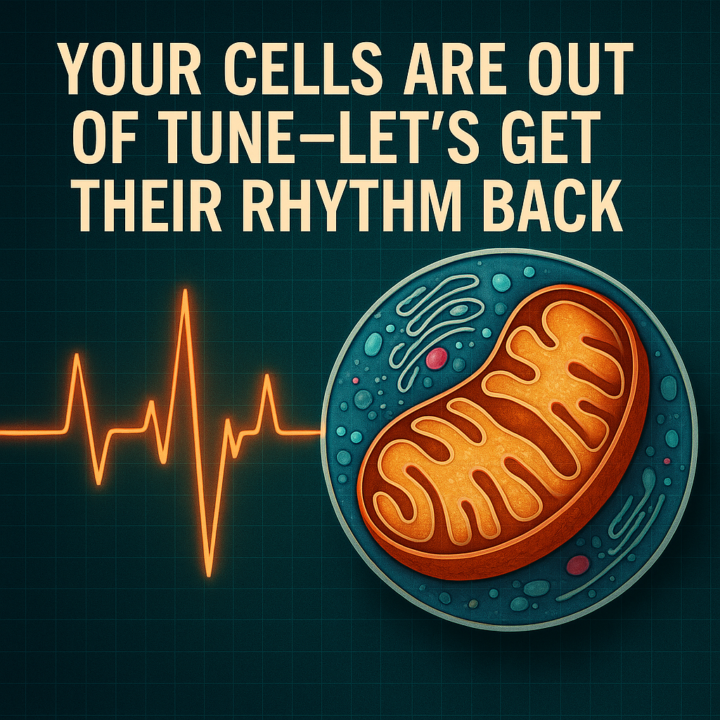
Join Me for Our First Day of Class: Your Cells Are Out of Tune—Let’s Get Their Rhythm Back
I’m testing out something new and wanted to bring you all along for the ride. I’ve started a daily learning experiment where I study new material each morning and then teach it back here to lock it in and spark better conversations inside the community. The goal is twofold: it helps me deepen my own understanding and gives all of us a chance to explore new ideas together. Some of what I’ll be diving into might sound a little weird at first it’s on the edge of where cellular medicine, physics, and performance meet but that’s exactly why I want to share it here. This is me getting my reps in, learning how to explain complex ideas simply so I can keep improving the way I teach and support everyone who trusts me with their health. Skool is officially in session and this is Day One. Coherence is one of those concepts that sounds abstract until you feel it. Every living system, from a single cell to a full human being, depends on rhythm and timing. When that rhythm is in sync, energy flows efficiently, signals are clear, and the system performs at its best. In biology, this rhythm is called coherence. Inside your cells, coherence is the difference between energy being stored as ATP or lost as heat and inflammation. Each mitochondrion operates like a small power plant. Its inner membrane holds a separation of charge about minus one hundred eighty millivolts that acts like the height difference of water behind a dam. This energy difference is the reason mitochondria can turn food and oxygen into usable fuel. Protons are pumped to one side of the membrane, building pressure, and when they flow back through the turbine-like ATP synthase, energy is released in a controlled, efficient way. If the membrane potential weakens, it’s like the dam lowering; water spills over without spinning the turbines, and you feel it as fatigue or slower recovery. In training terms, imagine the smooth rhythm of a strong set of squats. At the start, your body and breath are synchronized. Energy moves cleanly, the movement feels effortless, and power output is high. As fatigue builds, you lose that rhythm. The burn you feel in your muscles is the result of protons accumulating faster than they can be cleared. The gradient across your mitochondrial membranes collapses, energy flow becomes noisy, and contraction efficiency drops. That sensation is coherence breaking down in real time.
3 likes • Oct '25
I would say maybe a decrease in ATP production efficiency!
Oct '25 •
Testimonial
Well, I have to say if you're looking to take your health to the next level, Anthony is your guy! I was first introduced to Anthony through a YouTube video. I was intrigued with his conversations associated with mitochondria. I thought to myself, "Man, I would love to speak to this guy!" Not knowing what to expect, I decided to reach out to him in hopes to pick his brain about taking certain peptides and, of course, talk about all things mitochondria. He quickly responded to me. What I thought would be me asking a few quick questions about peptides. I ended up receiving so much more than expected! I must have watched our video 10 times after. Lol. The way he broke things down for me made so much sense! In order to navigate through mitochondrial dysfunction, you must start and build from the foundation up. He says it all time, but Ketones and proper hydration are an absolute game changer when done correctly. His passion bleeds through deeply through conversation and dedication to health and longevity. It has inspired me so much that I've become an absolute mad man when it comes to information, particularly with the mitochondria and peptides. I hope to one day be able to help others with their journey, just as he has helped me with mine. So, if you have considered reaching out to Anthony to start your journey. Don't hesitate! You won't regret it! Anthony, I am 100% looking forward to our next conversation to pick your brain. I can't wait. Thanks again, brother. PS these pics are my 1 year update. Summer of 2024 to just yesterday!

0 likes • Oct '25
@L S Absolutely I'll keep you guys in the loop on my progress!
1 like • Oct '25
@Katharina Clig Thank you really appreciate it! I look forward to continue to learn!
1-7 of 7

Active 17h ago
Joined Sep 17, 2025
Powered by