
Write something


Feb 3 •
Unique cat personalities
So I just recorded this random rant about understanding your cat or your friend's cat, and I thought it turned out nicely. Let me know what y'all think and if I managed to tune in to my inner charisma with this one =))


Jan 13 •
🤯 knowledge pill #3
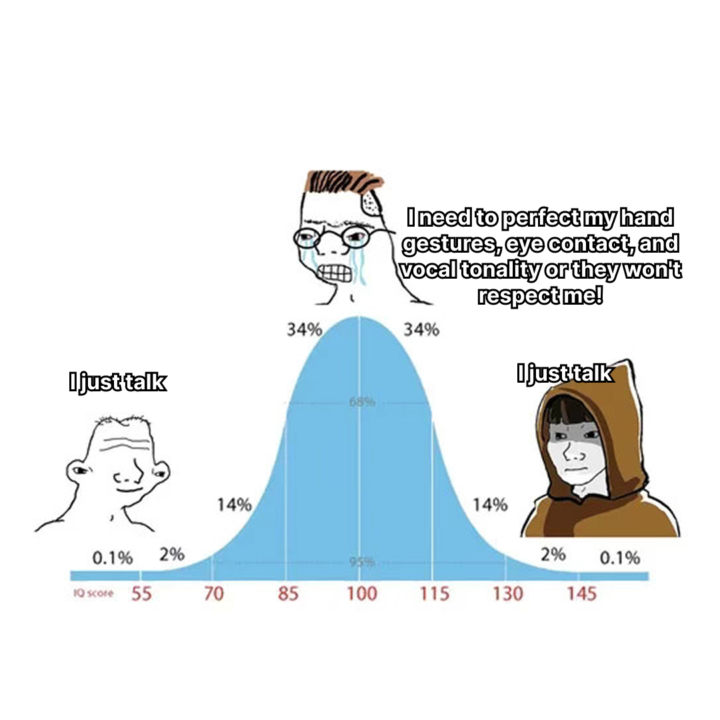
You should be concerned if people get what you say, if they understand your message and the value it brings; you should not by any means be obsessed with how you do it, because this is more yours than theirs. (Aristotle, 2007; Lucas, 2019; Savitsky & Gilovich, 2003). The merit must be there, be obsessed about the merit; let loose on how you will deliver it. You know the saying about eccentrics: “Yeah, he’s a bit weird, but he’s a genius”? Exactly, when you are really excelling at something, no one really cares if you sneeze during the speech, turn red or even green, because you delivered the value (Gilovich, Medvec, & Savitsky, 2000). Obsession over the merit. Chill over the delivery. People who have little to say sometimes try to compensate with the way they say it, and they become obsessed with their look, etc. (Lucas, 2019). *I expect some fierce debate in the comments! hahaha References Aristotle. (2007). On rhetoric: A theory of civic discourse (G. A. Kennedy, Trans., 2nd ed.). Oxford University Press. (Original work published ca. 4th century BCE) Gilovich, T., Medvec, V. H., & Savitsky, K. (2000). The spotlight effect in social judgment: An egocentric bias in estimates of the salience of one's own actions and appearance. Journal of Personality and Social Psychology, 78(2), 211–222. https://doi.org/10.1037/0022-3514.78.2.211 Lucas, S. E. (2019). The art of public speaking (13th ed.). McGraw-Hill Education. Savitsky, K., & Gilovich, T. (2003). The illusion of transparency and the alleviation of speech anxiety. Journal of Experimental Social Psychology, 39(6), 618–625. https://doi.org/10.1016/S0022-1031(03)00056-8
Jan 16 •
🤯 knowledge pill #4
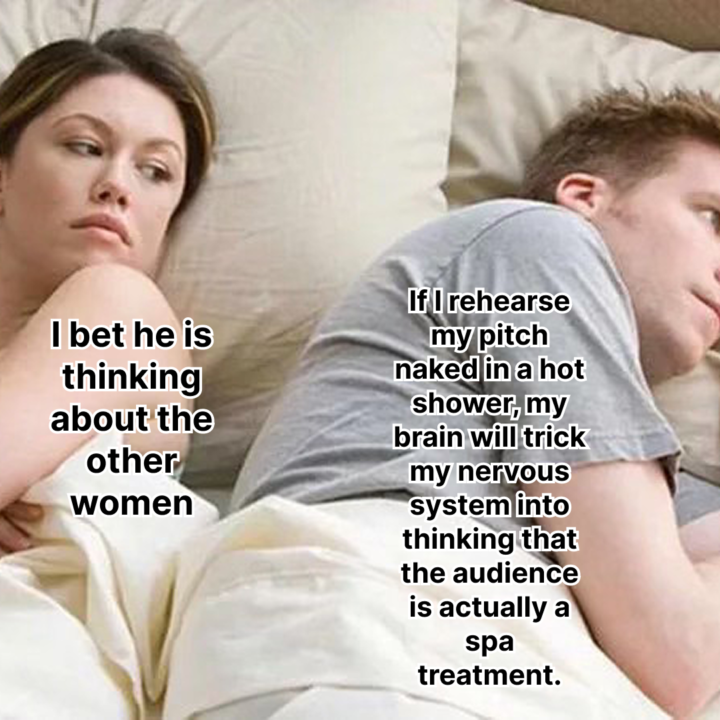
Yesterday I had this killer pres on public speaking at the Venture Cafe meeting in Warsaw, and wanted to share with you the 2 things that people particularly liked on the topic of stress management: - counter-conditioning – imagine super high stakes and mitigate the stress with full-body relaxation (e.g., a hot shower). Rehearse in the shower and condition your body to feel relaxed while rehearsing under “real” stress in front of the imagined audience. Thanks to that, when you actually present, your body remembers that even under stress it can relax. - bodily activation – we already do it here with some people, but this topic is broader than I initially thought. The science says that the more introverted you are, the less bodily activation you need to release stress. But during yesterday’s presentation I tested a super introverted-looking guy with mild activation, power activation, and super intense activation (photos soon), and he was getting less and less stressed each time - so, kind of the opposite of what the science says. - Would be awesome to hear how it works for you: do you see any patterns? Does it actually relieve your stress or not? References: Barlow, D. H. (2002). Anxiety and its disorders: The nature and treatment of anxiety and panic (2nd ed.). Guilford Press. Craske, M. G., Treanor, M., Conway, C. C., Zbozinek, T., & Vervliet, B. (2014). An inhibitory learning approach. Behaviour Research and Therapy, 58, 10–23. Deacon, B. J., Kemp, J. J., Dixon, L. J., Sy, J. T., Farrell, N. R., & Zhang, A. R. (2013). Maximizing the efficacy of interoceptive exposure by optimizing learning and dose. Behaviour Research and Therapy, 51(11), 742–750. Bodie, G. D. (2010). A racing heart, rattling knees, and ruminative thoughts: Defining, explaining, and treating public speaking anxiety. Communication Education, 59(1), 70–105.
Jan 20 •
🤯 knowledge pill #5
Say what is most exciting for you at the very start! Then when people still want to listen explain why is it so. There are two reasons: 1. on average what is exciting to you will draw attention of others too 2. when you talk about something you sincerely like - you are more charismatic I am not even mentioning the fact that people get bored super fast and building tension until the story climax that hits 10 min into the story is unfortunately something that is long gone. Heath, C., & Heath, D. (2007). Made to stick: Why some ideas survive and others die. Random House.
1
0
1-15 of 15
powered by
skool.com/willab-willpower-lab-6989
I bet you don't have the guts to test your public speaking skills ;)
Suggested communities
Powered by