
Write something

Jan 13 •
🤯 knowledge pill #3
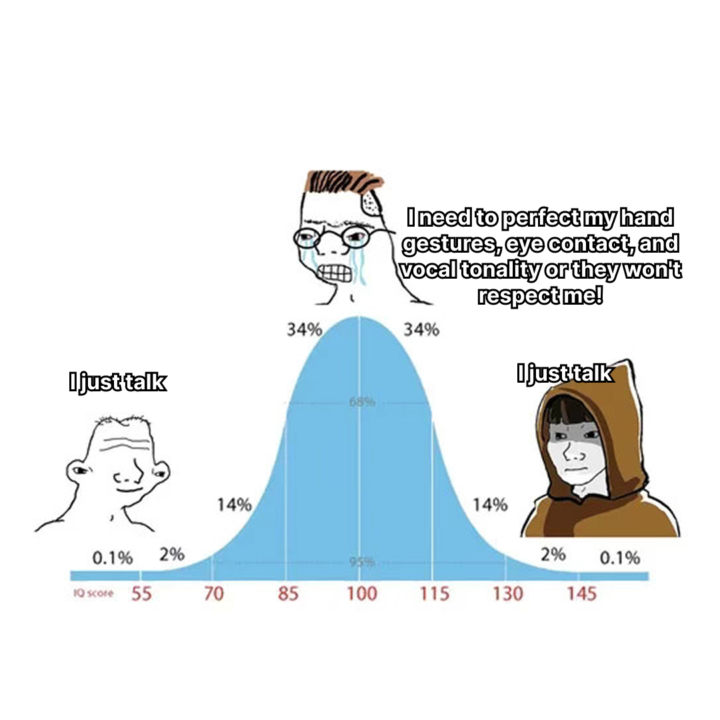
You should be concerned if people get what you say, if they understand your message and the value it brings; you should not by any means be obsessed with how you do it, because this is more yours than theirs. (Aristotle, 2007; Lucas, 2019; Savitsky & Gilovich, 2003). The merit must be there, be obsessed about the merit; let loose on how you will deliver it. You know the saying about eccentrics: “Yeah, he’s a bit weird, but he’s a genius”? Exactly, when you are really excelling at something, no one really cares if you sneeze during the speech, turn red or even green, because you delivered the value (Gilovich, Medvec, & Savitsky, 2000). Obsession over the merit. Chill over the delivery. People who have little to say sometimes try to compensate with the way they say it, and they become obsessed with their look, etc. (Lucas, 2019). *I expect some fierce debate in the comments! hahaha References Aristotle. (2007). On rhetoric: A theory of civic discourse (G. A. Kennedy, Trans., 2nd ed.). Oxford University Press. (Original work published ca. 4th century BCE) Gilovich, T., Medvec, V. H., & Savitsky, K. (2000). The spotlight effect in social judgment: An egocentric bias in estimates of the salience of one's own actions and appearance. Journal of Personality and Social Psychology, 78(2), 211–222. https://doi.org/10.1037/0022-3514.78.2.211 Lucas, S. E. (2019). The art of public speaking (13th ed.). McGraw-Hill Education. Savitsky, K., & Gilovich, T. (2003). The illusion of transparency and the alleviation of speech anxiety. Journal of Experimental Social Psychology, 39(6), 618–625. https://doi.org/10.1016/S0022-1031(03)00056-8
Jul 28 •
Women’s confident voice sounds different than men’s
A confident voice can be achieved in two ways, either by vocal or verbal cues. And they add up — if you say "I'm certain" in a confident tone, people rate you as more confident than the tone alone would get you. Say "maybe" and it pulls you down further than the tone alone would. Now, what's interesting is that women and men have different ways of displaying a confident voice. Men usually follow the script of a low pitch — their most confident statements are their lowest ones, and the pitch goes up as they get less sure. Women don't do that. They go higher in pitch for confident statements too. What they use instead is a lot of variety in the pitch, plus more volume. Confident female speech had the widest pitch swings and the biggest jump in loudness, while men's loudness barely moved. Men marked doubt differently — with longer and more frequent pauses. In both cases, what words are used is a key element. Words like "I'm sure," "definitely," and "for sure" show confidence. It's probably important to match those words with the right tone, but that's my guess, not something the study tested. They only used cues pointing the same way. What happens when your words and your voice say opposite things wasn't measured here. Interestingly, people often see a male voice as sounding more self-assured. Whereas female voice, not — at least on average. But that average hides something. When a woman did pull off a confident delivery, she was rated as more confident than a man saying the same thing. The catch is it works both ways: when women sounded unsure, they were rated as less confident than men sounding unsure. Female voices just got spread out over a wider range. More reward at the top, more punishment at the bottom. So basically, when a woman speaks with confidence, it really shows. It lands harder than it does for a man. But there's less room for error. One caveat — the study only used three speakers of each sex, so don't treat the men vs. women stuff as settled. Jiang, X., & Pell, M. D. (2017). The sound of confidence and doubt. Speech Communication, 88, 106–126. https://doi.org/10.1016/j.specom.2017.01.011
1
0

Jul 24 •
🎙️ Knowledge Pill #6: Why your voice is bad at "happy"
Communication is truly mysterious. I stumbled upon a study explaining that musical and vocal expression are alike — and it turns out that both in music and while talking to others, anger and sadness come through much more clearly than happiness, tenderness, or fear. And this only applies to sound-based communication. Because in other studies, where people looked at each other's faces, happiness was usually at the top! So what might explain this? The paper's own reasoning is that emotions that share the same energy level, also share the same vocal signature — happiness, anger and fear are all high-energy, so the voice can't really tell them apart. The face is what separates them. My own hunch, from evolutionary psychology, is the raw need to hear danger in the dark despite not seeing it. Think of the scene from movies where the attacker first angrily calls out his target before hitting him right in the face — you had to hear that coming. Whereas happiness usually happens in peaceful, well-lit situations, like a crowded dinner table where people smile rather than shout that they're happy. Now, what does this mean for a public speaker? 1. When talking about a sad or angry moment in your speech, it's more important to carry it with your voice — deepen it and slow down for sadness, push the pitch and pace up for anger. Less attention needs to go to body posture or making an angry or sad face. It's mostly about the voice. 2. When it comes to the happy moment, it's not that important to emphasize it with a change in pitch, variance or tempo — because your voice will undersell it anyway. What actually works here is a wide, genuine smile of yours. Citation (APA 7): Juslin, P. N., & Laukka, P. (2003). Communication of emotions in vocal expression and music performance: Different channels, same code? Psychological Bulletin, 129(5), 770–814. https://doi.org/10.1037/0033-2909.129.5.770
1
0



Feb 3 •
Unique cat personalities
So I just recorded this random rant about understanding your cat or your friend's cat, and I thought it turned out nicely. Let me know what y'all think and if I managed to tune in to my inner charisma with this one =))

1-17 of 17
powered by

skool.com/willab-willpower-lab-6989
In the making! Join if you are curious of what this is going to be!
Suggested communities
Powered by