User
Write something
Pinned

Community Rules
This community is built around discipline, respect, and real-world skill development. To keep it useful and professional, the following rules apply to all members. 1. Be Respectful Disagree if needed, but keep it professional. No insults, harassment, or personal attacks. 2. Keep It Practical Posts should be grounded in experience, training, or honest questions. Avoid speculation and internet theory. 3. Safety Comes First No unsafe advice. If a technique could cause injury, fire spread, or environmental damage, say so clearly. 4. No Politics or Drama This is not the place for political arguments, culture wars, or personal grievances. 5. No Self-Promotion or Spam Do not promote your own channels, products, or services without permission. 6. Protect the Community Do not share screenshots, content, or member discussions outside this group. 7. Instructor Discretion Moderation decisions are final. Posts or members may be removed to protect the quality of the community. This community works because members hold themselves to a higher standard. If you're here to train, contribute, and improve—welcome.
9
0
Today’s Tools
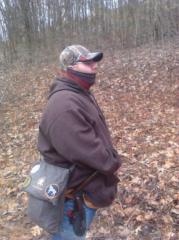
After today’s exercise, everything had to come inside for preventative maintenance. Not included in the photos are a pair of loppers. I have to rethink those because I don’t hike with loppers. I also don’t hike with the fixed blade Fiskars saw. The hatchet will be added to some kits. I have talked in other topic areas about how much I have learned about fire and shelters. I have not talked about tool use and maintenance. Since the beginning of the year I have seriously increased my knife utilization and the need for knife maintenance. In reviewing my after-action-report from the Wilderness Skills Course, GB2, I wrote that much more knife utilization and practice should precede course work. My hands and knife skills are seriously better today than a month ago. Reps and practice. Yes, I am also thrilled with the two Migizi knives. The Bushcraft / Survival Knife is currently riding in a leather dangler from LT Wright because I need to get it below the winter coat. I am working on a dangler design to use the Kydex sheath provided.
Today’s Tools
Wilderness First Aid Module Zero - Scenario
Outline: Two hikers, six miles from the trailhead, with rain starting and the temperature dropping, beyond cell phone service. One of the hikers has fallen and has an apparent femur fracture. Response: The now, first aid provider, (you) approaches the now, patient, to access his condition after the fall. The patient is in sever pain complaining about pain in the upper right leg. You check the patient for bleeding and determine that he does not have sever hemorrhaging. He is hesitant to move the leg and did not want to flex the right foot. He has straightened out the left leg and is willing to move the left foot. He is not complaining about any pain in his back. His breathing is good and no apparent circulation issues. He did not hit his head but the rain and dropping temperature is cause for hypothermia concern. You get him to sit on a waterproof sit pad and cover him with his poncho to get him out of the snow and out of the rain. You check cell service and determine that you do not have cell coverage and can not call 911. Your pack has a SAM splint and ace bandage, so you use your splinting training to stabilize the leg to minimize movement. Reassess to check pulse, respiration, and minor injury. You locate a suitable place to set up his T 6-zero lean-to shelter and gather firewood for a fire. As each of you are close to 200# and both on the cusp of 70 Y.O., it is apparent that you are not going to be able to transport him, the patient, by yourself. Your partner, the patient is scared, so you are talking to him as you are working on the fire preparation and firewood procurement. Understandably, he is concerned about how the two of you are going to get out, so you are talking out a plan together. Being six miles from the trailhead, that is a hike of two-plus hours to the car, and you are not sure how far it is to cell service. You save a waypoint on your smartphone and take a screenshot of the map with the waypoint. You have come to consensus that you should hike out when the fire is stabilized and firewood gathered. You don’t carry the GSMR radios when you hike and cell phones will not allow communication as you hike out. You leave him in the shelter with fire.
Wilderness First Aid Module Zero - Scenario
Weekly Skill Challenge: (Heat Management) Stay Warm Without Moving
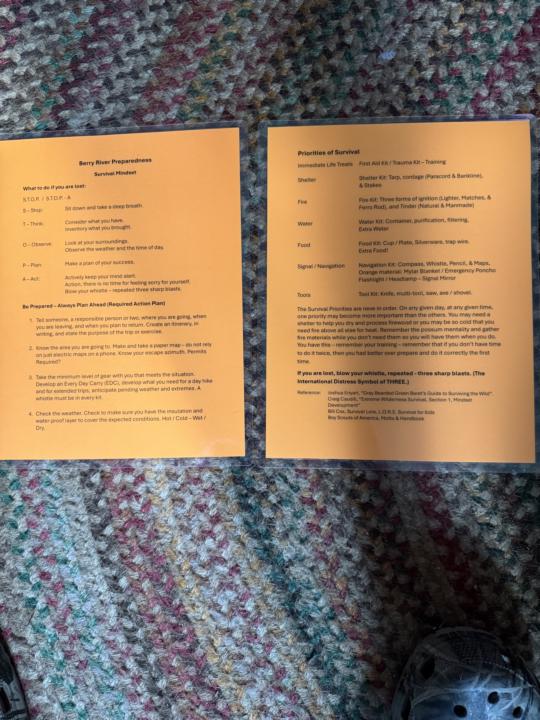
Purpose: This challenge teaches true heat management, not just “build a fire and hope.”Your objective is to retain, redirect, and manage heat while staying mostly static—the hardest condition in cold weather. Cold injuries happen after movement stops. This drill exposes weak points in your system. Challenge Objective: Remain comfortably warm for 30–60 minutes with minimal movement, using deliberate control of: - Conduction - Convection - Radiation Rules of the Challenge 1. No constant movement 2. One fire 3. One shelter 4. One insulation solution 5. Time Requirement The Heat Science 1️⃣ Conduction – Heat Lost to the Ground What it is: Heat transfer through direct contact. In the field: If you sit or lie on cold ground, rock, snow, or frozen earth, your body heat is being pulled out of you. Solutions you’re testing - Natural debris (pine boughs, leaves) - Foam pad, pack, bark - Raised bed or platform Failure sign: Cold creeping into hips, lower back, or legs. 2️⃣ Convection – Heat Taken by Moving Air What it is: Heat stripped away by wind or moving air. In the field: Even light wind will steal heat faster than cold air alone. Solutions you’re testing - Shelter orientation - Wind blocks - Terrain use Failure sign: Feeling chilled despite a fire burning. 3️⃣ Radiation – Heat You Can Capture What it is: Heat emitted from your fire in straight lines. In the field: If you can’t feel the fire on your face or chest, you’re wasting heat. Solutions you’re testing - Fire size and distance - Reflector (log wall, rock face, emergency blanket) - Fire height (platform fire) Failure sign: Fire burns well but doesn’t warm you. Pre-Drill Setup (Required) Before starting, record: - Air temperature - Wind conditions - Ground condition (snow, frozen soil, wet leaves) - Clothing layers worn at start - Fire type used - Shelter type used - Insulation material used HEAT MANAGEMENT LOG (Required) Participants must complete at least one full log.
Week #4 Challenge: Heat Management AAR Take 2 - Remote Location
2/4/26 Rochester Backyard Start 2:00 PM, Ken Berry 33 Degrees F. at 3:00 PM peak temperature. Average wind speed 6 MPH, Dry 24 Degrees F, Wind 5 MPH gusting to 12 MPH, Wind Chill a factor at 5:35 PM, Dry Shelter Type: SRO Orange & Silver Emergency Shelter with rapid ridgeline Fire Lay: Elevated Platform with Tepee lay, ferro rod on grass and flower top tinder bundle. White Pine kindling from the site. I used white pine and birch, unsplit, as fuel. Approximately 3 feet in front of the shelter. I tried to use the Star Fire Method. The shelter material was reflective, I did not build a fire pit reflector. The ground insulation was white pine branches harvested from the adjacent area about 500’ away, Tyvek sheet, garbage bag, puffer, and coat. Scenario start: 2:00 PM Hike until 2:30 PM Shelter complete: 3:00 PM Fire Ignition: 3:30 PM Collect pine boughs: 4:00 Occupy Shelter: 4:30 PM Done: 5:00 PM Ended due to uncomfortable laying on the ground and cold from the ground. The shelter worked very well but the pine boughs on the floor were way too thin. I harvested what I could from trees 500-feet away. The fire worked great and although a little too close to the shelter warmed the space very effectively. To work overnight it would have required much more ground padding / insulation and I would have needed much more firewood. Someone suggested using a star fire lay instead of processing firewood and splitting it down. This method was not successful. Splitting the wood exposes the dry interior wood and burns much better. As I was packing up to leave, I noted my right foot getting cold. When I got home my right foot was soaking wet, source unknown. I have never had an issue with the winter hiking boots. To overnight, this would have been a significant issue. Follow-up: No issue found with the boot. Perhaps melted snow from my pants and walking around. I have heard several times to build your bed and place the shelter over the bed. Packing the snow better and raising the shelter would have made it much less claustrophobic. The fire being so close added to the tightness and caused sparks to melt holes in my shelter.
1
0
Week #4 Challenge: Heat Management AAR Take 2 - Remote Location
1-30 of 59
powered by
Wilderness Mastery School
skool.com/wilderness-mastery-school-3134
Wilderness Mastery School: Green Beret-led survival training. Fire, shelter, water, navigation, first aid. Weekly challenges.
Build your own community
Bring people together around your passion and get paid.
Powered by