
Write something

15h •
Protein After 35: What You're Missing and Why It's Costing You💰
Your body is eating itself. And you don't even know it. Most people over 35 aren't eating too much. They're eating too little of the one thing their body desperately needs to hold onto muscle, boost metabolism, and perform at a high level. That thing is protein. And the numbers are alarming: 46% of adults over 51 don't meet their daily protein needs (Journal of Nutrition, Health & Aging). Without adequate protein and resistance training, adults lose 3-8% of muscle mass per decade. Lose enough muscle and your metabolism slows, fat accumulates, recovery suffers, and aging accelerates. Why the Rules Change After 35 After 35, your body becomes less efficient at using protein to build and repair muscle. This is called anabolic resistance - and it means you need more protein per meal than a 25-year-old eating the same food. For 70 years, the official protein recommendation sat at 0.8g per kilogram of body weight per day - barely enough to prevent deficiency, let alone support muscle, performance, or longevity. That changed in January 2026 with updated dietary guidelines. But even those updated numbers are a floor, not a ceiling. Here at Vybrant, after two decades of coaching real people, these are the targets that actually move the needle: Women 0.8 - 1.0g x lb bodyweight Men 1.0 - 1.25g x lb bodyweight Example: 150lb woman should aim for 120 - 150g / day 180lb man should aim for 180 - 225g / day What the 2026 Science Is Telling Us - Timing matters as much as total intake. The PROT-AGE study found older adults need 30-35g per meal to trigger muscle protein synthesis. (PROT-AGE Study Group) - High protein protects muscle during fat loss. Adequate protein preserves lean tissue while cutting calories. (UCLA Health, 2025) - Sarcopenia - age-related muscle loss - is directly linked to cognitive decline, fall risk, and early mortality. (ESPEN Expert Group) The Coaching Cues That Actually Change Behavior 1. Stop counting grams of food. Count grams of protein. Build your day around protein targets and calories tend to fall into place naturally. 2. Build every meal around a protein anchor of 30-35g minimum. Choose the protein source first, then fill in around it. 3. If you're not hungry in the morning, you're undereating protein at night. Fix dinner protein and watch your morning hunger return. 4. One shake does not make you a high-protein eater. A 25g shake fills a gap. If the rest of your day is cereal, sandwiches, and pasta, you're still under your target. 5. Eat your protein before your carbs at every meal. Protein first slows glucose absorption, reduces insulin spikes, and signals satiety sooner. 6. The scale lies. Protein tells the truth. Weight loss without adequate protein often means muscle loss. Focus on body composition, not just the number.
1
0
15d •
Your Watch Says You’re Recovered, But Your Body Says You’re Not⌚
What Wearable Fitness Data Actually Tracks Most recovery-focused wearables use several key metrics to estimate how your body is doing. Common wearable metrics include: - Sleep duration - Sleep consistency - Sleep stages - Resting heart rate - Heart rate variability - Respiratory rate - Skin temperature - Blood oxygen estimates - Movement - Training load - Stress estimates - Recovery score - Readiness score These metrics can be useful. For example, if your resting heart rate is elevated, your HRV is low, your sleep was short, and your body temperature is up, that may suggest your body is under more stress than usual. That stress could come from: - Poor sleep - Hard training - Alcohol - Dehydration - Travel - Illness - Emotional stress - Under-eating - Overtraining - Work stress - Hormonal shifts - Poor recovery habits The data is not useless. But it is not magic either. It is a dashboard. And a dashboard only helps if the driver knows what to do. The Problem With Sleep Scores and Recovery Scores Sleep scores and recovery scores are simple. That is why people love them. You wake up, open the app, and there it is: 82.83.84. Red. Yellow. Green. The problem is that your body is not a video game character. A single score can never perfectly summarize your full recovery state. Consumer sleep trackers can estimate sleep and wake patterns fairly well, but research has shown they can struggle with precise sleep staging and may overestimate certain sleep measurements compared with lab-based sleep testing. That does not mean your wearable is garbage. It means you should not treat it like a medical-grade sleep lab on your wrist.Your sleep score is an estimate. Your recovery score is an estimate. Your HRV is a signal. Your resting heart rate is a clue. The real skill is learning how to combine the data with how you actually feel. How to Use Wearable Data Without Becoming Obsessed Here is a better way to use your wearable. Look at Trends, Not One-Offs

Apr 21 •
Sciatic Nerve Pain Relief: How to Fix It Fast
“Pain is rarely the problem. It’s the signal.” If you’re feeling a sharp, burning, or shooting pain from your lower back into your glute, down your leg, or even into your foot you’re likely dealing with sciatic nerve pain (sciatica). And here’s the truth: Most people are treating it completely wrong. They stretch the wrong muscles.They rest too much or push too hard.They chase temporary relief instead of fixing the root cause. This guide breaks down what causes sciatic nerve pain, how to relieve sciatica quickly, and how to prevent it from coming back. What Is Sciatic Nerve Pain (Sciatica)? The sciatic nerve is the largest nerve in your body. It runs from your lower spine, through your hips and glutes, and down each leg. When this nerve becomes irritated or compressed, it leads to sciatica symptoms, including: - Sharp or shooting pain down one leg - Burning or tingling sensations - Numbness or weakness in the leg or foot - Pain that worsens with sitting, bending, or inactivity Sciatica is not just back pain! It’s a nerve issue caused by pressure, inflammation, or poor movement patterns. How to Fix Sciatic Nerve Pain Fast (3-Step System) Step 1: Decompress the Spine (McKenzie Method) Before stretching anything, you need to remove pressure from the nerve. Exercise: - Lie face down - Press up onto your elbows or hands (back extension) - Perform 10 slow reps, 2–3 times per day 👉 Known as the McKenzie extension exercise for sciatica Step 2: Release the Glutes and Piriformis If the nerve is compressed in the hip, you need to restore space. Tools: - Foam roller - Lacrosse ball Method: - Apply slow, controlled pressure to the glute and piriformis - Avoid aggressive rolling 👉 This helps relieve piriformis syndrome and sciatic nerve compression Step 3: Build Core and Hip Stability This is where long-term recovery happens. Focus on: - Core exercises (dead bugs, bird dogs) - Glute activation (bridges, step-ups) - Controlled, stable movement patterns

Apr 8 •
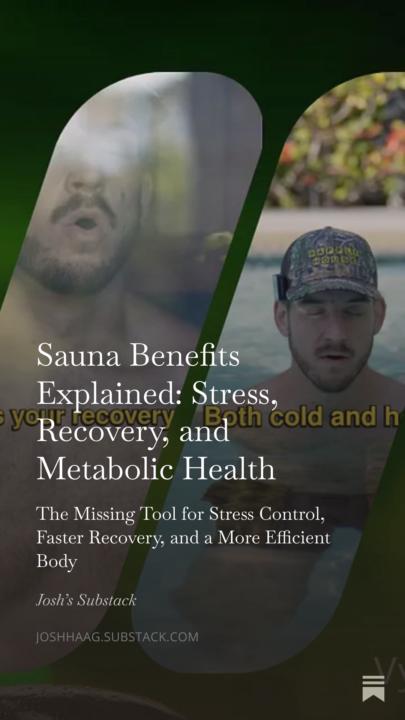
Sauna Benefits Explained: Stress, Recovery, and Metabolic Health
If you have been wondering about saunas, how to use them, and the real magic behind them. Check out this article and video I did!!! I hope you enjoy :) https://open.substack.com/pub/joshhaag/p/sauna-benefits-explained-stress-recovery?r=4bjill&utm_campaign=post&utm_medium=web&showWelcomeOnShare=true
0
0
Apr 1 •
How to Fix Back Pain Naturally💪
These 3 proven techniques relieve lower back pain fast! Read on to learn more and let me know if you try any of them below👇 Lower back pain is one of the most common complaints I see with clients. In fact, nearly 80% of adults experience lower back pain at some point in their lives😲 Most people assume the problem is their back itself. They stretch their back, massage their back, or try to strengthen their back. But here's the truth👀 Most lower back pain isn't actually caused by the back... It's usually caused by tight hips, prolonged sitting, poor posture, and spinal stiffness. When the hips stop moving well and the spine spends hours in a flexed position, the muscles around the lower back begin to compensate. Over time, this creates stiffness, irritation, and pain💢 The good news is that some of the most effective strategies for how to fix back pain naturally are also incredibly simple! Below are 3 techniques I frequently use with clients to restore movement, reduce tension, and provide long-term lower back pain relief. Common Causes of Lower Back Pain😩 Understanding the cause of back pain is the first step toward fixing it. The most common contributors I see include: Prolonged Sitting🪑 Modern life keeps many of us seated for hours at a time. Sitting shortens the hip flexors, weakens the glutes, and increases pressure on the lumbar spine. Tight Hips and Glutes🍑 When the hips lose mobility, the lower back is forced to move more than it should. This often leads to tightness in the piriformis, glutes, and surrounding muscles. Poor Spinal Posture❗ Rounded shoulders and forward head posture flatten the natural curve of the spine, which increases compression and stress in the lower back. Symptoms Your Back Pain May Be Coming From Tight Hips Many people experiencing lower back pain also notice symptoms like: - Stiffness when standing up after sitting - Tightness in the lower back when bending forward - Aching in the glutes or hips - Pain after long car rides or desk work - Relief when walking or moving around
0
0

1-7 of 7

skool.com/thefountainofyouth
Build a body and lifestyle that actually lasts. Not 30 days. Not 6 weeks. Decades.
Train, Recover, and Live Strong. Unlock Your Longevity here.
Leaderboard (30-day)
1

🔥
+7
2

+4
3

+2
Powered by