

13d •
Bills of Exchange paying a utility bill (With)
Can a "Bill of Exchange" be used in the UK to pay for a utility bill. Or would this be double dipping on the side of the utility corporations!

Mar 8 •
Council Tax
I watched Iain Clifford's stream yesterday and for those combating Council Tax this might help. In short: The councils are renting out the courtrooms and playing court, I am sure most know this. It seems they may also be using council employees to act as the council solicitor/prosecutor, and these actors are not actually legally qualified, therefore making the whole case null and void. So if anyone is going to court soon for council tax, this may be a strategy to look at to get the case kicked out. Iain states that after several months of research, the only cases he can find where people have actually won in court have been through process challenges. It's all about the process with court, and this would be a break in process, therefore breaking their case. More info in the course coming soon. https://rosmediaplatform.com/video/413/beat-council-tax-the-structural-solution-explainer-video/

12d •
Council Threatening to put a Charge on my Home re Council Tax
Hi All, I have taken the line of ignoring anything from Leeds City Council re Council tax. I understand that the Liability Orders are 'fake'. I have collected a package today from the Post Office after the sender (Legal Service at Leeds City Council) did not put sufficient postage on the envelope! It says, "We write to inform you that an Interim Charging Order has been obtained against the above mentioned property." (see attachment) The order has - it says - been registered with the Civil National Business Centre which I understand is an administrative centre rather than a court. I also ignored bills from Yorkshire Water and they have managed to put a CCJ on my credit file via the Civil National Business Centre. I did write to Yorkshire Water before they did that and asked for a copy of my contract, invoices and meter readings which they did not supply. I am wondering what my best course of action is here. I wonder if it could be another attempt to scare me into paying. There is a big pack with the attached documents which I can share with anyone interested. I have yet to read through the pack for the details. Has anyone else trodden this journey before or got any thoughts for me? Thank you.

19d •
Employers are not Debt Collectors
In case it could be useful to someone: Your employer isn't a debt collector. Send them this and follow through if they don't cease.. [Your Name] [Your Address] [City, Postcode] [Date] To: [Employer's Name / HR Department] [Company Name] [Company Address] Subject: Formal Notice – Unlawful Wage Deductions for Alleged Council Tax Arrears Dear [Employer's Name], I write to formally put you on notice that any deductions from my wages relating to alleged council tax arrears claimed by [Council Name] are unlawful unless and until the council provides clear and lawful evidence of their entitlement to enforce such deductions. Legal Framework Governing Wage Deductions 1. The Requirement for a Legally Executed Liability Order In Leighton v Bristow and Sutor [2023], the High Court reaffirmed that enforcement actions, including wage deductions, cannot proceed without a valid and properly executed Liability Order issued by a Magistrates’ Court. Such an order must: • Be properly executed, bearing the court’s official seal and the signature of an authorized officer; and • Clearly specify the liability in question. Without a valid Liability Order meeting these statutory requirements, any attempt to enforce the alleged debt is rendered unlawful under the Council Tax (Administration and Enforcement) Regulations 1992. 2. Employer Obligations Regarding Wage Deductions Under the Employment Rights Act 1996 (Section 13), deductions from an employee’s wages are only lawful if: • Required by statute; or • Made with the express consent of the employee. In this case, the statutory basis for deductions hinges entirely upon the existence of a valid Liability Order. Without such an order, deductions are unlawful, as established in Southfield v British Telecommunications plc [1998] IRLR 18. Employers must also act reasonably to verify the lawfulness of deductions. As stated in Cambridge and County Developments (Contractors) Ltd v Hughes [1973] QB 522, an employer is under a duty to investigate the validity of any purported statutory authority before acting on it.

23d •
Using the office of executor with effect
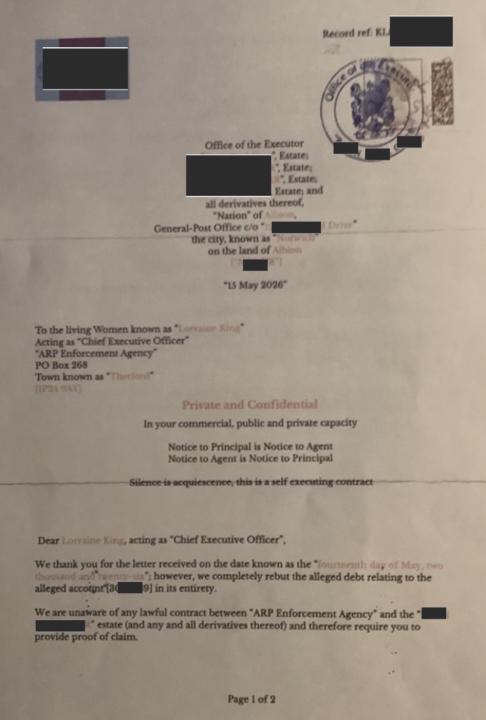
So I have used the office of executor twice now, once for a FOI with a response for LED lighting where they have both wrote back to Office of executor and a second letter where they wrote back to Ryan R./Executor. This I haven’t had a response but I have also not had a visit, this was a response sent the next day for unpaid council tax to the enforcement company any thoughts welcome including what I could have done better?
1-24 of 24
powered by

skool.com/not-a-person-3150
Just for fun and Education, the wonderful world of Law and legal, with video discussions and chat and motivation.
Suggested communities
Powered by