
Write something



4d •
Rabbit Care Series: Flooring Selection and Supporting Research
Rabbit flooring: the reasoning behind ½ × 1-inch mesh Let’s begin this housing discussion with the ½ × 1-inch welded wire flooring we regularly use. This specification has a documented history in agricultural husbandry literature. Published technical guidance and accumulated practical experience both carry weight when evaluating how rabbit housing is built and maintained. These sources give us a foundation for discussing the actual construction of the floor. The attached USDA Animal Welfare Act “Blue Book” gives us a useful starting point for discussing rabbit housing, feeding, sanitation, and management. The rabbit-specific standards appear on pages 184–198 of this May 2023 edition. These are minimum regulatory standards for covered activities. Rabbits raised solely for meat or fur fall under the farm-animal exclusion, so their use here is as a husbandry reference for evaluating a production rabbitry. The housing provisions focus on what an enclosure must accomplish: protect rabbits from injury and predators, keep them clean and dry, and provide convenient access to food and water. Floors must protect feet and legs. **Wire and mesh floors are expressly contemplated**, while solid floors require litter. These sections do not prescribe wire gauge, mesh spacing, or a universal foot-rest requirement. That leaves an important practical responsibility: assessing whether the actual floor and its condition protect the rabbits housed on it. Does with litters under one month old must have a suitable nest box containing clean nesting material (§§3.50, 3.53, 3.56). https://www.aphis.usda.gov/sites/default/files/AC_BlueBook_AWA_508_comp_version.pdf USDA’s [*Commercial Rabbit Raising* (1971, p. 11)](https://ageconsearch.umn.edu/record/322040/files/ah309rev.pdf ) specifies welded, galvanized 16-gauge wire with 1 × ½-inch mesh for the floor. Agriculture Canada’s [*Raising Meat Rabbits* (1986, p. 11)]( https://publications.gc.ca/collections/collection_2015/aac-aafc/A63-1782-1986-eng.pdf ) recommends 14-gauge welded galvanized wire measuring 12.5 × 25 mm—the nominal metric counterpart. Together, these publications document a longstanding recommendation for this rectangular mesh, including guidance supporting 14-gauge construction.
0
0

18d •
ISO Breeding Buck
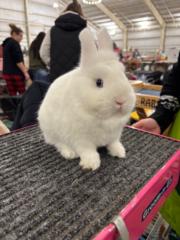
Howdy!! On the hunt for a new breeding buck. I haven't even started this year and our semi-annual cleaning took my only Senita breeding buck. He was gorgeous. The girls are looking great and packed on the pounds. We are starting to trim back to 10oz of pellets a day to get ready for breeding season in a few short weeks.
19d •
Question on Amount of Pellets
Hi, Does anyone change the amount of pellets based on the season? I used to feed hay with the pellets but I’ve removed the hay. Life has been better. Soooo much better. Wish I’d done this 3 years ago. But I was wondering if I should expect to increase the pellet amount once it starts to get colder. I figured I can always reduce if it doesn’t get eaten. But just curious what others do and what to expect. I have Netherland Dwarf that eat Rowe (16/18 non-medicated) and Blanc de Hotot & English Spots that eat Heinhold Family (orange bag).
16d •
Wirecages and Rabbits .
A claim that circulates constantly in rabbit groups is that rabbits kept in cages develop “dry, brittle bones” because they cannot exercise enough, leaving them at high risk of breaking a bone if they become frightened. There is a kernel of real physiology buried inside that claim: mechanical loading and locomotion can influence bone development. But the popular version goes far beyond what the rabbit research actually demonstrates. Much of this claim traces back to a 1996 paper by Drescher and Loeffler titled Scoliosis, Lordosis and Kyphosis in Breeding Rabbits. The study is real. What is frequently repeated about it is not. What Drescher actually studied Drescher and Loeffler examined the vertebral columns of breeding rabbits housed under different conditions to determine whether housing and opportunities for locomotion were associated with spinal deformation. They reported that the frequency and severity of spinal deformation in does were related to cage size and restricted locomotion. They also identified reproduction as another contributing factor because pregnancy and lactation alter mechanical loading and substantially increase calcium requirements (Drescher & Loeffler, 1996). That matters. But it does not demonstrate that rabbits housed in appropriately sized cages develop universally weak or “brittle” bones. The problematic cages frequently cited from this work were approximately 60 × 40 × 32 cm, or about 23.6 × 15.7 × 12.6 inches. That is an extraordinarily restrictive space for an adult breeding rabbit and can prevent normal posture and locomotion. The useful conclusion from Drescher is therefore fairly straightforward: Housing must provide sufficient room for normal posture and movement. It is not: Any rabbit kept in a cage will develop brittle bones. Those are very different statements. The study also does not demonstrate that the wire floor itself caused the skeletal changes. Cage size, locomotion, posture, sex and reproduction were among the variables under discussion. Using Drescher as evidence that wire cages inherently cause skeletal disease stretches the paper beyond what it investigated.
0
0
1-30 of 220
powered by

skool.com/mmcbunclub-6215
Bun Club: science-based rabbit education promoting data-driven care, accurate nutrition, and verified research.
Suggested communities
Powered by