
Write something

May 11 •
I do Science not Pinterest
Forage feeding 20 rabbits sounds romantic until you actually have to balance the diet, harvest enough volume, avoid toxic plants, manage seasonal variation, and make sure every rabbit is getting enough protein, energy, fiber, minerals, and calcium. Meanwhile, this is what I feed 120 rabbits. Pellets. Less work. More consistent nutrition. Better control. Better grow-out rates. Better reproductive support. Fewer guessing games. A good rabbit pellet is not “junk food.” It is a formulated ration. That means the protein, fiber, fat, calcium, phosphorus, trace minerals, and vitamins are designed to meet the animal’s needs more reliably than a random pile of greens ever will. Start here for a basic rabbit nutrition baseline. Adjust by life stage, production level, breed, condition, and activity. Alfalfa-based pellet baseline: 16–18% protein 15–24% fiber 2.5–4% fat 1–3% calcium Growing meat rabbits, lactating does, show conditioning animals, wool breeds, seniors, and maintenance pets do not all need the exact same ration. But if someone is telling you pellets should only be fed a few times a week, they are not talking about production rabbits, and they are not talking from a nutrition-first framework. That advice can underfeed the rabbit, wreck growth rates, hurt reproductive performance, and set people up for failure.

May 8 •
Yet another hay debate on facebook seems it never ends
Let’s correct one major misunderstanding here: pet rabbits, meat rabbits, show rabbits, and breeding rabbits are not different animals with completely different digestive systems. Their basic nutritional needs overlap heavily. I have an entire section in my nutrition course on feeding by lifestyle, and the differences are not nearly as dramatic as pet groups pretend. The real issue is not “pet rabbit versus meat rabbit.” The real issue is whether the ration is balanced. A properly formulated pellet is not junk food. It is not “rabbit cereal.” It is a complete ration designed to deliver fiber, digestible energy, protein, amino acids, vitamins, and minerals in a consistent form. That consistency is exactly why pellets became the standard in domestic rabbit production and research feeding. The other myth that needs to die is “pellets make rabbits fat.” No. Excess calories make rabbits fat. Poor ration control makes rabbits fat. Low activity plus overfeeding makes rabbits fat. Pellets themselves do not magically create obesity. A correct pellet builds muscle, supports organ function, maintains body condition, fuels growth, supports lactation, supports coat production, and keeps the rabbit from trying to survive on a nutritionally diluted hay pile. Protein is not the enemy. Digestible energy is not the enemy. A balanced ration is not the enemy. If a rabbit is getting fat on pellets, the answer is not “pellets are bad.” The answer is that the feeding rate, energy density, activity level, genetics, age, reproductive status, or total ration needs evaluated. Hay can be used as forage, enrichment, or part of a ration. But hay is not automatically balanced, and it is not a substitute for understanding nutrition. Rabbits need appropriate fiber. They do not need internet folklore dressed up as care advice.
2
0
Apr 2 •
More Rabbit Myths from the internet
Rabbits are hindgut fermenters, yes—but they are not the same as horses, rhinos, or elephants in how they process that fermentation. Rabbits use cecotrophy. They produce nutrient-dense soft feces (cecotropes), then re-ingest them to run the digestion process a second time. That allows them to extract nutrients efficiently without needing continuous intake of large volumes of forage. Horses, rhinos, and elephants do not do this. They rely on volume throughput—they have to keep eating constantly because they only get one pass at digestion. Rabbits don’t. They operate on a crepuscular feeding pattern—they primarily eat at dawn and dusk, then spend long periods resting while fermentation occurs in the cecum. During that time, they’re not “needing constant forage,” they’re actively digesting what they already consumed and then recycling it through cecotrophy. So no, rabbits are not “the same” as other hindgut fermenters in feeding behavior or nutritional strategy. They’re a high-efficiency recycler system, not a continuous grazing system.
Apr 11 •
Let's talk calcium and pregnancy.
Just a heads up to everyone running rabbits right now. The alfalfa crop coming out of Texas (fall 2025) has been testing low in both mineral density and protein efficiency. That matters more than people think. If that crop made it into pellet production, your bag may not actually be delivering what the tag says on paper. And we’re starting to see it. What I’m seeing — and what others are reporting — lines up: • more brittle bones • increased fractures • does struggling to kindle • more straining in labor • poor milk production • DOA kits or underdeveloped kits • late-term losses or does dumping litters in the third week Because of this, and because I’ve now seen it in more than one doe, I’ve started supplementing calcium in the water during the last week of pregnancy through the first 5 weeks of nursing. Mix and dosage are at the end. This is now being added into Class 5 of the nutrition course, but I’m putting it here because this is one of those moments where waiting costs litters. What Calcium Is Actually Doing in a Rabbit Calcium in rabbits gets reduced to “sludge” conversations way too often, and that misses the entire point. Calcium is not a side mineral. It is a structural, metabolic, and reproductive driver. Rabbits are built to absorb calcium efficiently and use it continuously. Their entire system assumes it will be available. When it’s not, things don’t degrade slowly. They fail across multiple systems. Growth — Building the Frame Calcium is what builds the rabbit. It drives: • bone formation • tooth development (which never stops in rabbits) • structural growth When calcium is inadequate, you don’t just get “slower growth.” You get: • weaker frames • poor bone density • dental problems • long-term structural compromise You are not raising a smaller rabbit. You are raising a weaker one. Bone — Maintenance, Not Just Growth Bone in rabbits is constantly being remodeled. Calcium is moving in and out of storage all the time to support: • muscle contraction
Mar 23 •
Rabbit Care Myths #7 “Alfalfa only for babies.”
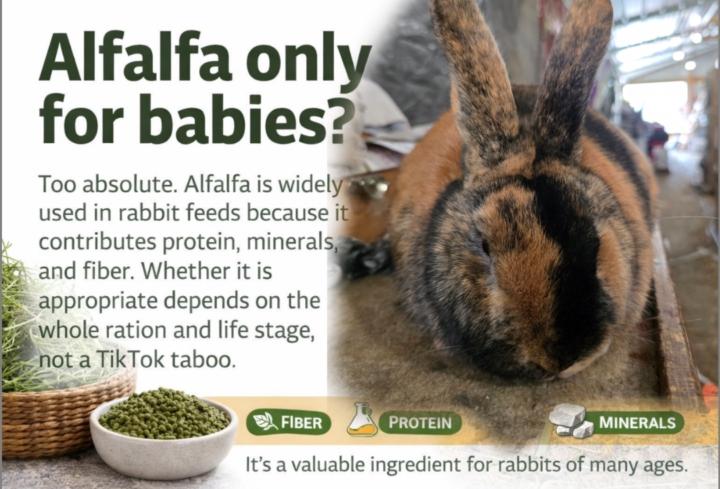
“Alfalfa only for babies.” Too absolute. Alfalfa is widely used in rabbit feeds because it contributes protein, minerals, and fiber. Whether it is appropriate depends on the whole ration and life stage, not a TikTok taboo. The statement “alfalfa is only for babies” gets repeated like a rule, but it’s not a rule—it’s an oversimplification that ignores how rabbit diets are actually formulated. Alfalfa isn’t some special “baby-only” ingredient. It’s one of the primary base ingredients used in rabbit nutrition across research, commercial production, and feed manufacturing. The reason is simple: it brings a dense package of nutrients—protein, calcium, digestible fiber, and energy—that are useful when you’re trying to build a balanced ration. What matters is not the ingredient in isolation, but the entire diet around it. Why alfalfa is used in the first place Alfalfa contributes: Higher-quality protein than most grass hays Calcium and minerals needed for growth, reproduction, and lactation Fermentable fiber fractions that support cecal function Energy density that helps meet metabolic demands That’s why most complete rabbit pellets—across decades of formulation work—are alfalfa-based, not timothy-based. Where the “baby only” idea came from The myth usually comes from a real observation that got turned into a blanket rule: Young, growing rabbits need more protein and calcium → alfalfa fits that well Adult maintenance rabbits need less excess energy/minerals → people were told to “switch away” Somewhere along the way, that turned into: “Alfalfa is dangerous for adults” That leap is where the logic breaks. The actual issue: balance, not the ingredient Alfalfa becomes a problem only when the overall ration is wrong, not because alfalfa exists in the diet. Problems show up when: It’s fed free-choice with no intake control It’s combined with high-energy treats and excess feed The rabbit is already overweight or inactive The diet isn’t balanced for fiber-to-energy ratio That’s not an alfalfa issue—that’s a ration management issue.
1
0
1-30 of 48
powered by
skool.com/mmcbunclub-6215
Bun Club: science-based rabbit education promoting data-driven care, accurate nutrition, and verified research.
Suggested communities
Powered by