
Write something

Jan 7 •
🏆 Top 10 AI releases, upgrades, and shifts since 1st Jan 2026
As of 7 January 2026, we’ve officially crossed the line from “AI experiments” into Agentic AI doing real work. These tools don’t just chat anymore — they execute, decide, and run multi-step workflows for businesses. Here’s your straight-up Dishy Digital rundown of the top 10 AI releases, upgrades, and shifts that have landed since the year kicked off — and why small businesses should care. 👀👇 ⸻ 1. xAI: Grok Business & Enterprise Tiers Elon Musk’s AI company officially stepped into the workplace arena over New Year, launching dedicated business tiers. What’s new: Permission-aware Google Drive access. Grok can analyse internal docs without breaking folder rules. Small biz win: The new Collections API lets you connect Grok to legal, finance, or policy folders — creating a single source of truth with instant, cited answers. Less digging. More doing. 📂✨ ⸻ 2. OpenAI: Atlas AI Browser (Early Windows Preview) This is OpenAI stepping beyond chat and straight into AI-first browsing. What’s new: An Agent Mode that fills forms, checks multiple tabs, and runs full research tasks autonomously. Small biz win: Cuts hours off admin jobs like competitor checks, lead research, and CRM updates. Your browser just became a junior staff member. 🧠💼 ⸻ 3. Microsoft: Copilot Business for Small Teams Copilot is no longer just for the big end of town. What’s new: Full Microsoft 365 Copilot access for teams under 300 — baked into Excel, Word, and PowerPoint. Small biz win: Auto-summarised bookkeeping, instant reports, and pitch decks built from one prompt. If you live in Microsoft tools, this is a quiet power move. 📊⚡ ⸻ 4. Google Gemini: Nano Banana for Presentations Yes, that’s really the name — and yes, it’s powerful. What’s new: A creative engine inside Gemini that builds entire presentations — layouts, visuals, even hand-drawn “vision board” vibes — from plain text.

Jan 6 •
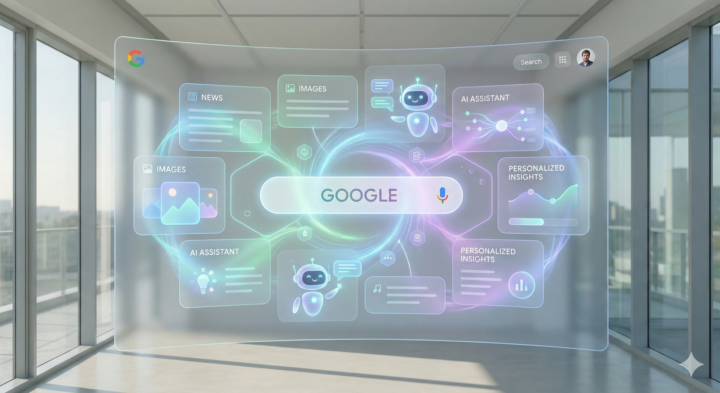
AI on Google Search: The New Era of Models, Agents & Intelligent Browsing
Google’s AI ecosystem is quietly — and rapidly — evolving into something far bigger than “search with smarter answers”. Behind the scenes, Google is rolling out powerful AI models, agent-based development platforms, and experimental browsing experiences that signal where search, work, and digital creation are heading next. If you’ve heard names like Gemini 3, Antigravity, or Disco, but weren’t quite sure what they actually mean — you’re not alone. Let’s break it down in plain English. ⸻ ➡️ Core AI Models: The Brains Behind Google’s AI At the centre of Google’s AI push is the Gemini 3 model family — its most advanced multimodal models to date. “Multimodal” means they can understand and work across text, images, audio, video, and code at the same time. Here’s how they’re shaping up: ➡️ Gemini 3 Pro This is Google’s most capable publicly available model right now. It’s designed for advanced reasoning, complex workflows, and real-world problem solving — and it’s already appearing across Google products. ➡️ Gemini 3 Flash Built for speed and efficiency, Flash is designed for fast responses, lightweight tasks, and real-time applications where performance matters. ➡️ Gemini 3 Deep Think (Ultra) This is where things get serious. Deep Think is an enhanced reasoning mode for complex, multi-step problems. It’s currently with safety testers and will soon be available to Google AI Ultra subscribers. ➡️ Alongside Gemini, Google also offers: • Gemma – an open-model family for developers and researchers • Nano Banana (Gemini 3 Image) – image creation and editing • Imagen – text-to-image generation • Veo – AI video generation • Lyria – AI-generated music • SynthID – watermarking to identify AI-generated content Together, these models form the backbone of Google’s AI ecosystem. ⸻ ➡️ Development Platforms & AI Agents: AI That Does the Work Google isn’t just building smarter models — it’s building AI agents that can actually do things. ➡️ Google Antigravity Antigravity is a brand-new, agent-first development environment. Instead of just writing code, developers can use autonomous AI agents to:
Oct '25 •
🚨 AI Just Made Advertising Invisible (And It’s Already Live…)
Okay team, this one is big… and most of the world hasn’t clocked it yet. One of the major tech giants, Tencent, has quietly rolled out a form of AI-powered in-scene advertising — which means ads are no longer separate from the content… they’re becoming part of the content itself. Read that again. Instead of interrupting your movie or show with a traditional ad break, AI scans the scene and digitally swaps objects in real-time: ✅ A blank coffee cup becomes a brand ✅ Posters on walls change depending on who’s watching ✅ Billboards morph based on your location ✅ Beer bottles, product labels, bus stops, flyers… all fair game And here’s the wild part: Two people watching the same episode can see different products in the same scene. Advertising has officially become personalised — and invisible. 🎯 How It Works AI builds a profile on your: - Location - Viewing habits - Purchase behaviour - Interests - Demographics Then it shows you products that blend perfectly into the background of what you’re already watching. It feels natural. You barely notice. But your subconscious definitely does. This is behavioural economics meets content. 🧠 Why Advertisers Are Drooling Over It For years, brands have fought a losing battle: - People skip ads - People block ads - People ignore ads But you can’t skip what you don’t consciously recognise as an ad. In-scene placement solves: - Viewer annoyance - Drop-off rates - Ad blindness It delivers reach without friction. 🔥 Why Platforms Love It Streaming services have hit a ceiling. Subscribers are fatigued. Competition is insane. This gives platforms NEW monetisation pathways: - Old shows become profitable again - Classic movies can be “updated” with fresh brands - Targeting becomes dynamic, not static Imagine watching a movie from 2006… with ads relevant to today. That’s happening now. 💥 Yes — Western Platforms Are Testing It Amazon? Testing it. NBC? Testing it. Others? Absolutely. They’d be crazy not to.

Oct '25 •
📣 Dishy Digital News & Strategy Update
Hey everyone 👋 I want to share a shift that’s not confirmed — but that’s worth your radar — and show you what to do right now to stay ahead: Google is about to limit LLMs to the top 10 results. What we know: • ChatGPT now processes more than 2.5 billion prompts every day. • But when you compare with Google, ChatGPT’s “search-type” queries are still a small fraction of what Google handles. • Because Google is increasingly offering AI-generated summaries and direct answers, more users are getting their answers on Google itself, rather than clicking through. That means less traffic for many websites. What’s still speculation — but worth paying attention to There’s a rumor going around: that Google might soon restrict AI tools so they only see the top 10 search results. That would be a serious shift — if true, it would amplify the importance of being on page 1 even more. We don’t have proof of that today — no official announcements, no technical documents establishing that rule. But it’s not out of the realm of possibility, considering how Google is tightening its access and experimenting with AI features. What this means for your business — now & later 1. Ranking well on Google is still non-negotiable. Even if AI tools grow, the majority of search volume, click potential, and visibility for real people still flows through Google. (That’s where customers go, where local searches happen, where ads work.) 2. You may gradually need to show up in AI responses, too. If Google does eventually limit what AI tools can see, only top-ranked content would be accessible to bots. That means being among the top 3–5 becomes even more critical — not just for people, but for AI “mentions.” 3. Don’t bet everything on AI — diversify. Use ChatGPT, Perplexity, etc., to help you create content, brainstorm ideas, repurpose your existing posts — but don’t rely on them to replace organic search traffic. 💪 What you can do today to future-proof • Use Google Search Console to spot keywords ranking just outside page 1 (positions 11–20). These are your best bets for improvement.
0
0

Oct '25 •
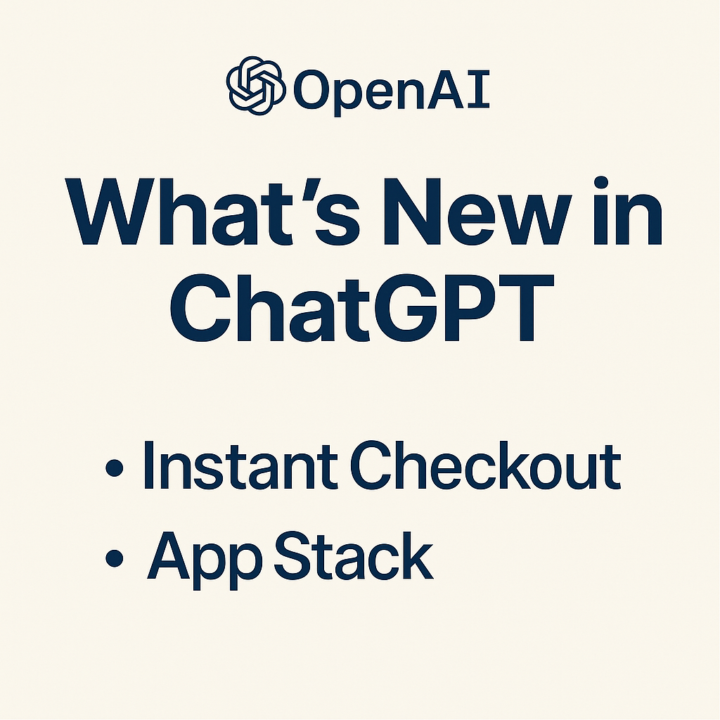
🚀 ChatGPT’s Next Big Shift: From Smart Agent Builder to Instant Checkout Powerhouse
AI isn’t just the assistant anymore — it’s becoming the interface, the store, and the strategy. OpenAI’s latest updates blur the lines between automation, software, and commerce — introducing two huge innovations: the Agent Builder + Apps SDK and Instant Checkout. ______________________________________________________________________ 💡 The Agent Builder + Apps SDK This new toolkit lets you build AI workflows and applications directly inside ChatGPT. Forget juggling integrations — now, ChatGPT itself can run your systems. Agent Builder / AgentKit: drag-and-drop workflows that use your APIs, data, and tools. Apps SDK: build your product as an in-chat app — just like Canva, Zillow, and Coursera. Model Context Protocol (MCP): a universal standard so your app and ChatGPT can talk seamlessly. Reasoning Modes: let your agent “think deeper” for complex problems. This is massive for creators, agencies, and small biz owners. You can design a chatbot that handles your customer bookings, creates content, or connects straight to your CRM — all within ChatGPT. It’s automation, interface, and experience — rolled into one. ______________________________________________________________________ 🛍 Instant Checkout – Buy Direct in ChatGPT OpenAI’s also turning ChatGPT into a shopping platform. With Instant Checkout, users can now find → buy → confirm purchases without leaving the chat. Here’s the flow: 1️⃣ Ask ChatGPT for a product (e.g. “vegan skincare gift under $100”). 2️⃣ It shows top-rated options. 3️⃣ Tap Buy, fill in your details, confirm — done. 4️⃣ Sellers manage shipping, returns, and support. It’s powered by the Agentic Commerce Protocol (built with Stripe) — the same infrastructure Shopify and Etsy merchants will soon use to sell directly in ChatGPT. Right now it’s U.S.-only, but the writing’s on the wall: this is how e-commerce will evolve. ______________________________________________________________________ ⚙️ What It Means for You Frictionless sales ->Prototype your own in-chat checkout ->Meet customers where they’re talking
2
0
1-22 of 22
powered by
skool.com/ai-for-small-businesses-6148
Learn about AI tools to grow your business with ease - no tech skills needed. Friendly tips, lists of AI tools & support to save time & boost results!
Suggested communities
Powered by