
Pinned

💎
⭐
21h •
🚀New Video: How Anthropic Engineers Actually Prompt Fable 5
Fable 5 is back, and it's the strongest model I've used. It's also expensive and won't stay free on your Claude plan for long, so this video breaks down the six habits I'm using to get the most out of it without burning tokens. Everything from giving it the right context, to matching effort levels, to knowing when it quietly hands your task off to Opus.
Pinned
💎
⭐
29d •
What do you get if you upgrade to AIS+?
Some of you have never heard of the AIS+ community. Others have but the part that trips you up is the actual difference between the two. Either way, this post will give you clarity. This free group is a bundle of quick resources pulled from my YouTube videos, plus a massive open community that anyone can join. It's a great place to get your bearings and see what's possible. But it's open to everyone, it can be noisy and overwhelming, and there's no path through it. You can get help from other members, but I rarely answer questions here. AIS+ is the opposite: - A step by step roadmap with a clear order, so you're never guessing what to do next - A much smaller community of people who are seriously committed to building and selling AI agents - I answer questions every day and run a weekly Q&A call where you can get direct access to me For the course material: The roadmap takes you from zero to building and selling AI agents, and the whole thing is built on the latest tech like Claude Code and Codex. We update it constantly. The old n8n material has been archived. It's still there if you want it, but it's no longer the focus, because the way you build today has moved on and the courses moved with it. Here's the actual roadmap inside, in order, with when each piece opens up: 1. Start Here (opens the moment you join). Gets you oriented. How the community works, the path ahead, and how to get help when you need it. 2. Build Your Portfolio (opens the moment you join). Why a portfolio matters, beginner level tutorials, and what types of projects to focus on. You end up with real work you can show a client. 3. Claude Code (opens the moment you join). This is now its own dedicated course. Build faster, turn ideas into working automations, and go deep on the tool serious builders are using right now. This takes you from beginner to advanced, step-by-step. 4. Get Your First Clients (opens after 30 days). Getting your first clients is hard, because you don’t have any case studies yet. So, we analyzed all of the success stories from our members and found they get their initial clients with two different techniques: warm outreach and Upwork. So, we teach both techniques in detail with exactly what to say, exactly how to position yourself when you have no proof.
Pinned
💎
⭐
Apr 11 •
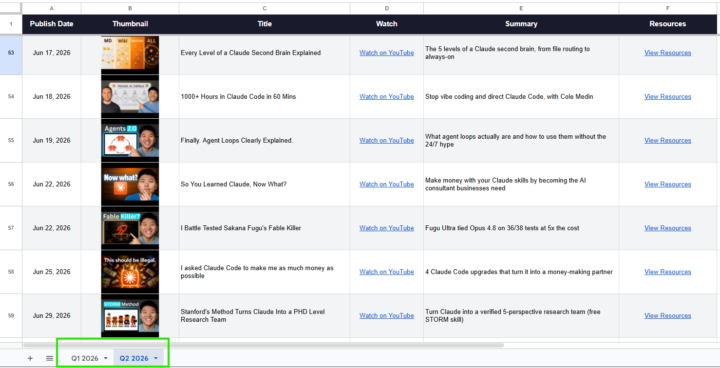
📚 Looking for a YouTube video resource?
Hey everyone, I built a Google Sheet that has every video I've published in 2026 along with the links to all resources, tools, and files mentioned in each one. If you're ever looking for something I referenced in a video, start here: 📌 YouTube Video Database This will get updated as new videos drop. Bookmark it. Check the tabs at the bottom to make sure you're on the right sheet. - Nate

9m •
Multiagent Systems
Hi everyone, I'm trying to understand the best way to set up multi-agent systems and would love to hear how you do it. Mainly on structure and orchestration, I'm torn between two models: 1. One main agent that directly controls subagents, so a single layer. 2. One main agent that coordinates several full agents in their own sessions, which in turn have their own subagents, so a nested setup. What do you use in practice, and when is each one better? And how do you handle the orchestration itself (handing off tasks, sharing context, collecting results)? On tooling: do you keep everything in Claude (Claude Code, Agent SDK), or bring in external orchestrators? I often hear n8n, LangGraph, CrewAI and Claude Flow, but I'm not sure what people actually use and for what. Thanks for any tips!

1h •
When an AI agent gives you a result that feels
When an AI agent gives you a result that feels like magic, don't just celebrate, capture the recipe. The single output is worthless if you can't recreate it. I learned this the hard way after spending an hour getting a Claude agent to produce the exact kind of analysis I wanted. I was thrilled, until I tried to run the same prompt again and got something completely different. The fix was simple: I asked the agent to "write me the system prompt that would create this exact response." It produced a clean, reusable instruction that I saved in my prompts folder. Now every time I iterate and find a good version, I extract the system prompt and store it. Over time you build a library of proven instructions, not just lucky one-offs. You turn random success into a repeatable asset. Next time you get an output that nails it, type: "now write the system prompt that generated this output." Then save that prompt. What's one prompt you wish you had captured?
1-30 of 20,670
skool.com/ai-automation-society
Learn to get paid for AI solutions, regardless of your background.
Leaderboard (30-day)
1

🔥
+7366
2

+5969
3

🔥
+5798
4

🔥
+4532
5

+1314
Powered by