
Pinned

💎
⭐
1d •
🚀New Video: How Anthropic Engineers Actually Prompt Fable 5
Fable 5 is back, and it's the strongest model I've used. It's also expensive and won't stay free on your Claude plan for long, so this video breaks down the six habits I'm using to get the most out of it without burning tokens. Everything from giving it the right context, to matching effort levels, to knowing when it quietly hands your task off to Opus.
Pinned
💎
⭐
30d •
What do you get if you upgrade to AIS+?
Some of you have never heard of the AIS+ community. Others have but the part that trips you up is the actual difference between the two. Either way, this post will give you clarity. This free group is a bundle of quick resources pulled from my YouTube videos, plus a massive open community that anyone can join. It's a great place to get your bearings and see what's possible. But it's open to everyone, it can be noisy and overwhelming, and there's no path through it. You can get help from other members, but I rarely answer questions here. AIS+ is the opposite: - A step by step roadmap with a clear order, so you're never guessing what to do next - A much smaller community of people who are seriously committed to building and selling AI agents - I answer questions every day and run a weekly Q&A call where you can get direct access to me For the course material: The roadmap takes you from zero to building and selling AI agents, and the whole thing is built on the latest tech like Claude Code and Codex. We update it constantly. The old n8n material has been archived. It's still there if you want it, but it's no longer the focus, because the way you build today has moved on and the courses moved with it. Here's the actual roadmap inside, in order, with when each piece opens up: 1. Start Here (opens the moment you join). Gets you oriented. How the community works, the path ahead, and how to get help when you need it. 2. Build Your Portfolio (opens the moment you join). Why a portfolio matters, beginner level tutorials, and what types of projects to focus on. You end up with real work you can show a client. 3. Claude Code (opens the moment you join). This is now its own dedicated course. Build faster, turn ideas into working automations, and go deep on the tool serious builders are using right now. This takes you from beginner to advanced, step-by-step. 4. Get Your First Clients (opens after 30 days). Getting your first clients is hard, because you don’t have any case studies yet. So, we analyzed all of the success stories from our members and found they get their initial clients with two different techniques: warm outreach and Upwork. So, we teach both techniques in detail with exactly what to say, exactly how to position yourself when you have no proof.
Pinned
💎
⭐
Apr 11 •
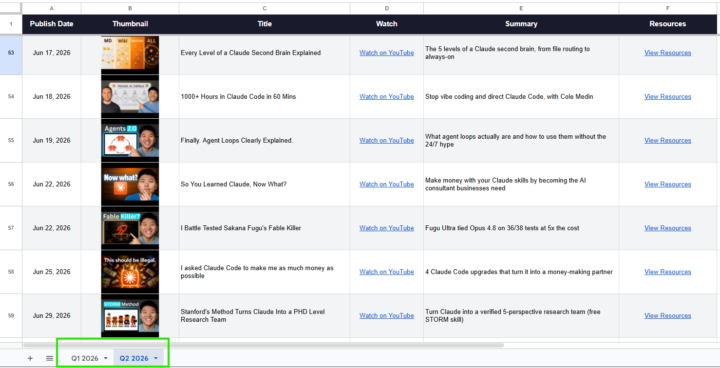
📚 Looking for a YouTube video resource?
Hey everyone, I built a Google Sheet that has every video I've published in 2026 along with the links to all resources, tools, and files mentioned in each one. If you're ever looking for something I referenced in a video, start here: 📌 YouTube Video Database This will get updated as new videos drop. Bookmark it. Check the tabs at the bottom to make sure you're on the right sheet. - Nate

28m •
Claude Fable 5 + AI Skills = Game Changer!
These custom AI skills combined with Claude Fable 5 will improve your productivity and increase performance while reducing your overall credit usage. Enjoy watching!

2h •
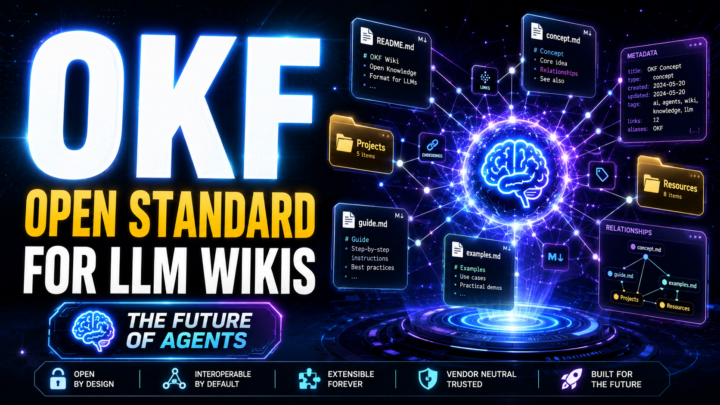
OKF: The Open Standard for LLM Wikis
OKF: The Open Standard for LLM Wikis OKF — Open Knowledge Format is an open standard for organizing LLM Wikis: personal, team, or project knowledge bases designed to be read, maintained, and updated by AI agents. Direct Summary The idea is simple: instead of dumping loose documents into a RAG system, you create a structured wiki in Markdown, with organized pages, links between concepts, entities, summaries, and metadata. With this structure, the AI agent does more than search documents. It reads, understands, extracts important information, and integrates that knowledge into a living system that can evolve over time. The problem is that everyone builds their wiki differently. One person uses one folder structure, another uses a different one. Field names change. Metadata changes. Links between pages change. This makes it harder to share knowledge bases across agents, teams, and systems. OKF solves this by creating a simple standard for organizing these wikis. It mainly defines two things: 1. How files and folders should be organized. 2. Which metadata fields should appear at the top of each document. The most important field is type, which identifies the kind of content: concept, video, entity, note, decision, resource, project, and so on. Other fields may include title, tags, relationships with other content, links, related videos, and connections between concepts. The Big Advantage OKF allows different agents to understand knowledge bases created by other people or teams. This opens the door to: - a more organized personal second brain; - shareable knowledge bases; - team wikis; - knowledge packages from content creators; - agents that navigate concepts more accurately; - better integration with Markdown, Obsidian, Notion, GitHub, and coding agents; - reuse of knowledge across different projects. n practice, OKF tries to do for knowledge bases what standards like MCP do for tools: create a common way for systems to communicate. The agent no longer depends on a random structure. Instead, it can find information inside a predictable organization.
1-30 of 20,693
skool.com/ai-automation-society
Learn to get paid for AI solutions, regardless of your background.
Leaderboard (30-day)
1

🔥
+7372
2

+5936
3

🔥
+5816
4

🔥
+4641
5

🔥
+1315
Powered by