
Pinned

💎
⭐
12h •
🚀New Video: I Tried 100+ Claude Code Skills. These 6 Are The Best.
After 400 hours in Claude Code, I noticed that businesses keep paying for the same six types of skills. In this video, I break down each one, what it does, and why these simple, boring skills are the ones that actually sell. Whether you're brand new to AI automations or already building for clients, these are the skills worth learning first.
Pinned
💎
⭐
3d •
🚀New Video: Build & Sell Claude Code Operating Systems (2+ Hour Course)
This is the full walkthrough of how I build my AI Operating System inside Claude Code, from the frameworks I use to think about it (the Three Ms and the Four Cs) to the actual setup, connections, skills, and routines that run while I sleep. By the end you'll know exactly how to set up your own AIOS, even if you've never opened Claude Code before. The full template, docs, and resources are free in my school community linked below. GITHUB REPO
Pinned

🔥
2d •
🏆 Community Wins Recap | Apr 25 – May 1
From AI roles and first clients to live receptionist systems and enterprise training deals - this week inside AIS+ showed what happens when builders stop watching and start executing. 🚀 Standout Wins of the Week inside AIS+ 👉 @Griffin Maklansky went from being laid off to landing an AI Workflow Builder role in just 1 month. 👉 @Ahmed Bin Faisal landed another $2,000 USD client — an interior design firm — and broke down exactly what led to the close 👉 @Narsis Amin built a working AI restaurant receptionist handling bookings, availability, and CRM logging end-to-end. 👉 @Josh Holladay closed a $4.5K (+$1K) client with half up front today — and dropped his top 10 lessons from the close 👉 @Dion Wang received his first official testimonial, validating real client impact and around 40 hours/month saved. 🎥 Super Win Spotlight | @Duy Nguyen Duy started as an engineer who was curious about AI — but unsure how to turn that curiosity into something real. After joining AIS+, he went from learning passively to building his own AI-operated business, Sharper Automations. Since then, he has: • Built a 24-agent AI business operating system • Landed 2 local paying clients through word-of-mouth • Created a system that improves itself weekly through feedback loops • Started moving toward his goal of leaving his corporate job His biggest shift? From “Can I really do this?” → to building a real business around AI automation.


🔥
9h •
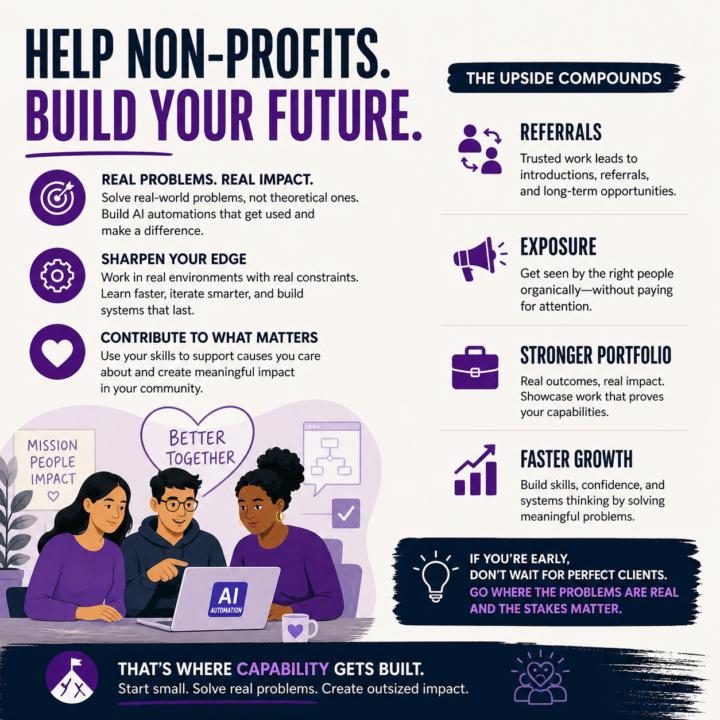
Build Your Skills: Helping Non-Profits
Helping non-profits is one of the smartest ways to start in AI automation. You get real-world problems to solve, not theoretical ones. You sharpen your execution, build systems that actually get used, and learn what breaks outside of controlled environments. At the same time, you’re contributing to something that matters. The upside compounds: - Stronger portfolio with real outcomes - Referrals from trusted networks - Exposure without paid acquisition - Faster skill development under real constraints If you’re early, don’t wait for perfect clients. Go where the problems are real and the stakes matter. That’s where capability gets built.

18h •
You don't realize this until it's too late.
Here's the most annoying thing I had to deal with when it comes to n8n: scraping data. And I'm not talking about 10 items or even 100. I'm talking about scraping 33,000 zip codes in the US. Now when I first received this project, I thought easy peasy. Use Apify, connect it with n8n and start scraping, right? How wrong I was. To lay out the scene. I built an entire system of 20 flows to scrape the data, clean it, process it, and deliver it in email form to the client. And it was working when I was scraping at a low volume. But once we increased it? Well, take a look at this. If you didn't know, each node in n8n will hold all the data until the entire flow is done. So when I brought in 1,000 rows of zip codes, that meant that every single node held 1,000 items in memory. But it got worse. For every zip code we could get anything from 10 results to 1,000 results. I should mention that we were not holding back at this point, because we were scraping all the details of every single business. So the first flow was holding at times 100,000 items in every single node, which meant that we ended up with so much data that my client's entire n8n would tank. So not knowing any better, I figured, well, let's lower the volume until it works. We kept lowering it, I redesigned the entire system until we could run 100 items each run. Which worked fine. Until he decided that he wanted to add another scraper for Instagram. I'll spare you the details on this one. But long story short, having two massive scrapers was not a good idea, and we could only run one full system at a time. After some deep digging into the issue and how to fix it, I soon realized that n8n is not built for this large-scale scraping. And even if you decided to upgrade to the best server available. It would have made no difference, and queuing with Redis would not have helped either. I mean, I had already created my own queuing system inside his cloud. The lesson I learned: use n8n for simple things, because it was not meant to handle large amounts of data. Think of n8n like Zapier or Airtable. You wouldn't try to scrape data with Zapier. So the better option is to use code, something like Python for example.
1-30 of 16,284

skool.com/ai-automation-society
Learn to get paid for AI solutions, regardless of your background.
Leaderboard (30-day)
1

+5682
2

🔥
+4445
3

+3949
4

+2283
5

+887
Powered by