Activity
Mon
Wed
Fri
Sun
Jun
Jul
Aug
Sep
Oct
Nov
Dec
Jan
Feb
Mar
Apr
What is this?
Less
More
Memberships
Clief Notes
25.3k members • Free
42 contributions to Clief Notes

2h •
Excerpt from a video essay inspired by Jake and the Eduba team I thought some may find valuable.
obviously when you hear the rewrite it wont be ai slop, but i thought having the idea laid out in this way was helpful: I'd been fighting with an image workflow for 12 hours. I had these images. Consistent. Striking. *Exactly* the aesthetic I'd been chasing. They came from a single session with Gemini — and I knew they worked. I just couldn't figure out *why* they worked. No problem, I'll just have my agents extract the style and we'll be good. *It was ass*. So I did what I had always done: Sent Violet to the files. Had Violet read the code. She even inspected the tokens. We reverse-engineered the style from the output. *Voila.* It was still ass. The more I studied the implementation, the less I understood the decision. The style wasn't *in* the code. *It wasn't in the folder I'd been told to look in.* So I went back to the session that made the images and asked one question: *"If I wanted the same stylistic output, what would I prompt you?"* And Gemini answered. Decomposed the whole thing into five layers — geometry, substrate, atmosphere, luminance, optics. The prompt wasn't a feeling. It was a formula. It *was* the intent. Every artistic decision mapped to a controllable parameter. What looked like intuition was actually architecture. It just lived somewhere I hadn't thought to look. **I had routed *myself* to the wrong layer.** And the moment I realized that, my first thought was: *can I systematize this so I don't have to stumble into it again?* Which — I realized immediately— was me doing the exact same thing again. Trying to automate my way around the fact that I had to *feel* the misalignment before I could name it. ---------------------------------------------------------------------------------------------------------------------------------------------------------------------- Hopefully you guys can abstract some sort of meaning from this nonsense, the actual essay is geared more towards philosophy, but I have a pretty big section in it that tries to break down the ICM process in an easier way to understand - helping *you* route yourself to the right layer! :)
0 likes • 40m
@Michael Steve brother it gets meaty, I didn't wanna spoil the sauce tho it's gotta simmer a lil longer
0 likes • 6m
@Kay K bahaha I appreciate you, this example wasn't recent though xD I've been playing with comfyui for a while now. Great tool!

21h •
Best Practices for Managing Separate CLAUDE.md Files Across Workspaces
Do you keep separate CLAUDE md files for each workspace to prevent them from becoming too long or unfocused? For example, would you maintain one CLAUDE md for a Content Creator workspace and another for a Software Developer workspace? If so, how do you handle situations where the work overlaps between workspaces? For instance, if the Software Developer workspace creates a new app, but then you want the Content Creator workspace to write a social media post promoting that app, where should the shared context live? Curious how others structure this in practice.
0 likes • 2h
@Joel Mastrian I mean technically if you just want the one workspace in the one folder the claude.md just points to itself so you wouldnt even need it lol xD
0 likes • 2h
@Joel Mastrian Build the thinnest possible version of your workflow first and route it alongside your agent auditing every step making sure that each routing point is the correct layer

5d •
From PDF to gorgeous book
Wanted to share this project i got super focused once i reached implementation 3.0— I had claude code help finish my book that bridges anatomy through the lens of Thomas Myers’ work and Traditional Chinese Medicine. It’s fully written, organized, but also through what i learned here, i had a separate project to build anatomy images to include illustrated detailed body alignment images from energy line system. This has been a passion project that ties directly into my yoga and movement philosophy — that movement is primary food and that the body speaks a language we’re only beginning to understand. Here’s the link for a the PDF: https://www.dropbox.com/scl/fi/fube1wf0l53azoyt0h4a8/JDM-Book-Minimal-LightCover.pdf?rlkey=zedmk3v2tb88qcnxkggo2olrx&st=b007apwj&dl=0 @Jake Van Clief i can’t express how grateful i am to what you share. I know i put the time in the chair to view implement and research further But your approach ensured i started from the best place and think organizational Thank you
2 likes • 2d
@Gabriel Azoulay i got out of that cult bro dont worry xD that's awesome, great to see someone else physio adjacent in the group! god bless brotha
1 like • 6h
@Oyekanmi Oladapo always good brotha whats happenin king
17h •
Creator of SpaceAgent on David Ondrej built it entirely with the ICM Mental Model.
https://www.youtube.com/watch?v=F3ZzNgf-R7Y Great watch, his implementation is slightly different, but his mental model is right in line with ICM. He explains his process at 33:20
1
0

20h •
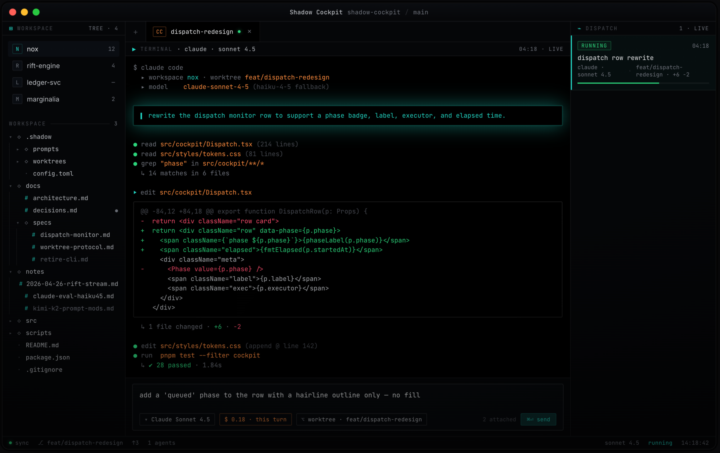
The orchestrator seat: I stopped letting Claude code and got it to delegate.
Most people use AI coding agents the same way. Open one chat, type, watch it work, copy the output. The model is doing both the thinking and the typing. That's the bottleneck. The interesting move is splitting those two roles. One model holds the judgment. Other models do the typing. The judgment seat never touches a file. The typing seat never makes a decision. I call this the orchestrator pattern. If you've been here a while You'll have seen me developing a system for dispatching workers from within a single Claude Code session. Briefs going out, workers running in the background, results coming back to one main seat without me ever switching windows. I've been running it for months. I just open-sourced the harness. What it does Pushing Dispatch is a multi-model dispatch framework for AI coding agents. You sit in one Claude Code session as the orchestrator. From there, you write briefs and dispatch workers. Workers run in the background on whichever model fits the task. Opus for hard reasoning. Sonnet for steady execution. Haiku for mechanical sweeps. Kimi for long-context. DeepSeek for cheap parallelism. One harness. Many models. One judgment seat. How I use it Three patterns: Brief and dispatch. I write a brief in the orchestrator session, hand it to a worker, and don't read code while the worker runs. I review the output when it's done. Parallel fan-out. When ten files need the same kind of edit, I dispatch ten workers and review all diffs in one pass. Long-context to Kimi. When something needs the model to hold a hundred-thousand-token codebase in working memory, the brief routes to Kimi automatically. The point is never to type the code myself, and never to do the same kind of thinking twice. Quick start Paste this into a fresh Claude Code session: ———————————————————————————————————— Read SETUP_WITH_CLAUDE.md from https://github.com/PUSHINGSQUARES/Pushing-Dispatch_ and walk me through setup end to end.
1 like • 18h
this is insanely based
1-10 of 42
Online now
Joined Mar 17, 2026
Powered by