Activity
Mon
Wed
Fri
Sun
Jul
Aug
Sep
Oct
Nov
Dec
Jan
Feb
Mar
Apr
May
What is this?
Less
More
Memberships
Lucidium Executive AI Strategy
72 members • Free
6 contributions to Lucidium Executive AI Strategy

Nov '25 •
Validating your product before scaling — and why it’s important.
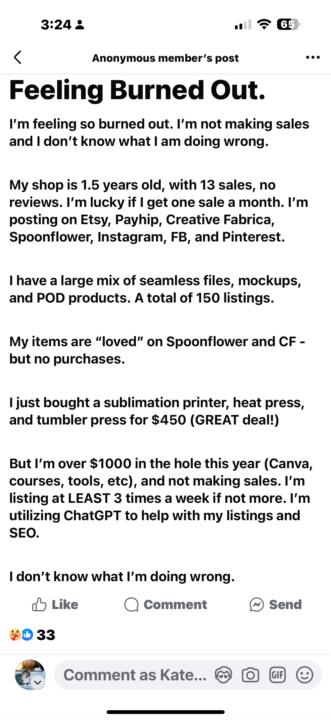
I came across a post on Facebook today where the poster had an unsuccessful Etsy shop and was burnt out making little to no sales or profit. After reading their post I realized a couple of things: 1. They scaled before they validated their products. They are over $1,000 in the hole because they bought a ton of equipment before they tested or researched their market. 2. They do not have a marketing plan or brand identity. 3. They have received sales, meaning there is demand, but lack the mindset to take advantage of it. Here was my advice to them: “This is common for the start of a business. Most businesses don't see profit in the first 2-5 years. It's a really slow grind, especially as an artist in a saturated market. The most important thing is consistency. Don't scale any further, you need to validate your current products. Making new patterns is fine, but don't focus on it. You have enough for now. Make sure you post on social media several times a week(consistency > quality), and maybe do some cold sales via email and DMs, and product plugs in discussions if you're brave enough. The fact that you have some sales tells me that there is demand for your products and that's a great place to be. One major thing I see businesses struggle with in their first year is they do not know their audience and their pain points. I'd ask the following questions: 1. What is my art style? 2. Who would be interested in my art style? 3. What are common applications for said style? 4. What problem could my audience have that I can solve with my product/service? 5. How can I implement and market that solution? What I'd do is give ChatGPT the link to your shop and ask it these 5 questions. Then have it locate 3-4 other shops with high sales within your market and breakdown what they are doing that is driving success. From that you can create a brand identity, a marketing plan, and a 1-year growth plan. Once your shift your mindset into a more business-focused one, you'll likely see more success.”

0 likes • Nov '25
Yep and as a start up, expect to work many many hours per week because you may need a small day job to fund those first 2-5 years. To me 1000 in the hole is a small investment for big gains if you keep pushing and don't give up. Once you have the basics for production, a lot of the work is branding, posting, engaging etc which can definitely be simplified/exemplified with good prompts that help you gain traction. You have to experiment with what vibe makes you uniquely successful in your industry by just trying new formats and styles. Maximum effort = maximum success
Sep '25 •
Nuance in Human–AI Communication - Section 1: "What is Nuance?" Discussion
We just went over how small word choices change the entire meaning of your copy. Now I want to hear from you: - Have you ever seen a business use wording that made them sound cheap, fake, or untrustworthy? - Or on the flip side, have you seen wording that made you instantly trust them? - Do you remember what they did or said to make you feel that way? Drop an example in the comments: it could be from an ad, an email, or even a store sign you saw. 👉 This is where we start training our eyes for nuance. The more you notice it in the world, the easier it gets to apply it in your own business.
1 like • Oct '25
"Nationwide is on your side" I have always thought that was a TERRIBLE pitch because it makes the customer remember that insurance is never on the insured's side 😂 don't remind your audience of the flaws of your industry 🤦
0 likes • Oct '25
@Katerina DiFatta It is so catchy that I could see people trying to think of companies to get a quote from and they will definitely come to mind
Oct '25 •
AI in Major Advertising Part II: Recognizing Common AI Sentence Structure
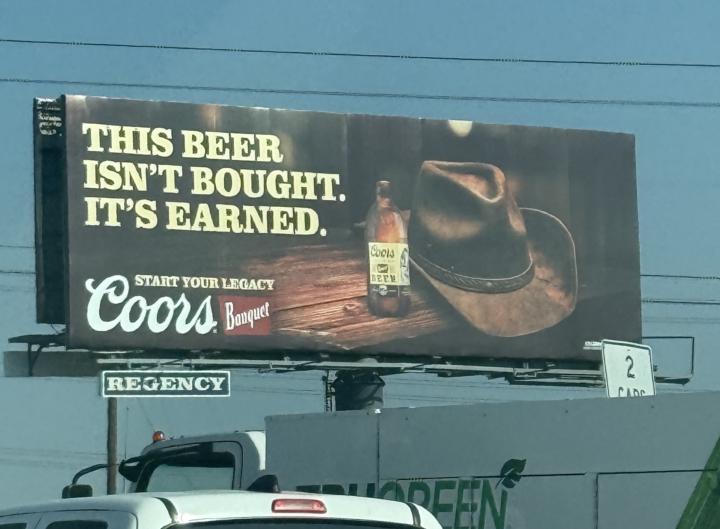
Today we’re looking at how major advertising now mirrors the same sentence structures that AI is famous for. Take this Coors billboard: “THIS BEER ISN’T BOUGHT. IT’S EARNED.” At first glance, you might not think much of it. Look closer, and you’ll see the exact same structure that ChatGPT or another AI might generate if you asked it for a “strong, motivational beer slogan.” Here are the reasons I believe this is AI-written copy. 1. Parallel Sentence Structure: The core message here is that Coors “Isn’t bought, It’s earned”. This is a perfectly mirrored contrast. AI loves this because it’s mathematically simple, easy to process, and rhythmic. 2. Generic Contrast: The line sets up a binary: “not this, but that”. This is a formula AI defaults to constantly because contrast creates drama without adding in detail. • Example: “This is not just a tool, but a revolution.” While this is a good writing structure to use in many cases, it’s over-use is becoming the most common tell-tale sign of AI usage, apart from the em-dash(—). 3. Motivational Lexicon: The word “earned” is emotionally charged but vague. AI tends to lean on “earned, legacy, elevate, empower, experience, discover” — all words that trigger feelings without specifics. These words don’t tie directly to anything. you could swap the product out and the slogan would still work: • “This car isn’t bought. It’s earned.” • “This job isn’t given. It’s earned.” That flexibility makes the line sound powerful, but also generic. This is exactly how AI writes: it leans on universal words like “earned,” “legacy,” “empower,” or “discover” that can fit almost anything, but don’t say much about the specific product. 4. Lack of Human Detail: Nothing in the line tells you why Coors specifically is “earned.” There’s no mention of brewing, ingredients or history, just broad phrasing. What exactly do they mean, and how does that benefit the consumer? AI speech is persuasive but often hollow and lacking relevance to the product and audience.
0 likes • Oct '25
Thats a great example of how a two sentence ad can make a big impact to a large audience and food for thought on how to promt AI to get those powerful statments.
Oct '25 •
🧠 What I Learned from Testing AI-Generated Video Content So Far
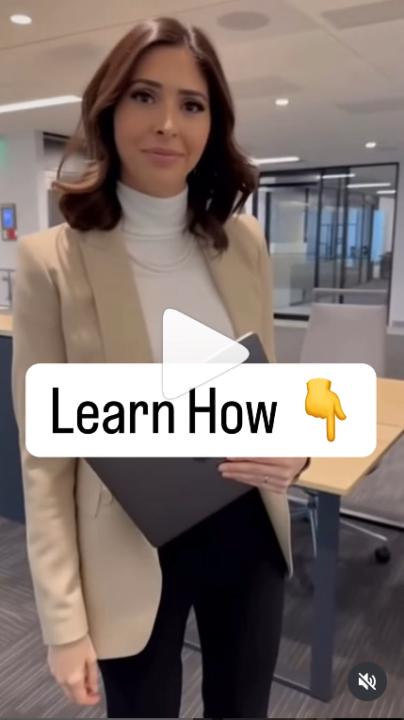
This week I ran an experiment: I started posting almost 100% AI-generated videos to brand-new accounts. Each video takes about five minutes to make using Sora 2 and ChatGPT for captions. The results: Pretty average — around an 8% like-to-view ratio, which is standard for marketing-style content, but the difference is time. At five minutes per video, even “average” engagement becomes really good ROI. Here’s what I’ve noticed so far 👇 - Relatable content still wins. Videos about the headaches of running a business do better than ones about success. People connect with what they’ve lived through — not what they envy. - Your audience mirrors what they see. When I use a 30-something female character with a modern office vibe, the audience skews toward people who look like her, dress like her, or strive to be her. It’s a reminder that visuals are a form of targeting — people are drawn to reflections of themselves. Representation shapes your audience. Be intentional about who appears on screen. - Music choice and vibe matter a lot. The more upbeat the song and faster the pacing, the higher the engagement. The tone and rhythm of a video often matter more than its message to keep your audience engaged. People feel your content before they think about it. - CTA Matters for conversion. Even the best visuals and storytelling fall flat if your call to action isn’t clear. Viewers shouldn’t have to guess what to do next, you have to tell them. “Learn how below”, “Visit >website< to start,” or “Message for more information” — it all works when it’s direct. Key Takeaway: AI hasn’t changed what works marketing, it just saves us time and allows for more testing. There's no filming and almost no editing, but the core principles haven’t moved an inch: - Relatability - Representation - Energy - Clarity That’s what connects with people — not the tool you used to make it. So if you’ve been holding off on creating because you think it has to be perfect, it doesn’t.
0 likes • Oct '25
Great insights!
Aug '25 •
What is AI: Lesson 1 is Now Live!
Good evening everyone! I just uploaded the video content for Module 1: What is AI? lesson 1. I'll have the text portion of the lesson up tomorrow. This lesson is intended to be a beginner-friendly introduction to AI where we cover the big picture: - A definition of AI - The difference between traditional software and AI - The three main types of AI - AI’s biggest strengths — and its limitations This is the foundation for everything we’ll build on in future lessons, so I’d love your feedback: - Was this lesson clear and beginner-friendly? - Did it help you see AI in a new way? - What questions came up for you while watching? Thank you for being here and have a wonderful night! :)
1 like • Aug '25
Excellent description of how traditional software differs from AI
1-6 of 6

@tabby-charmere-8623
Dream it, do it. ❤️ Everyone has a destiny, find yours make it happen.
Active 58d ago
Joined Aug 26, 2025