Activity
Mon
Wed
Fri
Sun
Jun
Jul
Aug
Sep
Oct
Nov
Dec
Jan
Feb
Mar
Apr
What is this?
Less
More
Memberships
Research Career Club
665 members • Free
31 contributions to Research Career Club
14d •
Micro-publications - update
If you want to have a look at how Octopus actually looks like, here's the link to my two recently published minute publications. https://www.octopus.ac/publications/yxks-sg07/versions/latest It is a piece of work I've been doing as part of the UKCCSRC project, and I am currently working on the full paper. I thought, let's use it as a template or example for the research community to kind of explore how the entire process works with micropublications. And I just want to test whether the journals will be keen on actually publishing my paper. So I'll be updating everyone as we go along. Here's the link. You can see it does have a DUI number. It links the two papers so you can clearly see how the output is shaping up. Let me know whether that is helpful.

1 like • 13d
Excellent work and Really insightful example Dr. @Dawid Hanak . One question that comes to mind is how interlinked components handle citation at the submission stage, particularly if DOIs haven’t yet been assigned. It feels like a key challenge when aligning micropublications with conventional journal processes.
2 likes • 13d
@Dawid Hanak I am going to work on CO2 conversion modeling research and if the results of your investigation are positive, I would like to try this method. Thanks
13d •
Feeling like a fraud in your PhD or academic job even when everyone says you’re “doing fine”?
You’re not alone. Scroll through Reddit and you’ll see thousands of researchers quietly burning out while telling themselves they’re just “lazy” or “not smart enough.” The reality: you’re running marathon effort on sprint expectations. That’s not a personal flaw. That’s a broken culture. In my 15 years in academia and 70+ papers, the one thing I wish I knew earlier is this: impostor syndrome rarely disappears, but you can stop it from driving the car. Here’s what I recommend: 1. Set a minimum viable day: 30–60 minutes of deep work on your most important task (methods, results, or revision). Once that’s done, you’ve already had a “successful” day. Everything else is a bonus. 2. Keep an “evidence file”: every acceptance, kind email, positive comment from a supervisor, or good result goes in one document. On bad days, don’t trust your feelings—read your evidence. 3. Reduce hidden expectations: write down what you think your supervisor, examiners, or PI expect from you this month. Then reality-check it with them in one short meeting or email. Most of the time, you’re carrying expectations no one actually asked for. 4. Protect one non‑negotiable boundary: sleep, a weekly day off, or exercise. Burning two extra hours at night is not what gets papers published; consistent, clear-headed work does. If this resonates, don’t try to “fix your whole life” this week. Pick one of these changes, apply it for seven days, and see how your stress shifts. 😊 What’s one small promise you’ll make to yourself this week so impostor syndrome doesn’t run the show? Drop your answer below 👇
2 likes • 13d
I find it very relating, working on the most important tasks and calling it a successful day on bad days, and keeping an evidence file is a strong strategy to help ourselves motivate on the days when we don’t have much motivation to start over. Thanks for the advice, let’s make another productive day!!! #tuesday — Working on CO2 conversion models in ASPEN…
18d •
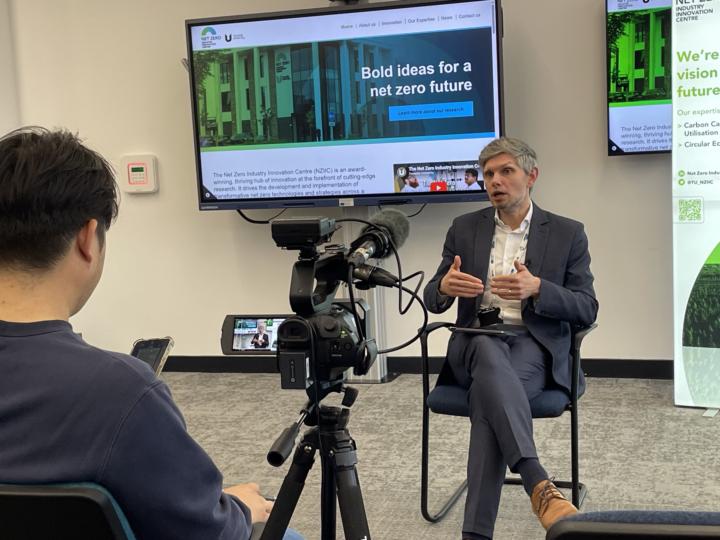
Get your research expertise out there - my recent interview
Yesterday I was interviewed by the Korean Broadcasting System (the BBC equivalent) about Teesside's transition to net zero. [This wouldn't be possible if I only published papers!] If you want to accelerate your academic career, try doing these in addition to publishing your research. 1. Seek external engagement: Publishing academic papers is vital, but stepping outside the academic circles will amplify your impact. Collaborating with media outlets and professional bodies can help showcase your expertise and research to a broader audience. 2. Build an expert brand: Visibility is key. Share your insights on various platforms (i.e. conferences, podcasts, or documentaries). This not only enhances your reputation but also helps position you as a thought leader in your field. 3. Engage with the community: Connect with peers and practitioners outside your usual circles. Networking and sharing your research with those who can benefit from it fosters innovation and collaboration. I apply ALL of this to my life and there is not a single day I am not grateful for keeping my focus on the things that are most important. How do you plan to take your research beyond the academic circles?
1 like • 18d
That’s big media, many congratulations Dr. @Dawid Hanak, Can we see the output, Would love to read/watch the interview discussion.
0 likes • 17d
@Dawid Hanak Looking forward!!
27d •
Alternative publishing practices
If you’re waiting 12+ months for “the right” journal, you’re quietly tanking your visibility, impact and sanity. Here’s a 5‑step publishing process from the attached Knowledge Exchange report you can implement this year – without blowing up your career: 1️⃣ Preprint everything (safely) Post a preprint as soon as a manuscript is coherent. Then submit to your target journal in parallel. You get instant timestamps, citations and feedback, while still playing the conventional game. 2️⃣ Show your peer review trail When given the option, choose transparent or open peer review and link those reports in your CV, website and grant applications. You’re no longer just “counting papers”; you’re evidencing rigour and responsiveness. 3️⃣ Preregister your next study For your next project, preregister hypotheses + analysis plan before data collection. In fields where it’s standard, you gain trust; in others, you instantly differentiate your work on quality, not journal logo. 4️⃣ Treat papers as versions, not monuments Use preprints or repositories to post corrected and updated versions. Own your errors publicly and you signal integrity; hiding them is what actually damages reputation long‑term. 5️⃣ Start modular, low‑risk You don’t need to “move to Octopus” overnight. Begin by sharing one extra module per project: detailed methods, datasets or negative results in an open repository or modular platform. If you implement just steps 1–2 in the next 6 months, your “publishing strategy” stops being: “Hope reviewers are kind and editors are fast” …and starts being: “Make my work visible, citable and obviously rigorous – before the journal decides my fate.”
1 like • 26d
Great piece of information, thanks for sharing Dr. @Dawid Hanak
0 likes • 26d
@Dawid Hanak Yes, and please take your time. Thanks
29d •
What’s your favourite tool to support your research?
We all have our favourite tools that we use in our research. Whether that’s data analytics, referencing, or AI tools. Share which tool you think is absolutely must have for your research and tell us how you use it.
2 likes • 26d
There are always some softwares that make our lives easier, but I must regard their developers; our fellow engineers. To me, I am in awe of ANSYS softwares brilliance to handle big simulations, SOLIDWORKS for model designing, Mendeley as a reference manager, similarly a Couple Others, last but not least I have been using Google Colab >> Python codes for figure creation and I find it good.
1-10 of 31
Active 4d ago
Joined Aug 25, 2025
Turkiye