

12d •
Which aspects of academic publishing and dissemination do you find most difficult?
Tell me what support do you need to inform the activities in this community.
Poll
10 members have voted
22d •
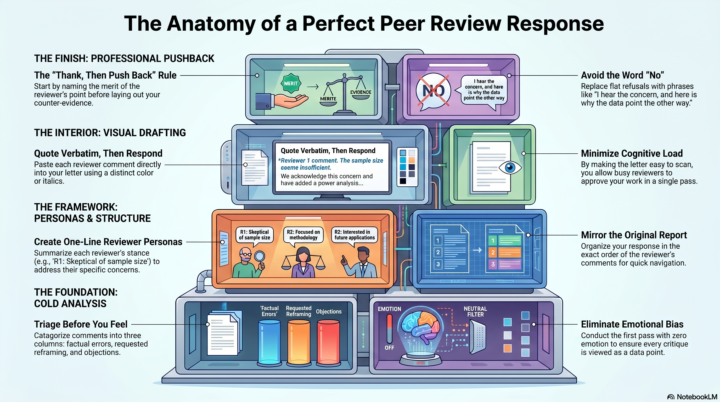
5 steps that cut the time I spend on responses to reviewers for my academic journal submissions from 3 weeks to 4 days.
(Steps 4 and 5 are the ones nobody teaches.) Most researchers treat "major revisions" as a near-rejection. It isn't. It is an invitation to publish, with conditions. Here are the rules I use, and now teach my PhDs and postdocs. 1) Triage before you feel Open the decision letter and make three columns: factual errors to fix, reframing the reviewer wants, and objections you will push back on. No emotion on this pass. 2) Write a one-line summary of each reviewer "R1: wants a broader intro, sceptical of the sample size. R2: accepts the contribution, wants tighter results. R3: silent on methods, has issues with our writing." Knowing who each reviewer is before you write the response saves you from arguing with the wrong one. 3) Answer in their order, not yours Reviewers reread their own comments. If your response letter jumps around, they scan for their point and get annoyed when they can't find it. Mirror the structure of the original report. 4) Quote, then respond Paste each reviewer comment verbatim in a different colour or italics. Respond underneath. As journals are short of good reviewers, such an approach will lower their cognitive load, and they can approve your work in a single pass. 5) Thank, then push back When you disagree, open with one sentence that names the merit of the reviewer's point, and then lay out your counter-evidence. Never use flat "no". Use a specific "I hear the concern, and here is why the data point the other way". One paper. Cleaner response letter. Faster turnaround. Save this for your next major revisions letter.
23d •
Micro-publications - update
If you want to have a look at how Octopus actually looks like, here's the link to my two recently published minute publications. https://www.octopus.ac/publications/yxks-sg07/versions/latest It is a piece of work I've been doing as part of the UKCCSRC project, and I am currently working on the full paper. I thought, let's use it as a template or example for the research community to kind of explore how the entire process works with micropublications. And I just want to test whether the journals will be keen on actually publishing my paper. So I'll be updating everyone as we go along. Here's the link. You can see it does have a DUI number. It links the two papers so you can clearly see how the output is shaping up. Let me know whether that is helpful.
25d •
Ask me anything about publishing (weekend edition)!
For the next 48 hours, I will be answering any of your questions that you might have about publishing. So if you have any questions regarding manuscript preparation publication process, how to make sure your work is not rejected by reviewers or editors, how to handle rejection, how to handle peer review. Anything really that is related to writing academic papers, drop your question below in the comments and I’ll make sure I answer.
Apr 10 •
Session Recap: Novelty vs. Originality — What Every Researcher Needs to Know
We just wrapped up today's Q&A and the conversation was brilliant. Thank you to everyone who joined — your questions made it really worthwhile. Here are the key takeaways for anyone who missed it (recording will be up shortly 👇): The difference that trips up most researchers: Originality = you created something yourself, without copying anyone — but someone else may have done the same thing independently. Novelty = your work is objectively new to the world. No one has done it before. Your research can be original without being novel. And that's exactly why reviewers push back. The 2×2 Novelty Framework (a simple way to check your research): 🟢 New solution + Old problem → Valid novelty 🟢 New solution + New problem → Breakthrough / incremental novelty 🟢 Old solution + New problem → Also valid novelty 🔴 Old solution + Old problem → Reinventing the wheel — this is where papers get rejected If you land in the bottom-right box, it's not that your work is bad. It means your lit review hasn't gone deep enough yet. The make-or-break paragraph: The last paragraph of your introduction is where novelty is won or lost. Reviewers read: abstract → last paragraph of intro → conclusions. That's often it. Your novelty statement needs to: 1. Show what others have done (with their limitations) 2. Identify the research gap clearly 3. Explain exactly how your work addresses that gap 4. Do this in one focused paragraph (or tight bullet points) One sentence should be able to capture your novelty. If it takes five, you haven't found it yet. A note on using the word "novel": You don't have to write "this is novel" — and sometimes it's better if you don't. If the gap and solution are clearly stated, the novelty speaks for itself. Saying "we propose a new model" is often enough. 📌 Reminder: We're going deeper at the end of April This was just an intro. Later this month (last week of April), we're running a full ~1 hour session on novelty, originality, and how to write a clear, compelling introduction from start to finish. Don't miss it.

1-30 of 48
powered by

skool.com/research-career-club-8446
Become 'go-to' research expert by delivering novel research; engaging outside academia; and building profile to amplify impact | Created by Prof Hanak
Suggested communities
Powered by