

27d •
Get your research expertise out there - my recent interview
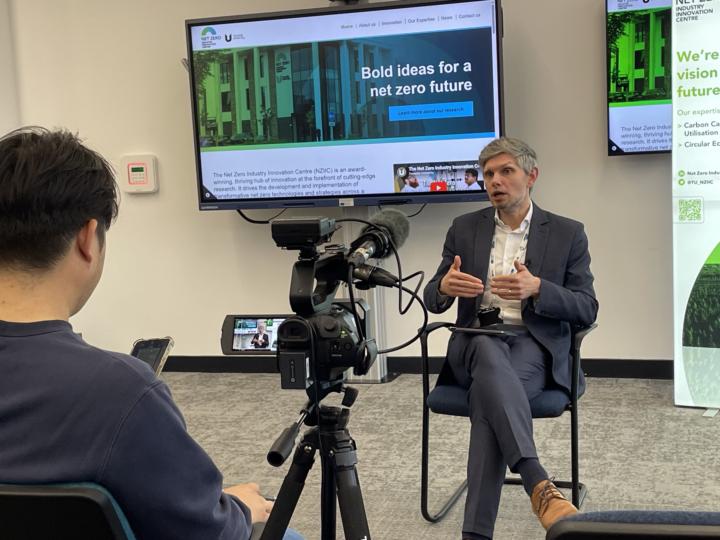
Yesterday I was interviewed by the Korean Broadcasting System (the BBC equivalent) about Teesside's transition to net zero. [This wouldn't be possible if I only published papers!] If you want to accelerate your academic career, try doing these in addition to publishing your research. 1. Seek external engagement: Publishing academic papers is vital, but stepping outside the academic circles will amplify your impact. Collaborating with media outlets and professional bodies can help showcase your expertise and research to a broader audience. 2. Build an expert brand: Visibility is key. Share your insights on various platforms (i.e. conferences, podcasts, or documentaries). This not only enhances your reputation but also helps position you as a thought leader in your field. 3. Engage with the community: Connect with peers and practitioners outside your usual circles. Networking and sharing your research with those who can benefit from it fosters innovation and collaboration. I apply ALL of this to my life and there is not a single day I am not grateful for keeping my focus on the things that are most important. How do you plan to take your research beyond the academic circles?
29d •
Industrial decarb webinar
The main idea behind this community is to give you practical tools for publishing and for building your visibility as researchers. And because I'm not just talking about this, but I'm actually walking the walk of building that visibility myself, I thought I would give you a practical example of how you can share your research via webinars by inviting you to one of my webinars next week on Wednesday, the 22nd of April. I'm going to share some insights from my recent research on decarbonising the transport sector. So what we're going to talk about in that webinar is the different decarbonization pathways based on the Tees Valley case study, where we're going to explain electrification, hydrogen, whole-system cost analysis, and many, many more details. If you're up for it, here's the registration link. It's free to sign up. https://book.drhanak.com/industrial-decarb P.S. Feel free to share your published papers/presentations with the community - you never know what collabs it could generate.
Apr 9 •
Publishing is slow. Visibility doesn’t have to be.
You don’t need a full content strategy or perfect branding to start sharing your research. You just need one clear message, one simple post, and the courage to hit “publish” even if it feels imperfect. Today, pick ONE recent output (paper, slide, figure, or review comment) and turn it into a 3‑line post: 1. What problem you tackled 2. One practical insight 3. Who this matters for (and why) Then share it on LinkedIn, ResearchGate or here in the community. You’re not “self‑promoting” — you’re making your work easier to find for the people who need it. What’s the one insight you could turn into a 3‑line post today? Drop your answer below 👇 Talk soon, Dawid P.S. If you want, paste your 3‑line draft in the comments and I’ll give you feedback.
Apr 12 •
Here’s a 5‑minute daily routine to share your research without stealing time from research:
Block 5 minutes after you open your email or before you close your laptop. That tiny consistency beats one “perfect” post you never publish. 1. Pick ONE micro‑update What changed today? A figure fixed, a review received, a new idea from a paper. One sentence only. 2. Add the “so what?” in plain language Write one extra sentence: “This matters because…” as if you were explaining it to a smart friend outside your field. 3. Choose a simple format Turn it into either: – A 3–4 line LinkedIn post, or – A short comment under someone else’s post on a related topic. 4. Attach or link once a week Once per week, attach a PDF (or accepted version) of one paper or link to your preprint and repeat steps 1–3. That’s how you turn papers into content without extra work. 5. Stop after 5 minutes The goal is to build a habit, not a second job. Two to three posts a week are enough to grow your academic visibility over time. Try this for the next 7 days with your current project and notice what becomes easier to share.

Mar 27 •
The AI Skills Audit: Future-Proofing Your Career in the Next 5 Years
Hello everyone Since our session on ethical AI use in research didn’t happen, here’s something you might still find valuable: “The AI Skills Audit: Future-Proofing Your Career in the Next 5 Years” Happening in almost 2 hours (It says Limited tickets though) If you're thinking about how AI fits into your career, this could be worth attending. Grab a spot if you can! https://www.eventbrite.co.uk/e/the-ai-skills-audit-future-proofing-your-career-in-the-next-5-years-tickets-1982685271018?keep_tld=true Regards
1-30 of 34
powered by
skool.com/research-career-club-8446
Become 'go-to' research expert by delivering novel research; engaging outside academia; and building profile to amplify impact | Created by Prof Hanak
Suggested communities
Powered by