Activity
Mon
Wed
Fri
Sun
Jun
Jul
Aug
Sep
Oct
Nov
Dec
Jan
Feb
Mar
Apr
May
What is this?
Less
More
Owned by Peter
Memberships
Clief Notes
27.8k members • Free
9 contributions to Clief Notes

9d •
The stack that works for me
There are two skills in Claude that I use over everything else that have been really successful for me. I love the folder system here and I use something similar just to keep things organized. As I'm sure most people have heard of Superpowers and I think it's good to a point. Superpowers is good at brainstorming and asking me the questions I didn't consider but it's bad on execution. That's where GSD or Get Shit Done comes in. It can take the plan from Superpowers, break it down into Phases and Waves and then you verify at every checkpoint to make sure a certain feature works. This effectively allows me to "one-shot" apps and make sure it works along the way. The part of the stack that I don't have nailed down yet (leaning into my cyber security background a bit) is security and just trying to make sure we cover stuff like prompt/code injection for example. Does anyone else have a similar stack or different process?

0 likes • 2d
@David Vogel This is great. I have not figured it all out yet, but I keep thinking about something - If you really want to get the most out of AI, it helps to remember basic project management 101. Human staff work best when you give them a set playbook for a project with tasks, sub-tasks, etc -- project management 101. Similarly - with AI- the "project management" scaffolding - the claude.md in the root folder - must be crystal clear first. This kind of ignores the time element like gantt charts and deadlines. But interesting to ponder the connections.

5d •
I was asked about my process: I didn't hire 3 teams. I built an architecture :)
On April 10 I was trying to clean up my Instagram.Tighten the cover graphics. Build a repeatable system. Stop redesigning the same template every week. A one-afternoon job. What actually happened was the first real test of an architecture I had been sketching for writing work — and I tested it on design. I built a sandbox, gave it a governing file, separated references from working material, wrote one clean brief… and let it run. Fifty covers came back in minutes. Same palette. Same typography. Same visual language. None off-brand. That was the moment something shifted. Not because of the output — but because of what it proved: Once an architecture is clear enough, the question is no longer “what can I delegate?”It becomes “what is now worth building?” In 21 days, that small test turned into: - Three working teams (orchestrator, content, design) - Four books shipped or shippable - A new website - Two additional teams already scoped Same operator. Same hours in the day. For those who asked about mindset and process — this is the real answer: 1. I stopped thinking in prompts and started thinking in systems.The model is not the asset. The structure around it is. 2. I separated thinking from doing.The orchestrator doesn’t write. It reads, structures, briefs, and validates.The workers execute. They don’t improvise outside their lane. 3. Everything moves through briefs.No direct “do this” requests. Every handoff is:task → context → scope → acceptance → return checklist.That alone removed most iteration cycles. 4. Context is layered, not dumped.Reference material lives separately from working material.The model doesn’t have to “figure out what matters” — it’s already decided. 5. The human sits outside the system.Not inside prompting.Outside — validating outputs and deciding what ships. The clearest proof this wasn’t theory came from the hardest task I’ve ever tried to coordinate: Mapping TCM meridians, Thai Sen lines, and Anatomy Trains on the human body — in one consistent visual language.
1 like • 4d
@Emmanuel Voke What I realized is that claude must know explicitly that you have project-agnostic folders/plugins that are control/execution, and client-specific folders that are full of outputs and data about the client...That was the first real ah-ha moment for me. These two areas project/client-agnostic control center and client-specifc files in which mostly the client data exists must be COMPLETELY separate areas--and Claude must follow this absolutely... This is all getting better now, because I know the root issue was poor folder management, but drift, hallucinations was a big problem in the beginning. About re-prompting -- yes, I had to re-prompt and then add explicit restrictions/constraints into almost every prompt, eg. about things like context bloat "tell me if this session is getting overloaded" because claude cowork will just keep going until the chat session compresses, which leads to drift, hallucination, and mistakes... or when I asked to update something related to an output, it would say "sure, I'll save this" then just put the udpated instructions only in the chat memory, instead of asking if I wanted to update the plugin itself (the client-agnostic, doctrinal source of truth for execution)... lots of things like that are solved with ICM. Some of these were just newbie mistakes, but I'm still learning... The ICM folder-management-as-workflow concept solves all this prompting stress...
0 likes • 2d
@Emmanuel Voke I first made this division inside cowork by drilling it into claude through chat sessions all the time. It definitely helped a lot, but made me wonder why claude was so sloppy if I didn't rant all the time about the difference between client-agnostic execution and client-specific data....Then ICM made me realize that this divide between data and execution should simply be a function of the folder structure itself. And that's actually what sold me.

4d •
First Big Win! First client is signed
Signed before the tool is finished. Signed before the new company is even incorporated. I'm building a Marketing Stack for my SaaS company and before I was finished with Phase 1 of the seven planned phases I was thinking about several people who had talked to me recently about their pain in the same area. Made the call, explained the idea, addressed their pain, and signed the deal. If you approach what your are building as a system that can be deeply customized for each user, then you have a product that people will want. Build it to solve your problem but remember that the customization, the personalization, the flexibility, and the agility of what we can build with AI as the newest abstraction layer of software development is what makes what we are doing here better than what SaaS can do. SaaS is a cookie cutter template that the r has to cram themselves into. What we can build is deeply personalized software solutions.

0 likes • 4d
well done that man!!

5d •
Win! Getting the go ahead to rebuild our website
Wanted to share that today my boss came to me and asked seriously "Is this really possible?" and I was able to confidently say absolutely and we can make it whatever we want. Probably gonna be some discussions about what needs to go on the website but really happy that after last week's proof of concept website we're actually gonna move forward on our branding, nice end of the week
1 like • 5d
congrats!!
0 likes • 5d
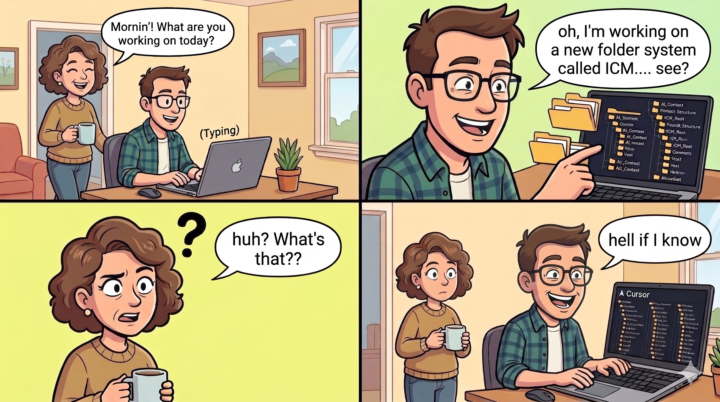
@Carl Gutierrez I'm working on it... I already have a content creation system I built inside of cowork, but realized that I was letting the actual core - the folder structure - stay hidden in the background, and that's what caused my problems. to be clear, claude did a great job doing this on my local folder, and inside the claude folder, but there were these minor errros that came up a lot, about 10% of the time. Because for me this is not a drill, I actually have clients to whom I need to ship excellent content, this was a huge stressball. So working hard to get the folder structure setup in a way that I know exactly what's going on. I'm a marketer by trade, not a dev or coder, so it's a bit of a learning curve for me, moving to cursor and managing an IDE.... Work in progress, but getting more understanding everyday.....How about you?
0 likes • 5d
I guess I'm old enough to have one thing on my side mentally, I'm well aware that the chaos and overwhelm at the beginning of a learning curve is completely normal. Might as well enjoy the ride and laugh a little when it gets a bit overwhelming.....it helps to not be impressed with overwhelm, it's all part of the journey. You'll break through it soon enough...
1-9 of 9

@peter-smith-2684
Korea-focused marketing specialist. Naver & Kakao. Verticals: Tourism & hospitality, destinations; and Korean market entry (marketing enablement).
Active 1d ago
Joined Apr 26, 2026
Danang, Vietnam
Powered by