

2h •
From a comment to a video
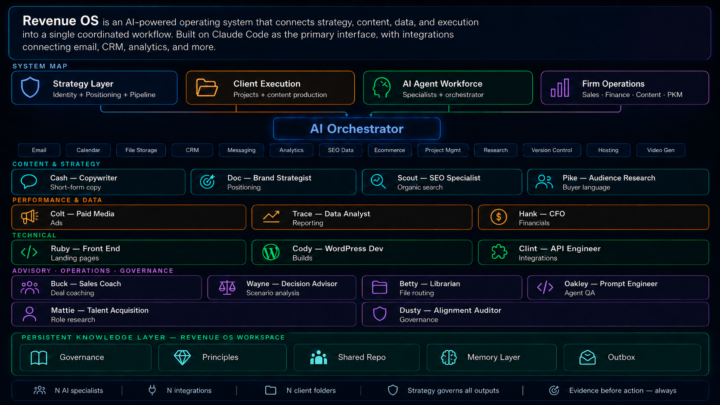
Thanks to @Leo Saraiva comment on my post: https://www.skool.com/cliefnotes/show-your-work-2?p=60f73fe2 I had my AI team come to life and make this. I must admit it came out better than I expected. But I am biased 🤪


May 3 •
The Folder System Became My Agency
Twenty-four days ago I posted about Jake's folder system video. This is what happened next. Same foundation — markdown files, orchestration prompts, clear roles. I just kept building. Fifteen named specialists. Each one with a soul file, guardrails, and a playbook. Duke orchestrates. Cash writes. Trace pulls the data. Hank runs the financials. Clint handles the MCP integrations. Behind each one is either a human counterpart doing the real work alongside them — or a role I can't afford to hire yet. Katie who's been with me for 18 years, now has her own orchestrator running the same system. Twenty-seven client folders. Twelve live MCP integrations. One shared repo. The folder system isn't replacing my agency. It becoming my agency. Jake gave me the unlock. This is how it's going.
1d •
Show Your Work
Stepping into new territory with making videos that "show my work." I have worked in this 'workflow' and tested it for last few weeks. Where I can delegate a task, like an article, and have multiple content use items made from that piece. From images for the article, posts or carousels for social, short and long form videos for YouTube. The intention was to focus on output (how many can be made easily by a team). When I realized that posting 4 carousels and 2 reels was a serious time guzzler, I built a tool that would handle that. All that work was done before I started "filming what i do." Should I back peddle and make videos about how I started the build?

8d •
A real client, a real process, one meeting. Here's exactly what I did. You can do it too.
A few people here have said the hard part is turning what they know about AI into work somebody will pay for. I can only help with half of that. I run an IT services business, so when a client shows an interest I already have the relationship and the trust. I can't tell you how to get the first conversation. I can tell you what I do once I'm in it. This is what happened this morning. All my clients are small businesses. Before we talk about any project, I tell them where I stand on AI. The wording below is close to what I actually said. 1️⃣ AI as it exists right now has been incredibly overhyped, particularly for small businesses. At least half the time, and probably a lot more, AI is not the solution you're looking for. 2️⃣ At the same time it has been undersold. The mad proposals for second brains and vibe-coded replacements for SAP have hidden the really easy wins that are available right now with off-the-shelf LLMs. 3️⃣ An "agent", or a swarm of them, is probably not what you want or need. 4️⃣ It is not a pool to dive into. It's a potentially scalding bath. Dip your toes in, adjust the temperature, and go in a bit further each time. That is the safe, low-cost way to build experience and end up with AI-augmented systems that actually work. 5️⃣ Doing number 4 puts you well ahead of your competitors. While they spend money on big AI projects and get burned, you build solid systems that move the business forward. Nobody has ever pushed back on this. If anything it relaxes the room, because most small business owners have already been pitched the opposite and didn't believe it. 🚨What we did next🚨 We spent about an hour going through one particularly painful, mostly manual process they run approximately ten times every day. I recorded the whole meeting. Afterwards I fed the transcript into Claude and asked it for a process map. The first draft was almost right. 🪙The link below is an anonymised version of a later draft. Company, people and email addresses are made up; the process is real.

21h •
Joseph here, and I'm here to share my AI journey!
I'm currently using AI for creating MVPs and high fidelity prototypes, and right now I'm at the exploration stage. One thing that caught my attention from this lesson is prompt structuring, because it provides considerable advantages if done well from the word go. I'm excited to learn utilizing ICM and see how structured approaches to AI can help me provide high quality results.
1-30 of 584
skool.com/cliefnotes
What we give away free beats most paid courses. Build durable AI systems with a Marine vet and Edinburgh researcher. 40+ lessons, growing.
Leaderboard (30-day)
1

+637
2

🔥
+625
3

+620
4

+511
5
+452
Powered by