Activity
Mon
Wed
Fri
Sun
Jun
Jul
Aug
Sep
Oct
Nov
Dec
Jan
Feb
Mar
Apr
May
What is this?
Less
More
Memberships
Clief Notes
27.8k members • Free
AI Automation Society
358.5k members • Free
21 contributions to Clief Notes

2d •
Company Name Generation
The old ways of doing company name generation and search just don't work in today's crowded landscape of tech and AI companies, not to mention the domain squatters. I'm working through a name check methodology and once we pick our name from the list. I'll be happy to share the methodology, prompts, and data so that you all don't have to spend the tokens that I spent. It checks the following things 1. Does an existing company with the exact name match 2. Is the space crowded with similar names in similar industry 3. Is the name available as .com .co or .ai 4. Trademark search 5. Radio check (sound and spelling ease) 6. Vibe check (does the metaphor land with your goal) How have you used AI to tackle this problem? What would be a good way for me to share this with you?
1 like • 2d
@João Cristiano Silva That's a great addition. Adding it in as a part of the Negative Connotation Check

3d •
It’s a win for me
One of my first goals in using all I’m learning here was to automate the monthly income statement for my (small) organic granola company. For many years my husband and I just winged much of the accounting and financial details of our business. Waiting till tax time or the end of the year to cobble together what we needed. The reports from Shopify and square worked fine. But over the past few years, we’ve put more emphasis on growing the business and i honestly hate being in the dark. My husband is ok being a little loosey-goosey - good thing we aren’t financially dependent on this! It’s still very much a side hustle but it’s our brand and we take pride in the quality and integrity of our product and love our customers. So, on to the win… Today, I did it! I set up my folders, write my .md files. Tested, iterated and eventually nailed it. All I have to do is export my revenue, my expenses and fill in a few other details regarding events we do and presto. 4 steps, pausing along the way to reconcile any flags and finally landing at a clear picture of all the numbers of our business! Plus more regarding events we do, fees and other things we want to have to make future decisions. I’m excited to run all my stages for May. This made so much click for me. This might be basic but a huge win for me!
3 likes • 3d
Incredible! One of my first wins was saving time in recipe development at my coffee shop. I hadn't even thought of doing this yet. Would you be willing to share more specifics on the steps, folders, .md, and prompt?
4d •
First Big Win! First client is signed
Signed before the tool is finished. Signed before the new company is even incorporated. I'm building a Marketing Stack for my SaaS company and before I was finished with Phase 1 of the seven planned phases I was thinking about several people who had talked to me recently about their pain in the same area. Made the call, explained the idea, addressed their pain, and signed the deal. If you approach what your are building as a system that can be deeply customized for each user, then you have a product that people will want. Build it to solve your problem but remember that the customization, the personalization, the flexibility, and the agility of what we can build with AI as the newest abstraction layer of software development is what makes what we are doing here better than what SaaS can do. SaaS is a cookie cutter template that the r has to cram themselves into. What we can build is deeply personalized software solutions.

3 likes • 4d
The Marketing Stack is human in the middle. Here's the overly simplified workflow: - Content Research - Human picks the topic - Drafts written for all channels - Human approves - Content posted across all selected channels - Human notified - Comments listened for and replies drafted - Human approves - Replies posted - Performance tracked - Performance and content revisions fuel the Self Improvement Loop - After 6+ months of work, maybe the user decides to let the agent go autonomous
0 likes • 4d
@David Vogel Thanks boss! I am more than happy to talk about what I'm doing. I'm not a developer so that 60% part is gonna be spaghetti. I've only being "doing AI" for about 6 months so there's so much for me to learn and no reason to gate keep anything. I'm sure there are 100s of people doing what I'm doing already in their own way

4d •
I built something I've been thinking about for a while — wanted to share it with you.
So this is my first try at being a GIT user. The idea is that this is the start of an idea, not a finished product. It's been sitting on my desktop for a bit, and I just need to throw it out into the universe. It's inspired by Information Architecture by Richard Saul Wurman (LATCH) and the desire to be able to 'tune' data to find harmonic correlations. So behold... Signal Harmonics is a cross-domain correlation instrument. You pick signals — GDP, inflation, S&P 500, violent crime, temperature anomaly, social mood, whatever combination — and it shows you how they move together across 2019–2024. Hit "Read the Signals" and Claude gives you an AI interpretation plus a historical parallel from another era that matches the same pattern. The idea: most tools show you one domain at a time. This one asks what happens when you put economy, markets, society, environment, and crime in the same room and listen for the harmony. It's live here: ajpaschka.github.io/signal-harmonics The code is fully open source on GitHub under MIT. I built it intentionally minimal so it's easy to branch. Good starting points if you want to dig in: swap in live API data, add new signal categories, build a different visualization layer, or just run your own version on your own domain. The README walks through the full deploy in about four steps. GitHub: github.com/ajpaschka/signal-harmonics Fork it, build on it, break it. If you make something interesting with it, I'd love to see it. Break it down. Make it better.
1 like • 4d
Thank you! This a really cool research tool. Makes me think of what Freakinomics podcasts talk about.
1 like • 4d
Finding new correlations between existing sets of data is one way to find inspiration for new solutions

4d •
Why your cold emails get ignored (and how I fixed mine to book 9 calls/week)
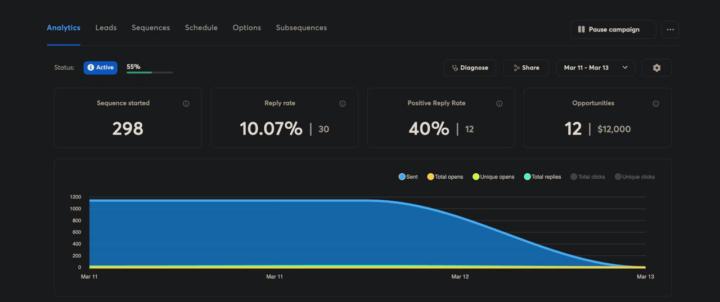
I've been running cold email campaigns for clients for 3 years and the biggest shift I've seen isn't the tools. It's what actually gets a reply. Personalization used to mean scraping a name and company from LinkedIn, dropping it in the first line, and hitting send. "Hey {FirstName}, I noticed {Company} and thought..." That worked in 2022. It's dead now. Everyone's doing it and prospects can spot a mail merge from the subject line. What changed for me was treating personalization like actual research instead of a data field. Here's what I started doing: → I scrape the prospect's entire website. Not just the homepage. Blog posts, service pages, case studies, about page, even their contact form if it's there. → Then I feed all of that into OpenAI and have it analyze what they actually do, who they serve, and what problems they're likely dealing with. The AI doesn't just summarize. It finds the specific details nobody mentions in generic outreach. So instead of "I saw you work in logistics," the email opens with "Noticed you handle cross border freight into Mexico. Your blog mentioned customs delays eating 15% of delivery windows." That's the kind of line that gets opened because it doesn't sound like 500 other emails they got that week. The reply rates went from 2-3% with generic personalization to 8-10% with actual research. One prospect replied last week: "Your email won because you actually read our site. Everyone else sent the same template." The system I built does this automatically. Scrapes the website. Analyzes every page. Generates icebreakers that reference non-obvious details. It writes openers like a human who spent 20 minutes studying their business, except it does it for 1,000 prospects in an hour. Here's what I learned building this: Small prompt details make a massive difference. Having OpenAI shorten company names naturally (say "Stripe" not "Stripe Inc.") and reference specific pages beyond the homepage makes it feel real. The difference between "I saw your website" and "I saw your freight tracking dashboard lets customers get ETAs without calling" is everything.
2 likes • 4d
This is already happening and as a business owner who receives the old version of mail merge personalized emails and this kind of personalized emails... I hate to admit it but sometimes these work and I want to talk to the person.
1-10 of 21

Online now
Joined Apr 14, 2026
Powered by