Activity
Mon
Wed
Fri
Sun
Jun
Jul
Aug
Sep
Oct
Nov
Dec
Jan
Feb
Mar
Apr
May
What is this?
Less
More
Memberships
Must-Hire Engineers
2.3k members • Free
Practical Physics Everyday
42 members • Free
Chemistry Physics Engineering
99 members • Free
Mechanical Engineering Mastery
316 members • Free
Life Engineering
25 members • Free
Lots Of Projects - Engineering
199 members • Free
Math Methods MasterMind
561 members • Free
Homeschool Reading and Maths
654 members • Free
SAT Prep
16.8k members • Free
19 contributions to The Energy Data Scientist
5h •
Saudi Arabia Energy profile (PDF)
This PDF document is the Energy Profile for Saudi Arabia, published by IRENA (the energy company in the UAE ) . Saudi Arabia has one of the world's most fossil-fuel-dependent energy systems. Oil and gas supplied around 99% of Saudi Arabia's total energy in 2022, with renewables under 1%.... And this makes Saudi Arabia a major net energy exporter, with energy self-sufficiency of 275%. Renewables still generated only about 1% of electricity in 2023. But Saudi makes progress in renewables also. Such as 1755 MW of new solar capacity was added in 2024 alone. Saudi Arabia has world-class solar potential, moderate wind potential, and very limited biomass potential. Renewable energy supply grew more than tenfold between 2017 and 2022, though from a very low base. Renewable electricity capacity reached around 5% of the total power mix in 2024, up from effectively zero in 2017. For 2030 its goal is to generate 50% of electricity from renewables . And to have renewable capacity equal to 130 GW, with 58.7 GW from solar and 40 GW from wind. Download below
0 likes • 5h
And the goal of Saudi is to become a global leader in green and blue hydrogen, with salaries of over 500k USD (non taxed) to hydrogen professionals... Lots of demand in hydrogen and energy

2d •
Interview Question on Sustainability Index
I found many Morgan Stanley recent interview questions. For the role of " Sustainable Finance or Utilities Equity Research Associate" and similar. It is related to the S&P Global Clean Energy Transition Index . Here is the link : https://www.spglobal.com/spdji/en/indices/sustainability/sp-global-clean-energy-transition-index/?#overview Study the index for trading jobs also. "In 2023, clean energy stocks dropped about 20% while the global stock market went up about 22%. Why did clean energy do so badly, and what would you buy or avoid in clean energy today?" One answer is that Interest rates went up almost everywhere in the world . And clean energy projects (solar farms, wind farms) cost a lot upfront and pay back slowly over 20+ years. When borrowing gets expensive, those projects become much less profitable. Meanwhile, the broader market was lifted by AI/tech stocks that don't have this problem.
0 likes • 5h
Thank you !

2d •
Benders Decomposition
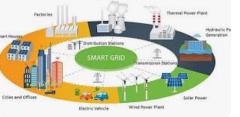
I've uploaded slides and a written explanation on Benders Decomposition, with the full code available inside online course 90 , found by clicking the 'Classroom' menu. The course presents a mixed-integer linear optimisation problem of the kind used by electricity network planners , which are the companies that decide which parts of the grid need to be reinforced (for example, upgrading the capacity of transmission lines). The objective is to minimise the total cost of expanding and operating the power system , i.e. deciding what to build and how to run it . The problem also accounts for sources of uncertainty. Problems like this become very large (many decision variables, many constraints), which makes them slow and sometimes practically impossible to solve . To get around this, we decompose them into smaller pieces and solve those instead. This course presents the Benders Decomposition approach, named after Benders, the researcher who introduced it and this approach is very widely used in power system planning (deciding when, where and how to reinforce the grid). This approach splits the original optimization problem into two subproblems . The full code and slides are available to download. Such a model and similar ones are used in electricity transmission / distribution companies : - UK & Ireland: National Grid, NESO, SSEN, SP Energy Networks, UK Power Networks, Northern Powergrid, EirGrid - Europe: TenneT (Netherlands/Germany), Elia (Belgium), RTE (France), Terna (Italy), 50Hertz (Germany), Red Eléctrica (Spain), Statnett (Norway), Swissgrid (Switzerland) - North America: PJM, MISO, ERCOT, CAISO, NYISO, ISO-NE, AESO (Alberta), IESO (Ontario) - Asia-Pacific & Middle East: AEMO (Australia), POSOCO/Grid-India, TEPCO (Japan), KEPCO (South Korea) Typical job titles that actually design / use such models at work, include: - Network Planning Engineer, - Transmission Planning Analyst, - System Development Engineer, - Power System Modeller, - Investment Planning Analyst, - Whole-System Strategy Analyst, - Quantitative Analyst at energy consultancies (e.g. AFRY, DNV, Baringa, Aurora Energy Research, Pöyry, E3).
0 likes • 5h
Thank you so much. It is very very useful , the model and explanation !
Mar 16 •
New Online Course: Kernel Density Estimation
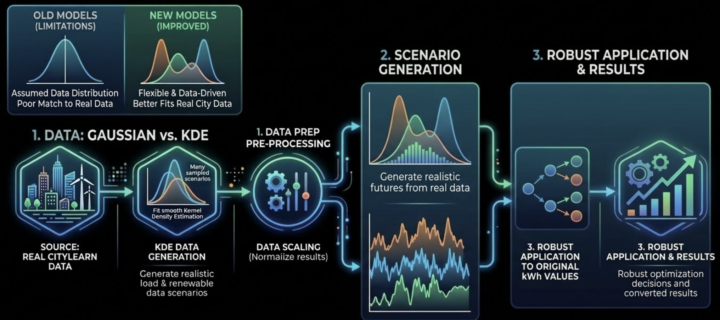
A new online course has been published in Classroom. It is course 118. Its title is "Kernel Density Estimation". Kernel Density Estimation (KDE) is a highly effective statistical method used in the energy sector. It allows you to take an existing dataset and generate new, realistic values that follow the exact same underlying patterns. This is perfect for when you need to simulate multiple scenarios. Specifically, in this course: - we look at a smart building with uncertain electricity demand, using 8760 hourly values (one year of data). - we want to simulate 1000 unique days where the demand is different but strictly follows the "logic" of our original dataset. - we walk through generating KDE-based data and using it to solve Monte Carlo and two-stage stochastic optimization models. These methods are absolute standards in the energy sector. Best of all, this is a highly applied course. I show you exactly how I used these exact techniques in a real-world energy project, so you can move past academic textbook exercises and start applying this to actual problems. The attached screenshots show the step-by-step process of how KDE is applied in industry. And also the differences between using KDE and non-KDE approaches ; KDE is more realistic. Non-KDE approaches are easier to model but lack realism.
0 likes • Mar 18
thank you
Mar 17 •
Commodities Trading- Interview
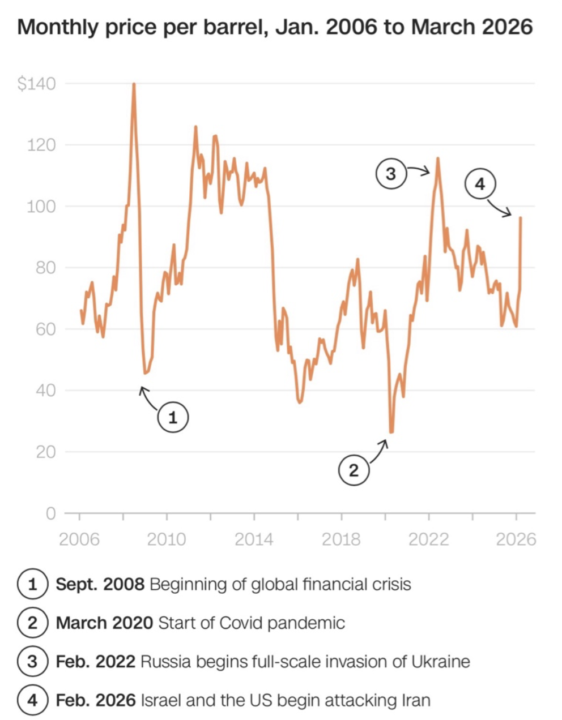
See the plot. You must explain what is happening. Source: JP Morgan round1 , February 2026. - What is the key conclusion ? Answer: oil prices are very sensitive to major global events. - Oil Prices why would they fall? Answer : When there is a global crisis that slows down the economy (like a recession or a pandemic), people travel less and factories slow down. Because the world needs less oil, the price drops. - Oil Prices why would they Rise? Answer: When there is a war or conflict, especially in areas that produce a lot of oil, markets panic that the global oil supply will be cut off, causing prices to spike. - Explain what we see on 1 Sept. 2008: Answer: When the global financial crisis hit, the global economy crashed, causing the demand for oil to become extremely low. - Explain the 2 March 2020 : When the world went into covid lockdown, travel stopped and industries paused. Because nobody was using fuel, the price of oil plummeted to the lowest ( $20 a barrel). - Explain 3. Feb. 2022 : Russia is one of the world's largest oil producers. When the war started, countries feared Russian oil would be cut off from the market. This panic caused the price to immediately spike back over $100. - Explain 4. Feb. 2026 : Iran sits right next to the Strait of Hormuz, where a massive portion of the world's oil is shipped. Because of the conflict, the market is scared that this vital shipping lane will close, causing a sharp spike in prices.
1 like • Mar 18
Oil is the reflection of geopolitics
1-10 of 19

@khalid-al-harbi-3476
Manager , Python, quantitative development and economics of energy
Active 4h ago
Joined Nov 2, 2025
INFP
Saudi Arabia