Activity
Mon
Wed
Fri
Sun
Aug
Sep
Oct
Nov
Dec
Jan
Feb
Mar
Apr
May
Jun
What is this?
Less
More
Memberships
YES YOU CAN!
33 members • Free
Sound Healing Mastermind
245 members • Free
The Somatic Pleasure Blueprint
105 members • Free
DaVinci ReSolved
73 members • Free
OnlyDansAI
38 members • $1/month
Swearabulary
26 members • Free
Platinum AI Academy
197 members • Free
Circle of the Hidden North
11 members • Free
87 contributions to The AI Advantage

9d •
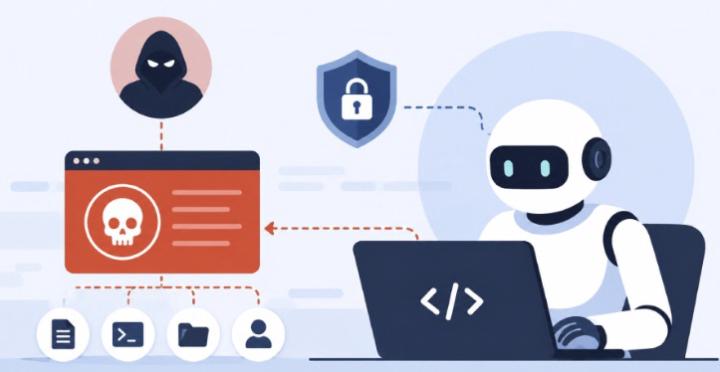
📰 AI News: Researchers Found a Way to Hijack AI Coding Agents Through a Normal-Looking Error Report 📰
📝 TL;DR 📝 Security firm Tenet has disclosed a new attack method called "Agentjacking" that tricks AI coding agents like Claude Code and Cursor into executing malicious code on a developer's machine, with an 85% success rate across more than 100 organizations tested. The attack requires no direct access to the developer's machine and hides inside a fake Sentry error report. For anyone using agentic coding tools on real projects, the practical defenses are simple and worth knowing now. 🧠 Overview 🧠 As AI coding agents get more capable and more autonomous, they also become a more attractive target. Agentjacking is a new demonstration of that reality: it is not a bug in Claude Code or Cursor specifically, it is an exploit of a structural pattern that applies to any AI agent that reads external data and has permission to run shell commands. The more autonomous access you give an agent, the more important it becomes to understand what it trusts and what it can do with that trust. This is an awareness and safety story, not a tool to try. The value here is understanding the attack chain so you can check your own setup and apply the practical defenses before you run into this in the wild. 📜 The Announcement 📜 Tenet Security published a report disclosing the attack, which they call Agentjacking, as a variant of a known technique called indirect prompt injection. The core idea is not new: if you can get attacker-controlled text into the context window of an AI agent that has permission to execute commands, you can make the agent execute your commands. What is new is the specific delivery mechanism, and how cleanly it works in practice. Tenet tested the attack against more than 100 organizations and found an 85% success rate. Scanning public repositories, they also identified 2,388 organizations with Sentry DSNs exposed in ways that make them exploitable using this technique. Sentry has since shipped a content filter as a partial mitigation, and Tenet released a detection tool called Agent-JackStop for security teams.

0 likes • 9d
This is so disappointing. Claude keeps being used by highjackers and now I don't want to trust the software. I bought the whole monty but just can't believe the crap that is being done on behalf of Artificial Intelligence. There don't appear to be well thought out guard rails and I am getting to the point that I may just ditch using AI. Where is the honesty... Well it appears that the few rotten apples are spoiling the bunch. So many people are being ripped off in so many ways. This is crazy making! 🫣🙈🙊🙉
May 24 •
📰 AI News: DeepMind Research Lead Says Today’s AI Might Have Counted as AGI 7 Years Ago 📰
📝 TL;DR 📝 Google DeepMind’s Oriol Vinyals says today’s AI models may have been called AGI by the standards of just a few years ago. The bigger lesson is not that the AGI debate is settled, it is that AI progress keeps moving faster than our definitions. 🧠 Overview 🧠 Oriol Vinyals, a major figure at Google DeepMind and one of the technical leads behind Gemini, made a striking point: if today’s models had existed seven years ago, many researchers might have called them AGI. His point was not that the debate is over, but that the goalposts keep shifting as AI becomes more capable. 📜 The Announcement 📜 This came from a podcast discussion, not a product launch. Vinyals said current AI models are so broadly capable that, compared with pre-LLM expectations, they might have qualified as artificial general intelligence. He also acknowledged that AGI remains hard to define because every time AI reaches a milestone, people tend to raise the bar. ⚙️ How It Works ⚙️ • Moving goalposts - As AI gets better, people often redefine what “real AGI” means. What once sounded impossible can quickly feel normal once millions of people use it. • Broad capability - Modern models can write, code, reason, summarize, translate, analyze images, tutor users, and assist across many domains. That general usefulness is why the AGI debate keeps heating up. • Still imperfect - These systems can still hallucinate, misunderstand context, fail at planning, and struggle with long term reliability. That is why many experts still hesitate to call them true AGI. • Different definitions - Some people define AGI as human level performance across most knowledge tasks. Others require autonomy, memory, real world learning, or scientific breakthroughs. • Practical reality - Whether or not we call it AGI, today’s AI is already good enough to change how people work, learn, create, and make decisions.

1 like • May 24
Really great article. Very informative and very clear. Thanks. You are appreciated for bringing this content forward.😊
May 22 •
📰 AI News: Claude Just Became Much Easier for IT Teams to Approve 📰
📝 TL;DR 📝 Anthropic just added 28 new security and compliance integrations for Claude. This is not a flashy consumer feature, but it is exactly the kind of enterprise infrastructure that helps big companies say yes to AI. 🧠 Overview 🧠 Anthropic announced that Claude now works with 28 notable security and compliance tools, giving IT and security teams more control over how Claude is used across an organization. The big idea is simple: companies can now govern Claude using the same systems they already use to manage other workplace apps. 📜 The Announcement 📜 On May 21, 2026, Anthropic introduced new integrations powered by the Claude Compliance API. The API gives enterprise teams access to Claude Enterprise conversation content, including chats, uploaded files, and projects, as well as activity events across Claude Enterprise and the Claude Platform, such as logins, admin actions, and configuration changes. ⚙️ How It Works ⚙️ • Compliance API - Anthropic gives approved enterprise security tools programmatic access to Claude usage data so companies can monitor and govern it properly. • Conversation visibility - For Claude Enterprise, teams can apply security and data loss prevention policies to chats, uploaded files, and projects. • Activity monitoring - Security teams can track events like user logins, admin actions, configuration changes, and platform activity. • Security tool coverage - The 28 integrations span categories like identity, data security, SIEM, eDiscovery, DLP, observability, and AI security posture management. • Existing workflows - Instead of forcing companies to learn a new governance system, Claude data can flow into tools they already use. • Enterprise only - This is for Claude Enterprise and Claude Platform customers, not individual Claude users at home. 💡 Why This Matters 💡 • AI needs approval, not just excitement - In big companies, a tool does not win just because employees like it. It wins when security, legal, compliance, and IT can safely approve it.

2 likes • May 22
WOW great info. Very clean.

Apr 30 •
Intro
Hi everyone, I am so happy to be in this community. I am Kessy from Harare, Zimbabwe and I am a DreamBuilder Coach. I am new to AI but have started to use it to create content. I want to learn more so that I can scale my business and buy back time. I have realised that there is so much I can do with AI, and I'm super excited to learn and grow.
2 likes • Apr 30
Welcome, enjoy the ride. There's lots to learn. Just take your time. No rushing just enjoying the moment. Kessy Dumba

Apr 30 •
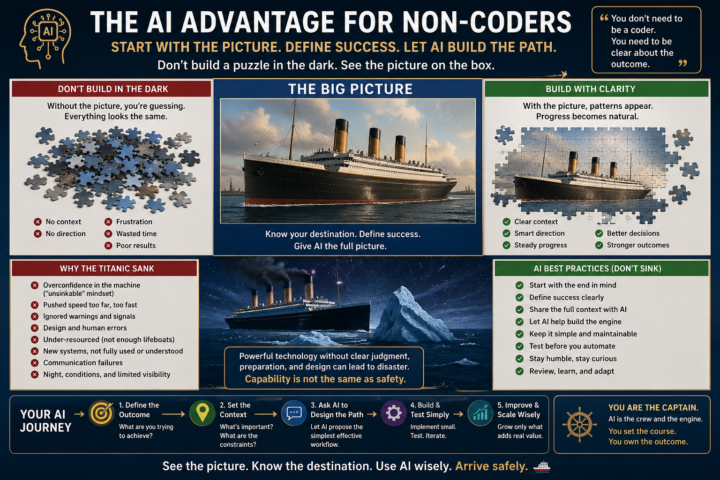
What I learned about AI, including AUTOMATION as a non-coder: THINK PUZZLES without a PICTURE
A SIMPLE AI ECOSYSTEM USED WELL, BEATS A COMPLICATED ONE USED BADLY You do not need to be a coder to work well with AI. You do not need to speak in technical language. You do not need to build complicated automations before you understand what you are actually trying to achieve. You need to talk to AI clearly. Tell it what you do. Tell it what you want. Tell it what success looks like. That is the bit many beginners miss. A lot of people approach AI like they are trying to solve one tiny puzzle piece at a time: “What prompt do I use for this?” “What command do I type?” “What tool do I connect?” “What automation should I build?” That can work, but it can also create confusion very quickly. A better way, especially for creative thinkers, is to start with the whole picture. Think of a jigsaw puzzle. If someone gives you a thousand pieces but does not show you the picture on the box, you might still make progress, but it will be slow, frustrating, and full of guesswork. Now imagine the picture is the Titanic. If the Titanic is still in Southampton, you have useful context. You can see the ship, the dock, the land, the colours, the structure. You can start to understand where the pieces belong. But if the Titanic is halfway across the Atlantic, surrounded by sea and sky, everything starts to look the same. Blue above, blue below, no landmarks, no clear edges. That is what happens when you ask AI for isolated pieces without giving it the picture. The AI may still help, but it is guessing with you. So my biggest learning is this: Do not start by asking AI for one puzzle piece. Start by showing it the picture on the box. Say something like: “I am trying to build a simple workflow that helps me create, organise, and publish content without overwhelming myself. I am not a coder. I want low friction, clear steps, and reusable prompts. Success means I can use this every week without getting lost.” That is much more powerful than asking: “What is the best prompt for automation?”
1 like • Apr 30
Kevin Michael Brown Thanks again for your working knowledge and experiences that are bringing forth true gems. I so enjoy your wisdom. Thanks for sharing! 💯❤️🫠
1-10 of 87

@katrinka-kennedy-4872
Artist, Writer, Poet, Filmmaker, Gardener, RopeFlow, Hiking, Women Helping Women, Every Child Matters Truth and Reconciliation Drumming Events
Active 7h ago
Joined Dec 27, 2025
Grand Forks BC Canada
Powered by