Activity
Mon
Wed
Fri
Sun
Mar
Apr
May
Jun
Jul
Aug
Sep
Oct
Nov
Dec
Jan
Feb
What is this?
Less
More

Memberships

The Consciousness Path

522 members • Free

6 contributions to The Consciousness Path

Simplicity
I'm having a dawning realization on just the nature of what I think is a lot of people's problems are and things that get in the way of learning as well. I'm noticing that a lot of crappy stuff that goes on that creates suffering in people's experiences and maybe inhibits people's abilities in learning stuff is just having a complex mind. As in there's just a bunch of shit being juggled around time to time. Like how you want to live your life you might have a million and one ideas of what it should be and this and that. Maybe making it hard to choose. Or if you wanted to learn something you might just start juggling around a lot of concepts trying to "figure it out." Been then there's just a simplicity in just paying attention to what's going on. Juggling around concepts and coming up with ideas seems to be the "thing to do" a lot of the time, but it kinda seems like the solution to a lot of our sufferings might honestly lean in the other direction. I think even in learning stuff too. Simplicity in living can look like an ease where you don't have to second guess yourself, and decisions can become clearer just by questioning or living. Simplicity in learning can look like the material ITSELF becomes the teacher, and your paying attention to the act or reality of it is what becomes the lesson. Less preconceptions I can even notice it in "combat," or even social interactions. Just move your body, mess around, do the thing. Stop "thinking" about it so much and actually participate. Funny how something so simple and in your face can be so powerful. Just doing the thing. Or when socializing, just get the dude across from you. Don't dramatize it or make crazy shit out of it. Just get him. Not even to mention how much more freeing of a life it can feel. Simple and direct. Reminds me of a quote somewhere that went something like "Zen is the de-symbolization of the world." Could just be a useful direction in general. Can feel a bit contemplative at times. Could be the direction in which contemplation "leans." Outside of all the "concepts," or "chatter." Just what is actually true
2 likes • 2d
Nice insights. Some additional thoughts on simplicity: An important ingredient of simplicity is to realize that life is complex, and to embrace that as well. In many ways, complexity is "smarter" than us. Our mind is constantly trying to predict, make sense of-, categorize stuff... thereby effectively trying (and often failing) to "simplify" life - when reality is actually more complex than that. Instead, as you said, the best we can do is often to sit with it, watch, and learn. Simple. The "simple path" would therefore be to accept that life doesn't even have to be simple. Consciousness Work is full of paradoxes and nuances of that kind.
Why we feel stuck (even when we "do the work")
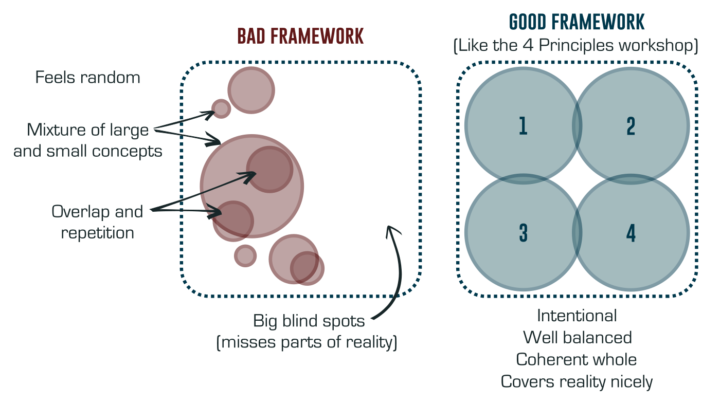
A very common way to approach life is to adopt a "more is better" attitude. When we are stuck, we look for more techniques, more routines, more methods… Basically, 𝗺𝗼𝗿𝗲 𝗶𝗻𝗳𝗼𝗿𝗺𝗮𝘁𝗶𝗼𝗻. But if we're honest: after years of reading and learning, is a lack of information still the problem? I'd argue that, usually, knowledge is not the actual limiting factor. The real issue is that we always had a 𝘀𝗵𝗮𝗸𝘆 𝗳𝗼𝘂𝗻𝗱𝗮𝘁𝗶𝗼𝗻 to begin with. Even if we received, say, the "Ultimate Textbook" on how to live life, the following things would still happen: - Not really knowing what we want - Setting goals but not acting on them - Being stopped by external conditions and turning them into excuses - Constantly "shooting ourselves in the foot" in small or big ways Even with the perfect plan, we'd still waste massive amounts of energy fighting our own internal contradictions. That’s a structural problem, and there’s no way to fix it with surface-level techniques found in self-help books. We need to go deeper: we need 𝗣𝗿𝗶𝗻𝗰𝗶𝗽𝗹𝗲𝘀. Next week (Saturday, Jan 31st), we’re running our 𝗻𝗲𝘄 6-hour interactive online workshop: The 4 Principles for a Free and Powerful Life. It’s about identifying the core mechanisms at the root of your everyday experience. When you align with these principles: - 𝗖𝗹𝗮𝗿𝗶𝘁𝘆 emerges: You know where you’re going - 𝗙𝗿𝗶𝗰𝘁𝗶𝗼𝗻 disappears: You stop fighting yourself - 𝗡𝗲𝘄 𝗽𝗼𝘀𝘀𝗶𝗯𝗶𝗹𝗶𝘁𝗶𝗲𝘀 open up: You realize you may not be as stuck as you thought - 𝗣𝗼𝘄𝗲𝗿 and 𝗙𝗿𝗲𝗲𝗱𝗼𝗺 return: You stop leaking energy on things that don’t matter Most productivity "hacks" stop working the moment we become internally stressed, or when too much external chaos appears. Conversely, principles are 𝘢𝘣𝘰𝘶𝘵 looking at what causes stress and chaos, and learning to navigate 𝘵𝘩𝘢𝘵. We're keeping this workshop affordable to make it a strong entry point for anyone new to this work. Even if you've worked with principles before, we'll approach them from a completely different angle, helping you integrate them in ways you likely haven't explored yet.
Why we feel stuck (even when we "do the work")
0 likes • 9d
@Amy Rattenbury Hi Amy, we'll work it out. Sending you a direct message.
3 likes • 5d
@Omer Mi Yes, it's even designed for them (though it's also very valuable for more advanced practitioners)
Is Mind pure imagination/Where does it exist?
Today i was contemplating distance, and had the insight that distance is actually a concept. The idea of "me being in here behind the eyes" is conceptual, thus the idea of "me here, wall there" must be conceptual, and therefor the idea of "distance between me and wall" must also be conceptual. As I was contemplating this along with other aspects of mind like "inside the skull, emotions, sense of self, beliefs and thoughts" I began to wonder...Where does any of this actually exist? It can't be coming from inside my head or brain because even that notion is a concept that I am doing, so it must just be imagined out of pure nothingness "thin air" if you'd like. Anyone come across this? Cheers
1 like • 7d
Yeah, the distinction of "space" is a strong one. More fundamental to our experience than what we usually think. Even when saying there's actually "no distance" between us and something, we still hold 𝘵𝘩𝘢𝘵 as taking place "here" (in space). And when asking "where does mind exist?" (if not in space), we already use "where", which is a space-related word. Regarding the other half of your title ("Is mind pure imagination?"), I'd ask: what is imagination, if not pure mind-stuff?
Mundane
Basically been grinding peters podcasts all over again and again, and everytime I ended up with this weird sense that i'm just not getting it, watched "how to stop self-destructive behaviour" one like 7 times already and It's just glimpses in my own experience of how much I actually grasp in there, but oh boy "why people hate being mundane" hit me like a truck. Basically what I did I've just noticed that there's such a thing in a first place, secondly that we run from it, and lastly we live our whole lives like this, funny that many people doesn't even consider about this, exactly like me, been doing this whole life. So i've sitted with it for more time and i've just started to connect the dots from all of the podcasts, like I could see that thoughts are distractions(self-made), all of the action we take is distractions, everything is a distraction when it comes to this, then i noticed emotions, i even laughed cause how can be emotion happening in nothingness without me doing it. Wanted to share this so much, cause it feels very profound when it comes to this work, now I can start integrating this into my daily life not just moments where nothing special is happening. anyone knows what i'm talking about? or i'm just fkin crazy, cause this one seems like root of everything, of every problem of every emotion you don't want, like just go and live from this state, in this state these thing has no possibility to happen cause they're just not there. And if you're further then this I would love to get some directions to look further, but for now i will keep looking at mundane until i get everything there is from it. Biggest question for me right now is why do we run from it in the first place and what is it even. Lets get back to work, also i'm grateful for answers and this community, peace✌️
1 like • 13d
"Biggest question for me right now is why do we run from it in the first place" Survival is about surviving. And I guess mundaning isn't a very good survival strategy. Especially if you want to construct a complex self, with an identity, a life, a social status... you know - the stuff we do as humans, when we're busy *not* being mundane
No Inner World?
One of the most radical ideas I came across in Ending Unnecessary Suffering was in the section on loneliness. Ralston says one ideation is that we live in an existentially isolated inner world, which leads to a sense of disconnect and therefore we need others to complete the experience. I do see a possibility of feeling that your isolated inner world is complete as it is, so that you don’t need another to view it to feel as such. However, the idea that the private inner world itself is a concept is so radical to me. I don’t know how to wrap my mind around it. It is incredibly obvious to me that I have thoughts, beliefs, self-judgements, etc. that are simply not observable by other people. Only I can witness them unless I share them. Does anyone have any insight into investigating this?
3 likes • 16d
"It is incredibly obvious to me that I have thoughts, beliefs, self-judgements, etc. that are simply not observable by other people. Only I can witness them" Well, if you think about it, that's the case for the totality of your experience, not just your thoughts :) What is actually a concept is the decision to draw a boundary somewhere in your experience, between what's supposedly "private" and what is not. At the end of the day, you can see that the shape of that boundary depends on what YOU decide to consider objective vs. subjective. Let me elaborate: In fact, you could just as well ask the question in reverse: instead of trying to see why your private inner world is an invention, you could try to see why a "public" outer world is also an invention. Indeed, both of these worlds are created at the same time: when we draw a line between the two. Yes, it seems "incredibly obvious" that your thoughts are private. But the other half of the story is that it also seems "incredibly obvious" that objects are public. But why do we assume that? We can list a bunch of qualities that make objects seem "external" to us, for example: - They are out of our direct control - They are witnessable by others - They persist even when we look away These aspects seem very different from what happens in our inner world. But are they really? Let's go back to that list, this time comparing objects with thoughts: - Objects are out of our control, BUT are our thoughts really under our control anyway? - No one witnesses our thoughts, BUT does anyone actually witness objects the same way WE witness them anyway? - Objects persist when we look away, BUT how do we know thoughts don't persist when we "think away"? (that one is a bit more abstract :D) I'm just trying to point that in many ways, after closer inspection, the boundary between what is objective vs. subjective isn't as clear as it seems. Making a clear cut between these two domains may be where conceptualization really takes place.
1-6 of 6
Corentin G
3
36points to level up
@corentin-g-4774
A self

Active 3h ago
Joined Jan 1, 2026
Powered by