Activity
Mon
Wed
Fri
Sun
Jun
Jul
Aug
Sep
Oct
Nov
Dec
Jan
Feb
Mar
Apr
May
What is this?
Less
More
Memberships
Bedrock Nation
161 members • Free
2 contributions to Bedrock Nation

Apr 7 •
The Physical and Mental Affects of Stress
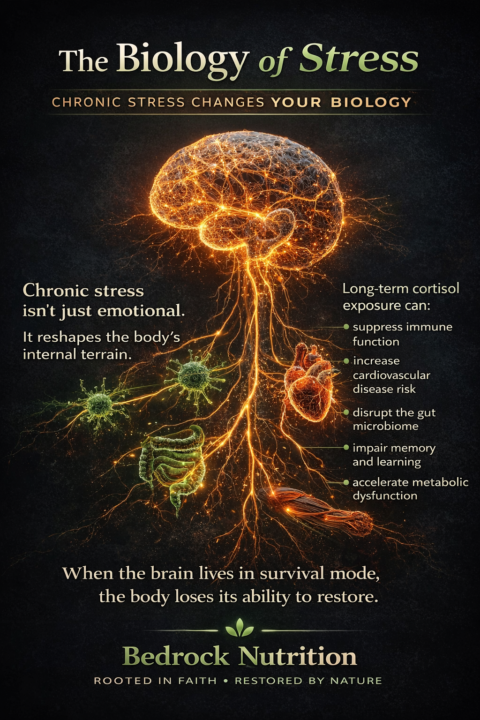
Your Mind Can Heal You… Or It Can Quietly Destroy Your Terrain This quote caught my attention this morning: “Nothing kills you faster than your own mind. Don’t stress about things that are not under your control.” At first glance it sounds like motivational advice. But biologically… it’s actually very close to the truth. Because chronic stress doesn’t just affect your thoughts. It reshapes your entire internal environment. And when the internal environment shifts, every system in the body responds. Stress Is Not Just Emotional It Is a Full-Body Biological Event When your brain perceives a threat — whether that threat is physical, emotional, financial, relational, or imagined — the body activates the sympathetic stress response. Your brain signals the HPA axis (hypothalamus-pituitary-adrenal axis), which triggers a cascade of stress hormones: • Cortisol • Adrenaline • Noradrenaline These hormones are incredibly useful in short bursts. They help us: • escape danger • increase alertness • mobilize energy • sharpen focus The problem is not acute stress. The problem is chronic stress. And modern life has created a world where many people live in a permanent stress loop. What Chronic Stress Does to the Body When stress becomes constant, the body never returns to baseline. Instead, cortisol stays elevated. And that creates a cascade of physiological effects. 1. Immune System Suppression Chronic cortisol suppresses immune function. Research from the American Psychological Association shows that long-term stress reduces lymphocyte activity, which are the white blood cells responsible for fighting infection. Over time this can lead to: • increased infections • slower healing • higher inflammation • immune dysregulation 2. Cardiovascular Damage Stress hormones elevate: • blood pressure • heart rate • vascular inflammation Over time this increases risk of: • hypertension • arterial damage • heart disease • stroke This is why chronic stress is now considered a major cardiovascular risk factor.

0 likes • 16d
This is a constant rollercoaster for me, and I would love to turn this ride off!
Mar 30 •
What if hunger isn’t the enemy… (the small frequent meal myth)
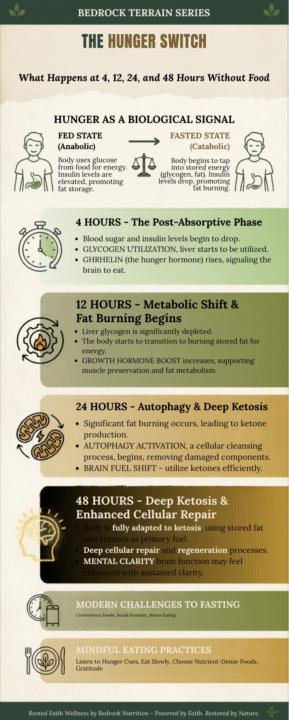
What if hunger isn’t the enemy, but one of your body’s most powerful metabolic signals? For decades we were told to eat constantly. “Six small meals a day.” “Never skip breakfast.” “Keep the metabolism firing.” But biologically, the human body was never designed to be in a constant fed state. For most of human history, periods of eating and periods of fasting naturally alternated. And those fasting windows triggered some of the most important repair processes in the body. When we constantly digest food, the body prioritizes storage and growth. When we pause from eating, the body shifts toward repair and restoration. This metabolic transition is sometimes called “the metabolic switch.” Instead of relying primarily on glucose for fuel, the body begins shifting toward fat oxidation and ketone production. And that shift activates several powerful biological processes. 1️⃣ Cellular Cleanup (Autophagy) Fasting helps trigger autophagy, the cellular recycling system that removes damaged proteins, dysfunctional mitochondria, and metabolic debris. This process was so important that it earned the 2016 Nobel Prize in Physiology or Medicine. Autophagy supports: • mitochondrial health • cellular repair • metabolic resilience 2️⃣ Metabolic Flexibility Many people today are metabolically inflexible — meaning their bodies rely almost exclusively on glucose for energy. Periods of fasting help restore the body’s ability to switch between fuel sources: glucose → fat → ketones This metabolic flexibility is associated with: • improved insulin sensitivity • more stable energy • better appetite regulation 3️⃣ Hormonal Recalibration Hunger is largely regulated by two hormones: Ghrelin — signals hunger Leptin — signals satiety Constant eating disrupts these signals. Strategic fasting can help restore normal hunger and fullness cues, allowing people to experience what true hunger — and true satiety — actually feel like again. But fasting is not one-size-fits-all.
0 likes • 16d
I’ve learned a lot about this over the last 5 years, but I still struggle beyond the 24 hour mark and I think my cortisol kicks in. I look forward to reading your Fasting 101 mini course.
1-2 of 2

@coleen-damato-5032
Hi, I’m Coleen. I’m a mom and grandma. Catholic, faithful, real. Trying to get to the root cause of health issues instead of treating symptoms.
Active 4d ago
Joined Apr 25, 2026