Activity
Mon
Wed
Fri
Sun
Mar
Apr
May
Jun
Jul
Aug
Sep
Oct
Nov
Dec
Jan
Feb
What is this?
Less
More
Memberships
Bedrock Nation
113 members • Free
4 contributions to Bedrock Nation

24d •
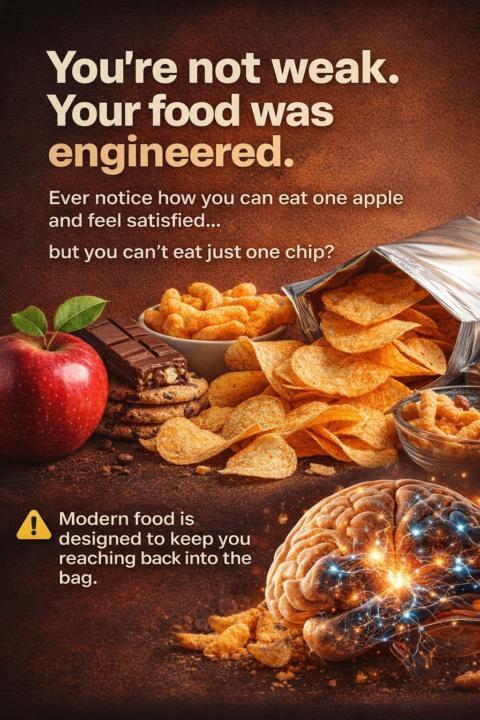
THEN vs NOW: (Part 1) How 150 years of “modern food” quietly rewired human biology
Did humans suddenly require processed grain at 8:00 AM to survive?Or did we get handed a story—and build our daily life around it? The “Breakfast” story (and why it mattered): The idea that “breakfast is the most important meal of the day” didn’t come from ancient wisdom—it was heavily amplified by modern marketing. A widely cited example is a 1940s General Foods campaign used to sell cereal and promote a “good breakfast” as a performance requirement for work and school. To be clear: humans have always eaten in the morning sometimes.But the mandate—“eat immediately, eat carbs, eat packaged”—is modern. THEN (human default): For most of human history, food was: - Seasonal + local - Protein-forward (when available) with fibrous plants - Naturally time-restricted (periods of scarcity were normal) - Minimal ingredients (because “ingredients lists” didn’t exist) Your nervous system was designed for alertness when hungry (“hunter mode”).That’s not starvation—that’s adaptive biology. NOW (the modern food environment): Over the last ~150 years, the biggest shift isn’t that we eat more.It’s what we eat—and how engineered it has become. 1) Ultra-processed food became the default Today, over half of calories in the U.S. come from ultra-processed foods. And historically, processed/ultra-processed foods rose from under 5% to over 60% of the food supply across the last two centuries. Ultra-processed = food designed for shelf life + hyper-palatability, not human thriving. 2) The rise of “always eating” We went from “eat when you can” to structured grazing: - breakfast snack - lunch snack - dinner dessert Constant stimulation → constant insulin signaling → constant appetite noise (for many people). 3) The metabolic disease curve didn’t come out of nowhere Adult obesity prevalence is now around 40% in the U.S. That’s not a willpower failure. That’s an environment failure. And yes—many things contribute (stress, sleep, toxins, sedentary life, meds, etc.).But food is the daily signal that hits your hormones, gut, brain, mitochondria, and immune system.

3 likes • 22d
I was middle class America family in the 70's. We are a lot of grains, mostly because they bulked out meals. Breakfast was cereal- hot or cold. I ate oatmeal and Cream of Wheat. On weekends it might have been pancakes made with Bisquick. Lunches were sandwiches most of the time. Dinners were casseroles, sometimes using Bisquick (think Impossible cheeseburger pie). Much of what I saw was preparing processed crap was considered "cooking". Also, my mom usually gave us an 8:00 before bed snack. Why that was necessary, I don't know. It was usually some sort of junk food like ice cream. Unfortunately, much of my mom's "cooking" model is what I raised my kids doing. Also, this cultural tendency to load up on sugar starting with Halloween, going through the holidays, then Valentines Day, and Easter us just stupid.
Jan 10 •
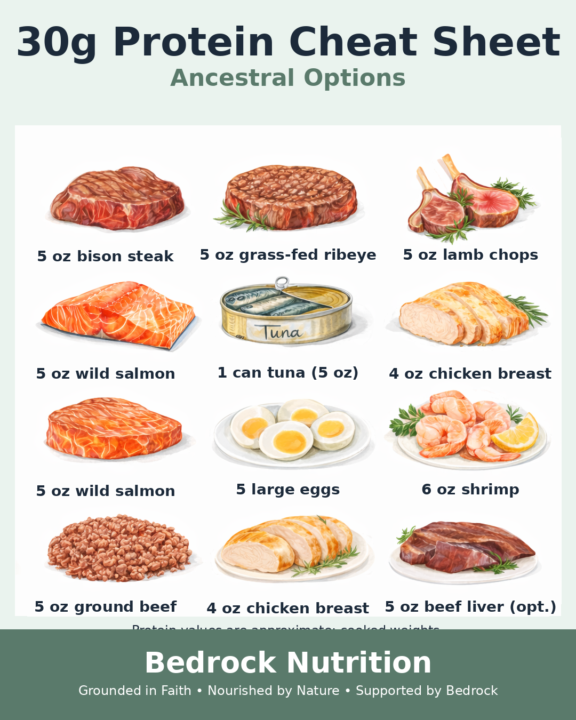
The 30/30/30 Rule (Bedrock Style): A Morning Rhythm That Changes Your Day
30 grams of protein, within 30 minutes of waking then 30 minutes of low-impact movement (walk, vibration plate, rebounding, easy bike) The reason this “rule” has taken off is simple: it’s not a trendy biohack—it’s a rhythm. And rhythm is where real results live. UCLA Health describes the 30/30/30 rule as a simple 3-step habit: 30g protein at breakfast, eaten within 30 minutes of waking, followed by 30 minutes of low-intensity, steady-state exercise—and also notes it hasn’t been studied as a single “plan,” even if parts of it are supported by research and common sense physiology. Below I discuss why we like it through an ancestral / functional / terrain lens—and why it can be especially powerful for women. Why this works: it stabilizes your terrain early Most women don’t have a “willpower problem.” They have a blood sugar + cortisol + under-fueled muscle problem. 1) 30g protein early = fewer cravings, steadier blood sugar UCLA points out there’s no magic in the exact number 30, but that protein in the morning helps you feel full longer than a carb-heavy breakfast, which can reduce mid-morning cravings/snacking. Functional medicine translation:When you anchor your morning with protein, you’re less likely to ride the rollercoaster of “coffee + cortisol + carbs → crash → cravings.” 2) Muscle is a woman’s metabolic “savings account” Women are trained culturally to under-eat—especially protein. But muscle is not just for aesthetics. It’s glucose storage, metabolic rate support, strength, resilience, and healthy aging. Research and position statements for active individuals commonly land higher than the bare-minimum RDA—often ~1.4–2.0 g/kg/day for many exercising people. And in menopause-focused nutrition reviews, higher protein intakes (often above 0.8 g/kg/day) are commonly discussed for supporting body composition and function as women age. Bedrock takeaway:Women don’t need less protein because they’re women. Many women need more, because they’re navigating hormonal transitions, stress load, and modern sedentary life.
3 likes • 30d
I had a deconstructed cabbage roll the other night- I was too lazy to actually roll the cabbage and filling. It was delicious 😋
Nov '25 •
Spotlight Nutrient: Vitamin D3
First - let’s explain the allopathic interpretation of this study (study linked below): What the new AHA abstract ACTUALLY found - Adults with established heart disease who had their vitamin D dosed to reach and maintain 25-OH-D between ~40–80 ng/mL had a 52% lower risk of myocardial infarction vs. a usual-care group that did not manage vitamin D levels. Primary composite outcomes (death/HF hospitalization/stroke) were not reduced. It’s a preliminary conference abstract (TARGET-D), not yet peer-reviewed. - 52% of the treatment group needed >5,000 IU/day to hit >40 ng/mL, and dosing was titrated every 3 months with safety monitoring; doses were reduced/stopped if levels exceeded 80 ng/mL to avoid hypercalcemia. Why “normal” lab values are often too low - U.S. National Academies/NIH materials frame ≥20 ng/mL as “generally adequate” for bone outcomes, which is why some labs set the “normal” lower bound near 20. But that threshold was never meant to optimize non-skeletal outcomes. - The Endocrine Society’s 2024 guideline moved away from endorsing a single universal target like 30 ng/mL for everyone, acknowledging heterogeneous needs and advising routine RDA-level supplementation only for most healthy adults <75 without indications—reserving higher targets/doses for specific populations/indications. - Earlier (2011) guidance commonly sought ≥30 ng/mL, and many functional clinicians aim 40–60 ng/mL for broader physiology—aligning with the TARGET-D optimization approach rather than a one-size-fits-all dose. (Note: the 2011 target is now superseded, but it explains today’s differing “normals.”) What low vitamin D implies (condensed) - Cardiometabolic risk: Low 25-OH-D is consistently associated with higher CVD risk; however, in the general population the large VITAL RCT (2,000 IU/day) did not lower major CVD events, suggesting benefit may require targeted treatment of deficiency or higher-risk subgroups (like TARGET-D did). - Infectious disease/COVID-19: Observational and some interventional/meta-analytic data link low D to worse outcomes and suggest benefit to supplementation—especially with multiple/adequate doses—but it’s not accurate to claim “nearly 100% of COVID deaths are due to low vitamin D.” That overstates the evidence. - Musculoskeletal/immune: Low D compromises calcium homeostasis, bone, and immune function; very high levels can cause toxicity (hypercalcemia, renal issues, arrhythmias), which is why monitoring matters. UL for most adults is 4,000 IU/day (outside supervised care).
1 like • Jan 2
I need to get more vitamin D. My levels are just too low. After our talk the other day, I'm anxious to see what you recommend for me.
Nov '25 •
Welcome to Bedrock Nation
We are so glad you are here! This is your space to learn, grow and connect - free from Facebook's distractions and censorship. Start Here: 1. Take your Free HIPAA Compliant Health Assessment and schedule a free 15 minute consultation by phone with one of our team. https://adobe.ly/41cHOYw (upon receipt of your assessment one of our team will contact you to set this up) 2. Download our 20 Truths to Better Health Guide (attached) 3. Introduce yourself in the comments and tell us what "Getting back to your Bedrock (Foundation)" means to you!
1 like • Jan 2
Cindy Williams. I am a Christian. I am a wife, married 31 years. I have 3 adult children. I am 55 and post menopausal. My whole body hurts every day. I am trying to work with my body to correct and reverse damage that happened when I didn't know any better than to eat the American middle class diet I was raised with.
1-4 of 4

@cindy-williams-6171
I'm a 54 year old woman with a husband and 3 adult children. I'm working toward undoing decades of damage I did while I was eating a western diet.
Active 16d ago
Joined Nov 12, 2025