Activity
Mon
Wed
Fri
Sun
Mar
Apr
May
Jun
Jul
Aug
Sep
Oct
Nov
Dec
Jan
Feb
What is this?
Less
More
Owned by Caroline
A space that promotes deeper connection, personal and business energy management, redefining energy awareness and expansion- with light and laughter.
Memberships
Idea To Impact Masterclass
31 members • Free
The ShiftShow
35 members • Free
Aligned Entrepreneur Network🌐
426 members • Free
REVENUE REVOLUTION
4k members • Free
Transform Your Soul's Journey
208 members • Free
No Hassle Website Support
889 members • Free
Cultivating Awesome
76 members • Free
Skoolaroos
148 members • Free
AI Tools + Apps 4 Businesses
47 members • Free
5 contributions to AI Tools + Apps 4 Businesses

Jun '25 •
START HERE: Hi everyone 👋
welcome to our new community! This group is a two-way dialogue – and I'm very excited to get the conversation going and share with you what I know (and am constantly learning) about AI. 👏 To start engaging with each other, please comment below with an introductory post, things you could include: where you’re from, why you joined, what your business is about, your biggest passion right now, your goals for your future. I have also created AI for sole traders, small businesses & entrepreneurs as a Facebook group (for those who prefer FB): https://www.facebook.com/share/g/16cVvtUErs/?mibextid=wwXIfr, feel free to join there as well. These groups are accessible on multiple platforms to allow, not only for people to share knowledge, but also to learn from one another. We are only as strong as those in our collective community so let’s band together, support and learn from each other and celebrate milestones and achievements 🤩👏

1 like • Dec '25
Hi ladies, I’m Caroline from NSW Australia. I’m a blend of an energy healer/Reiki Master&Teacher/shaman/certified crystal healer/qualified aromatherapist/mindset coach and Akashic Record Healer and my specialty is really helping people shed and transform their limiting beliefs post trauma to heal themselves. I have joined to learn more about AI in a fun way. My passion now is our website, that is a hugely awesome spiritual learning platform that caters to everyone’s needs and levels of knowledge and experience! I’m excited to really help it to be seen as I know in my heart and soul that it is full of integrity and embodied knowledge from our studies and lived experience. Exciting!!!!
1 like • Dec '25
@Trish Beven thank you! It really is!!!
Oct '25 •
🚨 AI Just Made Advertising Invisible (And It’s Already Live…)
Okay team, this one is big… and most of the world hasn’t clocked it yet. One of the major tech giants, Tencent, has quietly rolled out a form of AI-powered in-scene advertising — which means ads are no longer separate from the content… they’re becoming part of the content itself. Read that again. Instead of interrupting your movie or show with a traditional ad break, AI scans the scene and digitally swaps objects in real-time: ✅ A blank coffee cup becomes a brand ✅ Posters on walls change depending on who’s watching ✅ Billboards morph based on your location ✅ Beer bottles, product labels, bus stops, flyers… all fair game And here’s the wild part: Two people watching the same episode can see different products in the same scene. Advertising has officially become personalised — and invisible. 🎯 How It Works AI builds a profile on your: - Location - Viewing habits - Purchase behaviour - Interests - Demographics Then it shows you products that blend perfectly into the background of what you’re already watching. It feels natural. You barely notice. But your subconscious definitely does. This is behavioural economics meets content. 🧠 Why Advertisers Are Drooling Over It For years, brands have fought a losing battle: - People skip ads - People block ads - People ignore ads But you can’t skip what you don’t consciously recognise as an ad. In-scene placement solves: - Viewer annoyance - Drop-off rates - Ad blindness It delivers reach without friction. 🔥 Why Platforms Love It Streaming services have hit a ceiling. Subscribers are fatigued. Competition is insane. This gives platforms NEW monetisation pathways: - Old shows become profitable again - Classic movies can be “updated” with fresh brands - Targeting becomes dynamic, not static Imagine watching a movie from 2006… with ads relevant to today. That’s happening now. 💥 Yes — Western Platforms Are Testing It Amazon? Testing it. NBC? Testing it. Others? Absolutely. They’d be crazy not to.

1 like • Dec '25
I feel this is very dangerous as we all know that the big league companies don’t have scruples and will continue to manipulate their audiences exhaustively. Unfortunately I don’t feel that they will be responsible and will aggressively target all levels, especially the vulnerable.
Nov '25 •
👋 I’m back! MIA 7 days, 8 messages, 729 notifications 🙃
🙃 What a week! Since running the workshop last Tuesday I haven’t stopped long enough to post or even check skool! Firstly, the workshop went well, the interview with Julia is really valuable, the reason why I haven’t posted it yet is halfway through session one, when I paused to check on my youngest, I somehow didn’t share my screen again for the zoom recording, so I need to re-record the workshop, which I’ve scheduled in for tomorrow, if you’re interested in attending live, comment here or send me a DM and I’ll send you a link. It’s taken me so long as last week is my crazy custody week where I lose 20 hours driving my youngest to school and I had two big projects for clients to deliver. One was my first ever app that I’ve built, it’s a map route planner for sales reps with some cool features 👏 I’m now considering taking to market as feedback from those close to me is it could really take off 🤩, and the other project which was a comprehensive notion database for another client. I now have a clear schedule to complete the workshop tomorrow! Plus, I have a lot of updates about different AI tools and new releases!

0 likes • Dec '25
Awesome! That sounds like a lot and good look with your app! That’s fabulous!!!
Dec '25 •
The Biggest AI Shifts of 2025 (and What They Actually Mean for Small Business)
Let’s be honest. 2025 wasn’t the year AI magically replaced everyone’s jobs. It was the year AI stopped being a novelty and quietly slid into everyday business like it belonged there all along. The biggest change wasn’t just better models. It was confidence. Confidence to use AI for real work. Confidence to automate more than one step. Confidence that you won’t break something, embarrass yourself, or accidentally summon the legal department. So let’s break this down properly — Dishy Digital style — with clear explanations, practical implications, and zero waffle. ———— 1. AI models stopped feeling “experimental” and started feeling dependable In earlier years, using AI sometimes felt like trusting a very clever toddler. Impressive… but you still hovered nervously. 2025 changed that. With major releases like GPT-5 and Claude 4, models became: - More consistent - Better at following instructions - Far less likely to hallucinate wildly - Much better at multi-step tasks What this meant in real life: People stopped using AI just for brainstorming and started using it for: - Writing first drafts that didn’t need a full rewrite - Summarising real documents (accurately) - Planning campaigns, workflows, and launches - Supporting customer service and internal docs 👉 For small businesses, this was the year AI became a team member, not a toy. ———— 2. Multimodal AI became normal (not fancy) In 2025, AI stopped being “text-only” in practice. Uploading: - PDFs - Images - Screenshots - Audio files - Videos …became part of everyday workflows. Instead of saying: “Imagine a flyer with blue text and a logo in the corner…” You could say: “Here’s the flyer — fix it.” Why this mattered: It massively reduced friction. For marketers, designers, VA’s, and business owners, this meant: - Faster feedback loops - Less back-and-forth explaining - More accurate outputs - Less mental energy wasted translating ideas into words AI finally started seeing what you see.
1 like • Dec '25
Excellent!
Dec '25 •
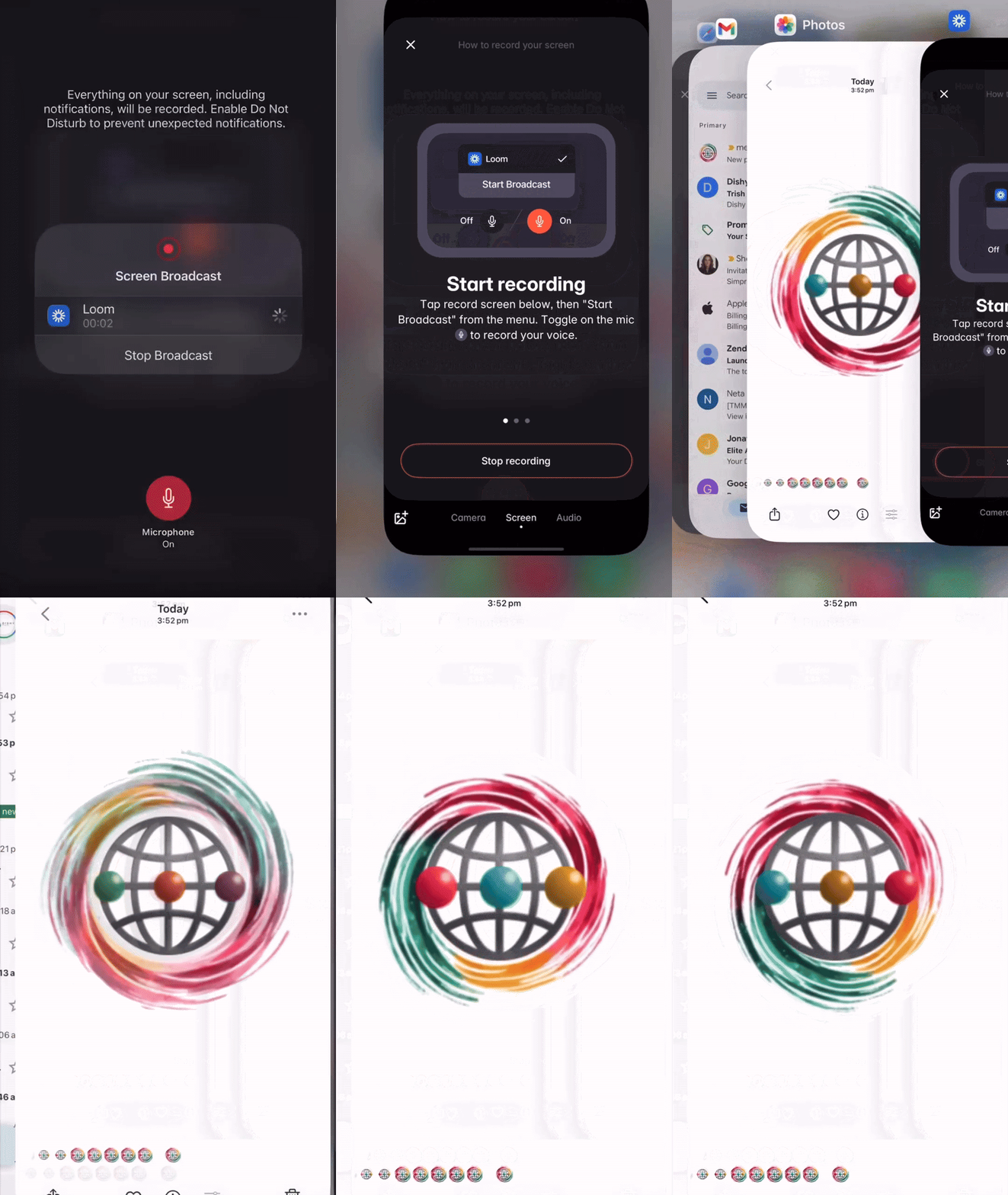
Example of animated logo/profile pic in gmail
Hey everyone! I wanted to share something really cool… I modified my logo in Canva as an animated gif (using animations and exporting as GIF), and now I can use it as my profile pic in Gmail and other email accounts, where it rotates and blinks. 🙌👏🤩 If you're interested in having an animated logo for your own email account, I encourage you to try this out! If you’re unsure how to create in canvas, comment below or send me a DM and I’ll teach you or happy to do it for you! 🫶🤗 Next to create a video of me waving and then convert it to a gif, I’ll use this for my personal brand and my personal gmail account 👏😁
1 like • Dec '25
This is fantastic! Well done!
1-5 of 5
@caroline-jones-1183
I’m a kind hearted, crystal loving, deeply committed energy healer to my personal growth and supporting the growth of others.
Online now
Joined Dec 22, 2025