Activity
Mon
Wed
Fri
Sun
May
Jun
Jul
Aug
Sep
Oct
Nov
Dec
Jan
Feb
Mar
Apr
What is this?
Less
More
Memberships
Institut IA
360 members • Free
Freq4Health AI Prompts & more
21 members • Free
Renewable Energy Career growth
33 members • $10/month
Mechanical Engineering Mastery
309 members • Free
Technical Interview Prep
210 members • Free
FEEL: Tech to Leader
10 members • Free
Lots Of Projects
195 members • Free
Software Engineering
712 members • Free
Abundance Engineering
104 members • Free
29 contributions to The Energy Data Scientist

19h •
New Course: Fundamentals of Energy Economics for Electricity Grid Planning
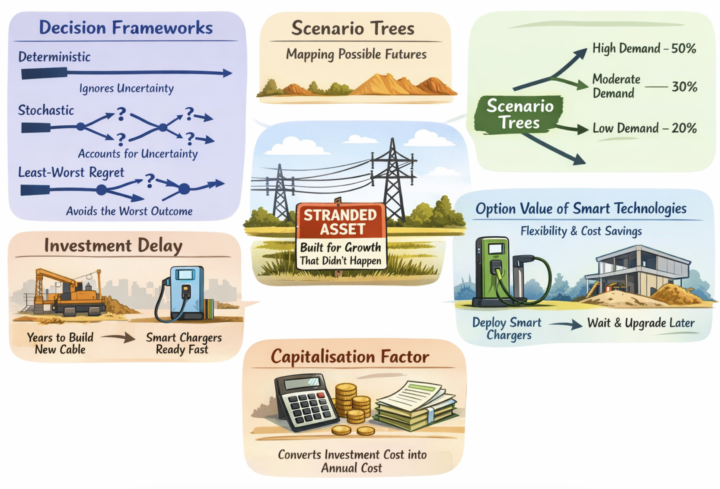
Just released a new course on energy economics, covering important economic concepts behind investment decisions in electricity distribution networks. You'll learn about - decision frameworks (deterministic, stochastic, least-worst regret), - scenario trees, - stranded assets, - option value of smart technologies, - investment delay. All concepts are illustrated through a practical example. No prerequisites. Ideal if you're preparing for energy economics or power system economics roles, or doing research. It is course 120 at the very end of the Classroom. Briefly here are the definitions of fundamental economic concepts in power systems: - Decision frameworks: these are approaches that network planners use to decide where and when to invest in power systems. These frameworks are: deterministic (ignores uncertainty), stochastic (accounts for uncertainty and probabilities), and least-worst regret (accounts for uncertainty but not probabilities). - Scenario trees: A way to map out possible scenarios. Demand might grow a lot, a little, or not at all. The tree captures these paths and their probabilities. - Investment delay: Some investments take longer to build than others. Upgrading a cable might take years; deploying smart chargers can happen faster. This difference matters hugely for planning. - Stranded assets: You invest in upgrading a line expecting electricity demand to grow, but it doesn't. Now you've paid for capacity nobody uses. That's a stranded asset. - Option value of smart technologies: Smart technologies like smart chargers can be deployed quickly, letting planners wait and see how uncertainty plays out before committing to expensive upgrades. The cost savings from having this flexibility is the option value. - Capitalisation factor: Converts a one-off investment cost into an equivalent annual cost, accounting for the asset's lifetime and the discount rate. Attached is a summary slide, and a slide on the concept of option value and stranded assets. No need to fully understand these screenshots . Just to get an idea of what the course teaches.

0 likes • 18h
thank you
12d •
How Climate Policy Shapes Energy Markets
I was reading this paper about how climate-related news and policy changes affect the financial stability of both fossil fuel and clean energy markets. It says that major political events, such as the U.S. withdrawal from the Paris Agreement or international climate summits, create short-term volatility and long-term price shifts across the entire energy sector. Also that market prices are driven much more by people's expectations of future climate policies rather than actual physical events like natural disasters.
18d •
Interview Question: Shell Energy Trading
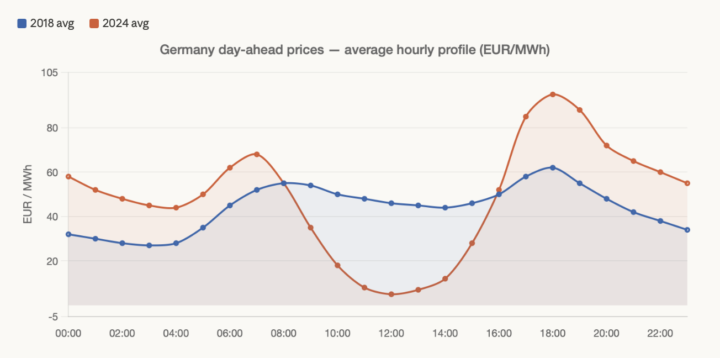
The following interview question (energy economics) has appeared in a recent student database. You can find my answer in the Classroom --> Career Support. - Company: Shell Energy Trading (London) - Role: Quantitative Analyst - Power Trading Stage: 2nd round, technical interview Asked: January 2025 - Question: Look at this chart (attached) showing average hourly day-ahead electricity prices in Germany. Focus on what happens between 10am and 3pm. Why have prices in that window changed so dramatically between 2018 and 2024, and what does this mean for a gas-fired power plant operator?
0 likes • 12d
Many thanks for sharing
15d •
🚨 NEW EXECUTIVE BRIEF: Energy Intensity & The Impact of Oil Shocks
Here is the macroeconomic breakdown from our latest intelligence report: Oil price shocks (such as disruptions at the Strait of Hormuz) hurt developing economies far more than richer ones. Why does this happen? Because developing countries use more energy per unit of economic output and depend heavily on imported fuel and industrial inputs. Richer economies have steadily improved their energy efficiency since 1990 by shifting toward services, while developing economies remain stuck in energy-intensive manufacturing. Furthermore, because oil and gas are key inputs for fertilizers, chemicals, and plastics, a fuel shock rapidly ripples into food security and industrial production, widening the economic gap between rich and poor nations. 🔑 KEY CONCEPT: Energy Intensity (EI) The attached screenshot illustrates Energy Intensity—the ratio of energy supply to GDP output. Essentially, it measures how much energy an economy consumes to produce a unit of economic value. 🔻 High EI (Low Efficiency): Lots of fuel is needed to generate GDP (represented by a large barrel with a small money pile). 🟢 Low EI (High Efficiency): A small amount of energy produces a large pile of economic output (represented by a small barrel with a large money pile). 📊 DOWNLOAD THE REPORT: Head over to the "Energy Market Intelligence" section inside the Classroom tab to download the full PDF. The report includes all downloadable market diagrams and official citation links (Financial Times, WSJ, Bloomberg).

0 likes • 12d
Thank you !

15d •
Download The Global Energy Talent Index Report 2025
Just sharing the Global Energy Talent Index (GETI) Report 2025. This report is about five-year workforce trends across the traditional, transitional, and future energy sectors. It is drawing on insights from nearly 11000 global professionals to map out the industry's evolving landscape. The findings show the rise of local clean energy projects. Shows also an intensifying competition for talent, with employees increasingly valuing clear career pathways, technological innovation, and the opportunity to make a meaningful impact on the energy transition.
0 likes • 12d
Thank you !
1-10 of 29

Active 18h ago
Joined Sep 23, 2025
INFP
Indonesia