Activity
Mon
Wed
Fri
Sun
Aug
Sep
Oct
Nov
Dec
Jan
Feb
Mar
Apr
May
Jun
Jul
What is this?
Less
More
Memberships
Engagement Design Collective
21 members • Free
8 contributions to Engagement Design Collective

7d •
It is not capacity depletion, it is motivational misalignment
I'm genuinely not sure how widespread this actually is outside of the client work I see, so I'm curious what you're noticing in your own world. Everywhere I look right now, teams are being handed the same diagnosis for going quiet: burnout, capacity depletion, too much on their plate, prescribe rest. And in some cases, that's exactly right. But I keep running into cases where the person still has plenty of energy, they just cannot locate a reason to spend it on the work in front of them, and no amount of recovery time touches that, because rest fixes overload and does nothing at all for a system that quietly stopped making the work worth caring about. Have you seen the two get mixed up in your own teams or clients? What tipped you off that rest wasn't the answer?

0 likes • 2d
I'd really liked to have a talk with you about this and many others topics you have shared. And that is the fact, many teams even mine in my ecosystem are facing right now capacity depletion, which consequently lead to motivational misalignment. It's not about declaring that the team isn't able to design a solution for its society. It looks like everyone is waiting for the instructions of the team leader. And the team leader merely identifies himself as equal to each team member. So it's like broken system, which needed a schedule to be restarted. But that all you have explained in earlier topics, we also discussed about it, and I appreciated that the system needed to be designed before the launch or at least the activities inside and each application (resolution). So what is the team waiting to act (resolv)? I'd rather give an answer in two or three months if I'd seen what happened with my team. This also means staying quiet remains a steady option.
Apr 20 •
Less about what to install and more about what to turn down...
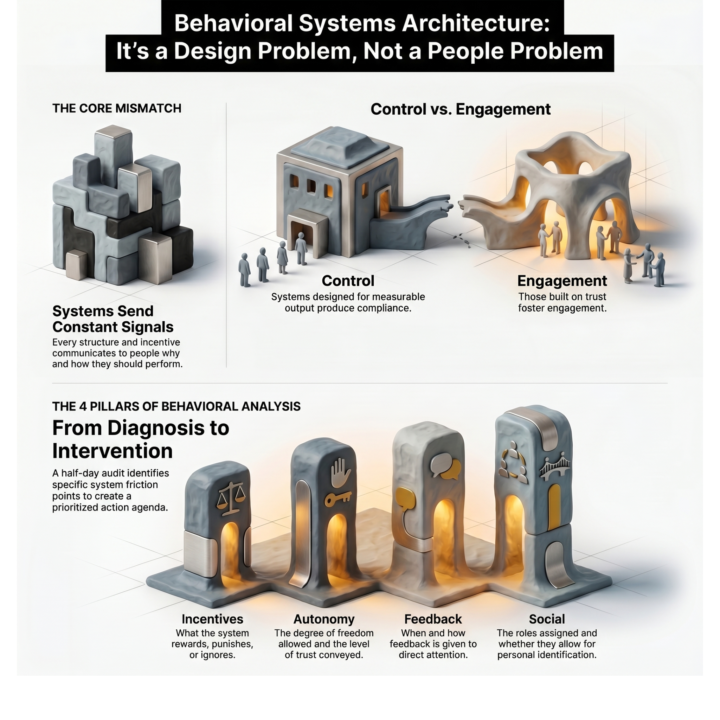
Something I keep returning to this week: the idea that external and intrinsic signals don't actually coexist in a system, they compete, and the external one wins almost by default because it's louder and more immediate. Which raises a question I haven't fully resolved. When we design for engagement, we tend to add things, a feedback loop here, a recognition moment there, a clearer sense of purpose. But if signal dominance is real, then the ceiling on all of that might not be the quality of what we add. It might be the volume of what's already there, the performance metrics, the reward conditions, the implicit consequences for non-performance. So the actual design work might be less about what to install and more about what to turn down. I'm curious whether this maps to what you're seeing in your own work. Are the engagement interventions you've tried hitting a ceiling that feels structural rather than psychological? And if so, where does that pressure actually seem to be coming from in the systems you're working with?
1 like • Apr 28
I never made a relation between extrinsic and intrinsic bevahior, since I learned both separately. In programming languages, we used patterns like garbage collector to increase the performance of a system. When a system is becoming loud by default, its cause at the beginning is definitely extrinsical🚗. It might be helpful as human to identify all the noise and to turn them off. I've never seen this before outside the box💻. So I have to test it in myself ⛪
Apr 8 •
Inspired by TalentLMS 2026 Report
70% of learners are multitasking during training sessions in 2026. That's the highest number in three years. Before blaming attention spans: what does that number actually tell you about design? When you see a drop-off or a distraction in something you've built, what's your first instinct? - The content needs to be shorter / more interactive - The timing or context is wrong, as it's competing with real work - The person isn't motivated enough to begin with - The design never earned their attention in the first place Drop your answer, and if you've changed your diagnosis on this over time, I'm curious what shifted.
1 like • Apr 8
It's rather a span of audience ⛪. Since the usage of internet💻 is promoting more borderlessness, and less creativity👟. How do you make the content interactive if you don't know your opponent? That's why the person isn't motivated to produce.
Mar 31 •
What's the most common assumption the client or stakeholder brings in that you end up having to challenge?
Yesterday, I shared research about managers piling extra work onto their most intrinsically motivated people, based on the assumption that those people will enjoy it. The technical term the researchers use is "motive oversimplification". Here's what I'm curious about from your own experience: when you design for engagement or motivation in an organization, what's the most common assumption the client or stakeholder brings in that you end up having to challenge? Drop your pick in the poll, or write the assumption you hear most often in the comments. I'm curious whether the motive oversimplification problem is something you run into from the outside (as a designer or consultant) or something you're fighting from the inside.
Poll
2 members have voted
0 likes • Apr 2
Hey Roman, in my lately general assembly, I've faced this third sentence "people are disengaged and they won't participate if you launch the programme. Just a few a interacting in the forum". So I guess this is the new trend or type of obstacle designer for engagements should deal with in an organization. How did I react? I just let the process solve its own systemic issue. And everything succeeded.
0 likes • Apr 2
@Roman Rackwitz I meant I didn't react immediately. I just let all the collection process of all reactions to the end, and somehow the remark didn't catch attention anymore. Now that the assembly is close we could have a resolution 😁. I meant sometime the organization should be considered as part of the engagement system being designed and let optimize the interactions.
Jan 4 •
Quick pulse check
When you think about human development and personal growth, where does your attention go first? Not where it should go. Where it actually goes. Choose the option that feels most natural to you. There is no correct answer here. This is about orientation, not quality. If you want, add one sentence in the comments explaining why you chose what you chose. No justifications needed. I am curious where this community actually stands.
Poll
7 members have voted
0 likes • Jan 4
I read recently the book "From performance to excellence", and I approved we should move forward from the performance to a better life style. Meanwhile, I admitted there should exist a basis of writing and references to project itself. Thus, the story should prior the "self" since it's the result of combining "performance" and "self". If we could reshape our story, it would trully match the humility spoken for excellence.
1-8 of 8
@albert-justin-zeh-bekono-4203
I studied business informatics, software engineering and lately information systems. Since 2024, I have been teaching Gamification and Programming.
Active 2d ago
Joined Nov 26, 2025