Activity
Mon
Wed
Fri
Sun
Jun
Jul
Aug
Sep
Oct
Nov
Dec
Jan
Feb
Mar
Apr
May
What is this?
Less
More
Owned by Mary
Life is busy enough. Let’s make play the easy part. No pressure, no stress! Just simple, playful ways to really connect with your kids.
Memberships
AEN Town Square
47 members • $1
EmpowerEd 💡
23 members • Free
The Proactive Parent Community
88 members • Free
The Baby Sleep Skool
17 members • Free
Skool Monetization Lab
74 members • Free
Crust & Crumb Academy
1k members • Free
The Relationship Chef
101 members • Free
Psychological Flexibility 💫
206 members • Free
Panda for Skool
315 members • Free
122 contributions to the skool CLASSIFIEDS

🔥
5m •
Overcoming Sunday Afternoon “I’m Bored Slump"
Parents, can you relate? It’s Sunday afternoon. The "I’m bored" whines are starting to echo through the house. The easiest fix is to hand over a tablet just to get twenty minutes of peace, but that nagging feeling remains the feeling that we’re losing something to a glowing screen. Did you know, in the 1970s, architect Simon Nicholson proposed the "Theory of Loose Parts." He proved that the more "variables" an environment has (sticks, stones, fabric, or even old spoons), the more children interact with it. Boredom isn't a problem to be solved; it’s an invitation for your child to become the architect of their own world. Try this at home, the indoor picnic. Spread a blanket on the living room floor and declare "No chairs allowed" for lunch. Ask your kids how they’d build a "fortress" around the picnic using only pillows and the items in the room. Suddenly, lunch isn't a chore, it's an adventure. You don't have to be perfect to raise creative kids. You just need a little community support. Grab your favorite mug and join our Connected Thru Play Coffee Chat this Sunday, 17 May at 7:30 am CDT. Let's talk about why "I'm bored" is actually the best thing you'll hear all week. Join US and share your "Play Win" today! https://www.skool.com/connectthruplay/about
0
0

2d •
Why exposure alone doesn’t help some kids try new foods
If you’ve been told to “just keep offering it”…you’re not wrong for trying that. For some kids, repeated exposure does help. But for others, it starts to feel like: - more pressure - more refusal - or less and less willingness over time And that’s usually the moment parents start wondering… “Why isn’t this working for my child?” Here’s what I want you to know: Exposure doesn’t create curiosity on its own. Curiosity comes from feeling safe enough to explore. And for many kids with sensory sensitivities and feeding challenges, unfamiliar foods don’t feel neutral. They can feel: - unpredictable - overwhelming - or like “too much” before they even touch them So when we keep offering without adjusting what’s underneath it, it can actually make things feel harder. It's not because the strategy is wrong. It's because it’s not matched to what your child needs yet. Inside Raising Curious Eaters, we look at the pieces that come before the strategy—sensory processing, nervous system regulation, and the feeding relationship— so you can start understanding what’s actually getting in the way…and what to do next.

🔥
1 like • 1d
I wish I’d known this when my kids were younger. It also turned out my “picky” eater had some food allergies and intuitively knew not to eat something.
🔥
0 likes • 18h
@Brenda Chilstrom that’s helpful to know.
🔥
2d •
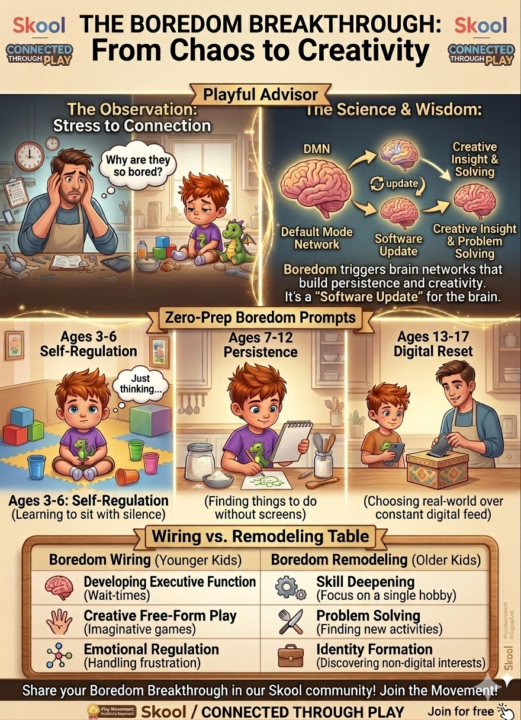
The Gift of the "Blank Space"
We’ve all been there. Your child wanders in, sighs, and says, "I’m bored." Usually, we feel an instant pressure to fix it. We suggest a craft or hand over a phone to stop the whining. We treat boredom like a problem, but it’s actually the moment right before creativity wakes up. Letting the Brain Wander When a child isn't being entertained, their brain starts connecting ideas and imagining possibilities. That uncomfortable pause is just the runway they need to invent a game or build a fort. A little bit of empty space builds more resourcefulness than a packed schedule. Here’s something you can try the next time you hear, “I’m bored!” Instead of being the entertainer, try a lighter touch: • Say, "I wonder what your brain is going to come up with." • Leave out a few items like a roll of tape, a spoon, and a box. Don't give instructions. Just walk away. • Give them five minutes of quiet before you jump in. The magic usually happens at minute four. We’re diving deeper into this during The Playful Shift, our weekly 30-minute chat. We’ll be talking about how to turn "I'm bored" into a win this Sunday 17 May from 7:30 to 8:00 am CST. Come hang out with us in the Connected Through Play community to grab the link and share what your kids ended up creating this week. See you there! https://www.skool.com/connectthruplay/about
🔥
2 likes • 2d
@Sheena Mason-White Thanks for the book suggestion. I need to look for that. Yes, to play in corporate life, too.
🔥
2 likes • 2d
@Sheena Mason-White checking my library now

5d •
One Post Per Day
Just a reminder that you are allowed to post once per day in any category, not once per day in every category. If you break this rule three times, you will be removed from the group. The rule is important so that everyone has a chance of having their posts seen without one or two people clogging up the feed. Thank you for your attention to this matter.

🔥
1 like • 4d
@Tori Davey same
5d •
What your child might really be saying when they say “I don’t like it”
One thing I keep hearing from parents lately is this: “My child says ‘I don’t like it’ right away.” And when that keeps happening, it can start to feel defeating. It's like the meal is over before it even begins. But that quick “I don’t like it” is not always about the food itself. Sometimes it’s: “I already feel unsure.” “This feels unfamiliar.” “My body is saying no before my brain even has a chance to explore.” Because trying something new takes capacity. Sensory systems notice things quickly. Nervous systems protect quickly. And some kids say “no” almost instantly because their body is already working hard just being at the table. When we understand what may be happening underneath the reaction, we start responding differently. Less pressure. More curiosity. More support for the nervous system first. 💗 I’d love to hear from you…When your child says “I don’t like it,” what do you think might be going on underneath that reaction? These are the kinds of conversations we’re having inside Raising Curious Eaters if you want support that looks beyond “just keep offering it" and "wait and see" type of advice about picky eating.

🔥
2 likes • 4d
This is powerful and really even helpful for adults.
🔥
1 like • 4d
@Brenda Chilstrom you’re welcome. A lesson learned the hard way.
1-10 of 122
🔥
@mary-nunaley
Former homeschool mom & learning engineer. I’ve spent years turning everyday life into a playground. Let’s bring play & connection back home.
Online now
Joined Jan 9, 2026
INTP
Nashville, TN
Powered by