Activity
Mon
Wed
Fri
Sun
Sep
Oct
Nov
Dec
Jan
Feb
Mar
Apr
May
Jun
Jul
Aug
What is this?
Less
More
The Pawpaw patch
59 members • Free
Perma Resilience
1.2k members • $7/month
Syntropic School
589 members • Free
Food Forest Family (FREE)
3.8k members • Free
Syntropic Sunlands w/ Milan
189 members • Free
Living Soil Community
1.3k members • Free
Natural Gardening
429 members • Free
Sunnyside Soil Collective
169 members • Free
Oasis Builders
147 members • Free
233 contributions to Oasis Builders
6h •
Water holding capacity
Today I'm trying a new idea to reduce the effect of drought on poor sandy soil, it won't make a difference this year, but will improve the CEC of the land long term and increase how much water, nutrients and biology can be held. The plan is to crush biochar in a cement mixer with a couple of bricks, then apply to the dry pasture with a seed /fertiliser spreader, and water in with pond water. We already know that pond water has high fertility from experiments in watering plants with just plain well water and pond water, trapping this fertility in the biochar will prolong it's efficacy. When working with micro powders, don't forget to wear a mask.

2 likes • 4h
Two sumach leaves, one watered with well water and the other with pond water, both on a similar soil and positioning, both grown the same time from cuttings. I don't have a refractometer, but one is definitely greener, has stiffness in mid drought and overall it's a stronger plant .
1d •
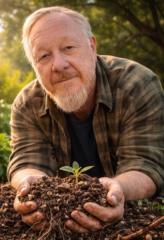
Grafting Fruit Trees Nearly 600 Years Ago
Around 1440, an English gardening poem attributed to Jon Gardener described how to grow vegetables and herbs, save seed, propagate plants, and graft fruit trees. In The Feate of Gardening, Gardener gives surprisingly practical instructions for grafting. He describes cutting the tree stock with a saw, smoothing it with a knife, preparing the scion, fitting the pieces together, and protecting the graft afterward. For those of us growing grafted pawpaws, apples, pears, or other fruit trees today, the basic idea is familiar. A seed-grown fruit tree is a new genetic individual. If we want to preserve a particular variety, grafting allows us to keep that variety growing by joining living tissue from the plant we want to another compatible plant. Gardener was writing about apples and pears, not pawpaws, but the underlying principle has carried forward for centuries. What interests me just as much is how much observation sits behind a skill like this. Someone had to notice that cut plant tissues could join, learn which combinations worked, determine when the timing was right, and then pass that knowledge forward. The Feate of Gardening did exactly that. It preserved practical gardening knowledge in English at a time when books were still copied by hand. The surviving manuscript is considered the earliest existing English account devoted to gardening. There is much more in this little work that we can come back to. Gardener discusses seed saving, seasonal planting, propagation, and a long list of useful herbs. Even his planting dates raise an interesting question for us today. Rather than simply copying a date from fifteenth-century England, we can ask what seasonal conditions and signs in nature surrounded that date. The calendar changes with place and climate although our relationships between plant growth, season, and timing remain. If you are growing a grafted fruit tree, what are you growing?
2 likes • 23h
Northern Europe in the middle ages was almost all forest and people's of that time respected trees as a thing of value, a woodsman could make a good income on half an acre. So the knowledge and craft of working with trees is not recent, in a world without plastic we were far more resourcefull, unfortunately not too good at replanting trees. An account from around 1500 mentioned that you could mount a horse and ride for three months across Europe and into what's now Russia, without leaving the forest . It's thought only 0.5% of that original woodland survives, mainly in remote parts of Eastern Europe and Russian.
1 like • 17h
@Jim Flach in mixed woodland you can with simple tools and a pole lathe, make,; spoons, bowls, candle sticks, shingles, hurdles, gates, charcoal, fagots and firewood, tannins and dyes , and use acorns for flour , and pig food (the origin of the word acre). Plus timber for construction and many other things and obviously fruit ,nuts and fungi .
1d •
Tomatoes
This year the tomatoes seem to be very fleshy with a high pulp to seed ratio, as always super tasty, straight from the vine, they make a great lunch time wrap. It's also the best year ever for aubergines, these came from a 39 cents packet of generic unnamed seed I found in a discount shop .

1 like • 1d
@Jim Flach we only eat garden produce fresh , our freezer tends to be full of leftovers from the restaurant and there's only so much food you can eat. After living the dream for a long time, we don't need to stockpile to feel safe , our skills are our security.
1d •
Madness phase
I think yesterday was the last day of craziness, I'm not sure if the madness was internal, external, local,or global. For at least the last month everything has been extreme,not only in the garden, but with work and socially, every one and everything at the limit, and strangely people are coping and adapting with good humour and an attitude that ,we can't do anything else, but deal with it. Not the everything is bad, a large number of things are going well, it's just unusual and unexpected. My intuition is telling me, today there's a change in the air, and hopefully a return to normal events, with the promise of the beginning of new routine. Maybe it's me, and the 15th of August passing by has sent a subliminal massage. (In France this is the date the marks the beginning of autumn/winter planting, and the decline of summer.) Am I the only person who has seen this madness or is it a local, or personal phenomena?
2d •
Pushing buttons.
As technology advances our hand eye coordination and dexterity get better and perhaps our upper body strength and stamina reduce , does it matter ? No. Working the land simply with basic tools is almost a thing of the past , petrol equipment is being replaced by battery tools, even larger energy demanding equipment, like tractors can be electric, quite, clean and less emissions. All this help we have to do work ,comes at a price, not only to purchase, but with embodied energy in the manufacturing and delivery. Our practical skills and physical strength is more sustainable, and we should do our best to improve and maintain them, then as we age recount the knowledge and experience that we invested in when we were younger, and pass it on. Our abilities to the new crafter's and grafters. One big problem is that pushing buttons is easier than learning a trade and all the hours of practice, the blisters, cuts and bruises, that it takes to become an expert in a manual skill . Electric secateurs what next?

1-10 of 233
@phillip-greenwood-2467
Committed forest gardener for over 30 years, guardian of an historic monument oak tree in Brittany, France.
Active 8m ago
Joined Feb 7, 2026