

Sep 23 •
Before You Accept Your Next Brand Collaboration, Read This
Picture this… A brand reaches out because they’ve already seen your content. - They can see your views. - They’ve reviewed your delivery style. - And they’ve decided you could be a good fit. - Then they ask for your rate. You calculate it based on the actual workload: four original long-form videos, published over four months, with up to two revision rounds per video. You send your starting rate and clearly explain that you’re open to negotiating. …Suddenly, the conversation changes. Now the budget is “supposedly” based on your view count—even though that pricing criteria was never disclosed in the original email nor campaign brief (always ask for this when any brand reaches out to you). That is the moment to pause. 💯 The problem isn’t that the brand has a smaller budget. Brands have budgets, and negotiation is normal. The problem is asking a creator to price an entire production scope without explaining, in writing, the metric that will ultimately be used to evaluate that price. I’ve worked on both the agency side and the creator side, so I understand how these conversations happen behind the scenes. A brand usually has some type of approved budget range before outreach begins. Before giving your rate, ask: - What is the approved budget range? - Is compensation based on deliverables, performance, views, or a combination? - What exactly is included in the requested scope? - How many revision rounds are expected? - Are usage rights, paid media, whitelisting, raw footage, or exclusivity included? - What happens to the scope if the budget is lower? Because a smaller budget should purchase a smaller scope—not the same workload at a heavily discounted rate. 🚮 And if a brand introduces a new pricing metric after receiving your quote, you are allowed to challenge it professionally. Being excited about a collaboration does not mean surrendering your leverage or disrespecting your value 👀 Your rate is not only for views. It also covers your strategy, production time, research, scripting, filming, editing, revisions, expertise, audience trust, and the content asset the brand receives.

Jul 5 •
If YAMS Has Helped You… Don’t Keep It to Yourself.
Can I ask you something? 🤔 If YAMS has helped you think differently, build something you probably wouldn’t have built on your own, or simply made AI feel less overwhelming… why are you keeping it a secret? I bet you already know at least a few folks who would benefit from being here. - Maybe it’s the coworker who’s drowning in work and needs a better system. - The friend who’s been talking about starting a business for years but never takes the first step. - The creator who keeps saying, “I know I should be using AI, I just don’t know where to start.” - Or the family member who somehow turns you into their personal AI help desk every weekend. 😂 Now imagine this… - One day they join because you sent them your affiliate link. - A few months later they’re launching an app they never thought they could build. - They land a new client. - Create a new stream of income and feel confident using AI instead of intimidated by it. And every time they tell someone how much YAMS helped them, you’ll know you had a hand in that story. 🫶🏽 That’s pretty incredible! As a thank-you, YAMS members earn 50% commission whenever someone purchases or upgrades through their affiliate link. So yes, you can earn dinero 💰. But what excites me even more is knowing you helped someone change the trajectory of their business—or maybe even their life. That’s bigger than an affiliate commission. If you’ve ever told me YAMS has helped you, this is your chance to help someone else experience the same thing. So here’s my challenge: Don’t just tell me YAMS is valuable. Prove it. 👀 Share your affiliate link with someone who immediately came to mind while reading this. Because awareness grows when it’s shared. -Whit 🧡

Jul 23 •
You Could Be Earning 50% From YAMS—Even as a Free Member 👀
Did you know every YAMS member—including free members—can earn 50% when someone upgrades or purchases a course instead the classroom through their affiliate link? The goal is not just to refer more people. The goal is to refer the right people. The best fit for YAMS is someone who is READY to move. Someone who wants to build, market, experiment, ask questions, apply what they learn, and create something real. They do not have to know everything. They can even be newer to AI. But they should be curious, willing to try, and ready to take action—not just looking for another community to join and quietly forget about. 🧐 Before recommending YAMS, ask yourself: Is this someone who will actually use what is inside? Because the folks who get the most value here are not always the most experienced. They are the ones who participate, implement, and keep moving forward. If you are not sure how to promote the community, I already created resources to help you. 😏 Head to the Affiliate Module inside the Classroom, where you will find ready-to-use graphics and promotional support you can use when sharing YAMS. You do not have to create everything from scratch. Grab your affiliate link, use the resources, and start referring folks who are READY to turn awareness into action. — Whit aka Lit Dubo🔥
3
0

Jun 3 •
🚨💛 YAMS AFFILIATE PROGRAM UPDATE 💛🚨
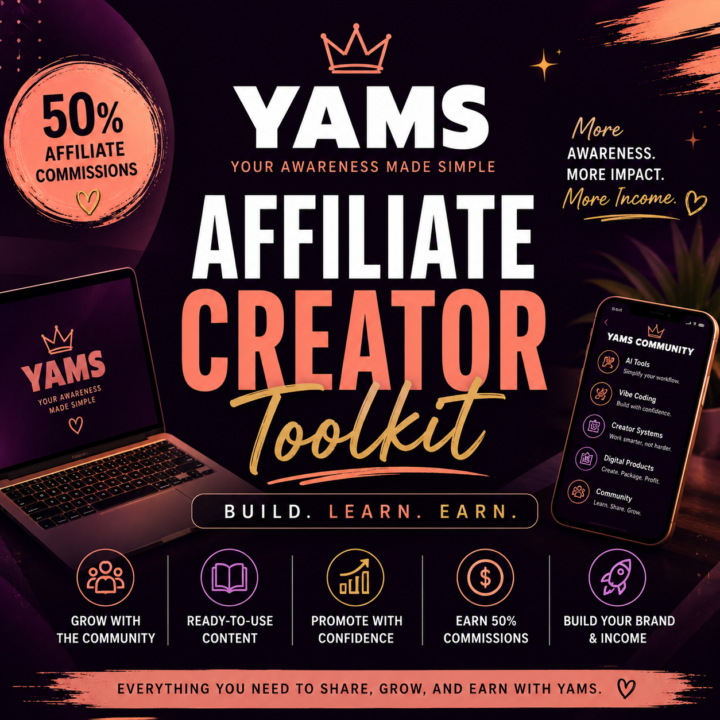
Okay YAMS Fam… this is actually a REALLY big deal. 👀🔥 I’ve decided to keep the YAMS affiliate payout at 50% for members. Yes…FIFTY. PERCENT. 😳🔥 Which means if someone joins YAMS through your affiliate link and upgrades… ✨ You get a cut. ✨ If they grab Premium… you get paid. ✨ If they upgrade later… you get paid. ✨ If they purchase inside YAMS… you get paid. And here’s the thing… You do NOT have to be some giant influencer to participate. Some of y’all are already naturally talking about: 💛 the apps 💛 the builds 💛 the trainings 💛 the live sessions 💛 the community itself So why not get rewarded for it too? 👀 Even Standard members can participate. Meaning…You don’t have to upgrade to start sharing YAMS and making money from referrals. Honestly? Some folks could literally use the affiliate program TO fund their own upgrade later. 🔥 And now that we’re growing faster, this is the PERFECT time to start sharing before pricing changes happen. I already have a “Become An Affiliate Of YAMS” module inside the classroom, and I’m about to start adding: ✨ Shareable graphics ✨ Infographics ✨ Promo visuals ✨ Easy content assets ✨ More affiliate resources …so it’s easier for members to spread the word without overthinking what to post. - Here’s the link to the affiliate module inside the classroom -Whit 🫶🏽 If you’re already an affiliate or thinking about becoming one…Drop a 🔥 below.
Apr 14 •
💸 50% Affiliate is LIVE — Let’s Chat About It
I made an update that can actually shift things for you inside YAMS… I’ve increased the affiliate to 50%! 🙌🏽 But before you get excited — I want to be very clear so no one feels confused or disappointed later. Inside Skool , every member has access to their own invite link. That’s how referrals are tracked. So if you share YAMS, make sure people are joining through your link — because that’s what ensures you get credit (this is very important). Now with that said… Let’s zoom out for a second. When you invite someone here, you’re not just sharing a link. You’re putting them onto: • Better ways to build • Systems that actually help things work • A space where ideas don’t just sit… they get executed That matters. So now? You get rewarded for that. 50% of every tracked referral And to make it fun… From now until June 7 (my birthday) 🎂 👉 Whoever brings in the most referrals gets upgraded to Premium!!! Also — Premium is currently $50/year until June 7 So if you’ve been thinking about sharing YAMS, this is actually the best time. As a reminder… I’m building this with you… not just for you. So I want this to be something that actually works — not just sounds good. Details on how to participate are in the comments ⤵️ 🤎 Whit

1-7 of 7

Leaderboard (30-day)
1

🔥
+224
2

🔥
+100
3

🔥
+69
4

🔥
+46
5

+28
Powered by