
Write something

May 10 •
🚨 Future Junior High school Athletes
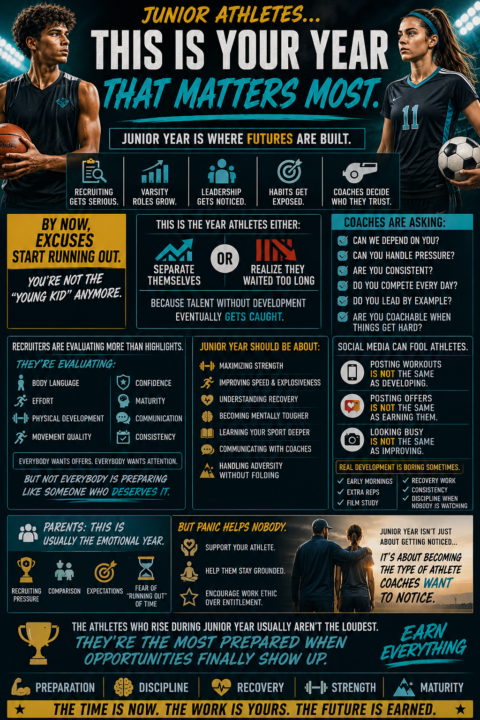
Junior athletes… This is the year everybody says matters most. And they’re not wrong. Junior year is where: • recruiting gets serious • varsity roles grow • leadership gets noticed • habits get exposed • coaches decide who they trust By now, excuses start running out. You’re not the “young kid” anymore. This is the year athletes either: • separate themselves OR • realize they waited too long Because talent without development eventually gets caught. At this stage, coaches are asking: • Can we depend on you? • Can you handle pressure? • Are you consistent? • Do you compete every day? • Do you lead by example? • Are you coachable when things get hard? And athletes need to understand something important… Recruiters are not just evaluating highlights. They’re evaluating: • body language • effort • physical development • movement quality • confidence • maturity • communication • consistency Everybody wants offers.Everybody wants attention. But not everybody is preparing like someone who deserves it. Junior year should be about: • maximizing strength • improving speed and explosiveness • understanding recovery • becoming mentally tougher • learning your sport deeper • communicating with coaches • handling adversity without folding This is also where social media can fool athletes. Posting workouts is not the same as developing.Posting offers is not the same as earning them.Looking busy is not the same as improving. Real development is boring sometimes. It’s: • early mornings • extra reps • film study • recovery work • consistency • discipline when nobody is watching And parents… This is usually the emotional year. Recruiting pressure.Comparison.Expectations.Fear of “running out of time.” But panic helps nobody. Support your athlete. Help them stay grounded.Encourage work ethic over entitlement. Because junior year isn’t just about getting noticed… It’s about becoming the type of athlete coaches WANT to notice. The athletes who rise during junior year usually aren’t the loudest.
2
0
May 10 •
🚨 Future Sophomore High School Athlete
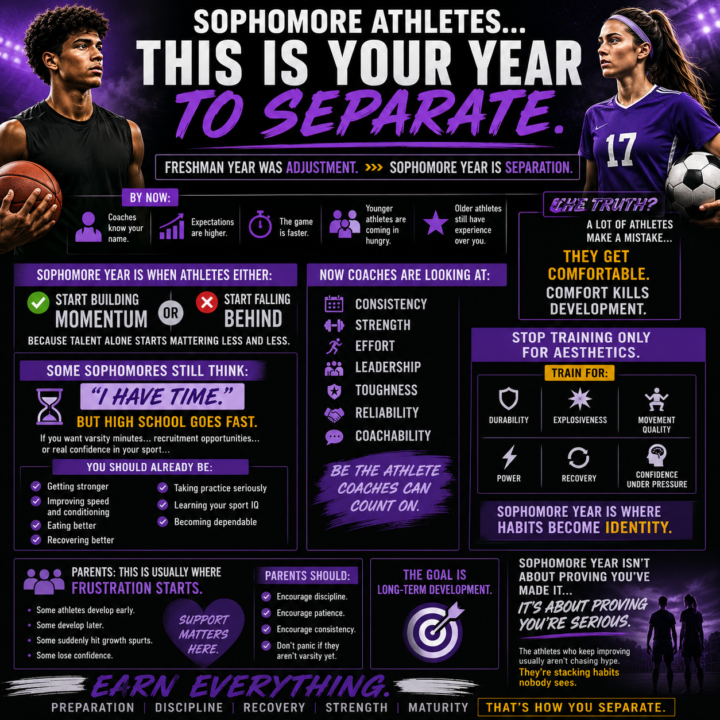
Sophomore athletes… This is usually the year the truth shows up. Freshman year was adjustment.Sophomore year is separation. By now: • Coaches know your name • Expectations are higher • The game is faster • Younger athletes are coming in hungry • Older athletes still have experience over you This is where a lot of athletes make a mistake… They get comfortable. Comfort kills development. Sophomore year is when athletes either:• start building momentum OR• start falling behind Because talent alone starts mattering less and less. Now coaches are looking at: • consistency • strength • effort • leadership • toughness • reliability • coachability And here’s the reality… Some sophomores still think:“I have time.” But high school goes FAST. If you want varsity minutes…recruitment opportunities…or real confidence in your sport… You should already be: • Getting stronger • Improving speed and conditioning • Eating better • Recovering better • Taking practice seriously • Learning your sport IQ • Becoming dependable This is also the year athletes need to stop training ONLY for aesthetics. Train for: • durability • explosiveness • movement quality • power • recovery • confidence under pressure Sophomore year is where habits become identity. And parents… This is usually where frustration starts. Some athletes develop early.Some develop later.Some suddenly hit growth spurts.Some lose confidence. Support matters here. Encourage discipline.Encourage patience.Encourage consistency. Don’t panic if they aren’t varsity yet. The goal is long-term development. Because sophomore year isn’t about proving you’ve made it… It’s about proving you’re serious. The athletes who keep improving usually aren’t chasing hype. They’re stacking habits nobody sees. Earn Everything.
2
0
May 10 •
🚨Soon to be high school Freshman Athletes
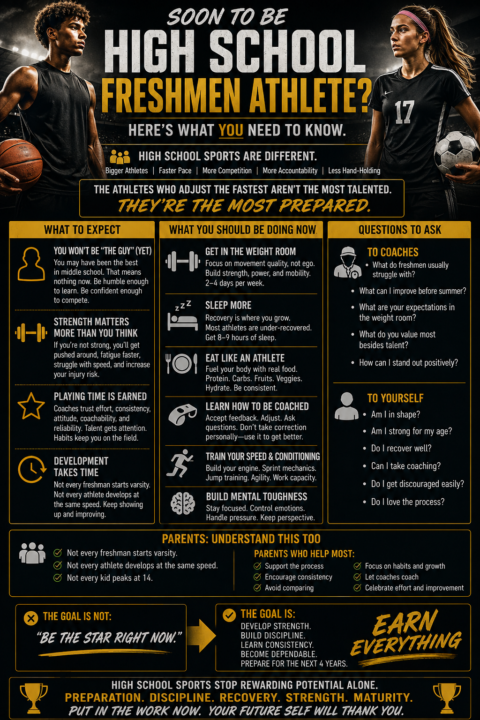
Soon-to-be high school freshmen athletes… High school sports are different. Bigger athletes.Faster athletes.Stronger athletes.More competition.More accountability. A lot of athletes walk into freshman year thinking middle school success automatically carries over. It doesn’t. The athletes who adjust the fastest usually aren’t the “most talented.”They’re the most prepared. So what should you EXPECT? You probably won’t be “the guy/girl” right away.You may not start immediately.You may get humbled.You may realize strength matters way more than you thought. And that’s okay. Freshman year is about development. Right now, athletes should already be: • Strength training correctly • Learning movement mechanics • Sprinting and jumping • Improving mobility • Building conditioning • Learning recovery habits • Sleeping more • Eating like an athlete Not just playing games. You also need to start asking better questions. Questions like: • “What do freshmen usually struggle with?” • “What can I improve before summer?” • “What do coaches expect in the weight room?” • “How can I stand out positively?” • “What does coachability actually look like?” And parents… Understand this: Not every freshman becomes varsity immediately.Not every athlete develops at the same speed.Not every kid peaks at 14. The goal isn’t: “Be the star right now.” The goal is: Develop strength.Build discipline.Learn consistency.Become dependable.Prepare for the next 4 years. Because coaches trust athletes who: • Show up •Listen • Work hard • Handle coaching • Stay consistent • Bring energy every day Talent gets attention.Habits keep athletes on the field. High school sports stop rewarding potential alone. Preparation starts mattering. Earn Everything.
2
0
May 3 •
D1 Dreams vs D1 Reality — What Parents & Athletes Need to Hear
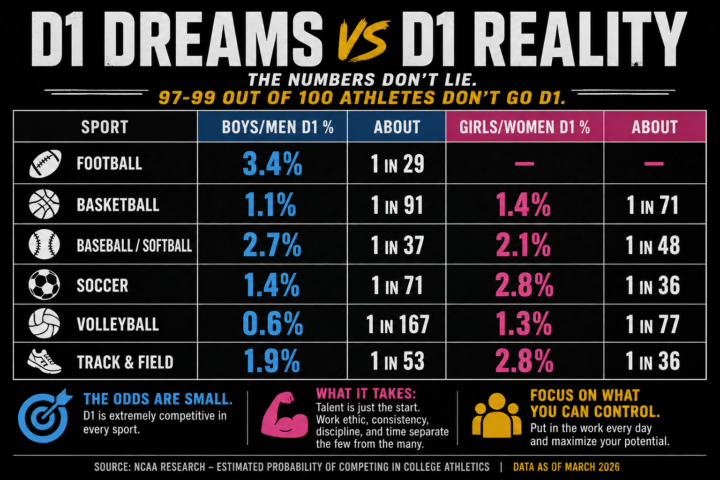
Everybody says “my kid is going D1.” Let’s slow that down. 📊 The numbers: - Football: ~3% - Basketball: ~1% - Baseball: ~2–3% - Soccer: ~1–3% - Volleyball: ~0.5–1% - Track & Field: ~2–3% That means 97–99 out of 100 athletes don’t go D1 Parents — This Part Matters Your child isn’t competing against kids in your town. They’re competing against: - Athletes training year-round - Kids with size, speed, and genetics - Athletes getting coached at a high level early - Kids already on college radars Love your kid… but don’t lie to them. Overvaluing them: - Creates unrealistic expectations - Slows down real development Athletes — Listen Up Being one of the best on your team means nothing. Being one of the best in your state is where it STARTS. D1 athletes are: - Bigger - Faster - Stronger - More skilled - More consistent And they’ve been putting in work longer than you think 🧠 What It Actually Takes - Years of consistent training (not seasonal effort) - Strength development (non-negotiable) - Sport-specific skill work - Daily recovery, sleep, and nutrition - Performing under pressure - Exposure and relationships The Truth Nobody Likes Some athletes won’t go D1. Not because they failed… But because: - The numbers are small - The spots are limited - The competition is elite ✅ What You SHOULD Focus On Instead of chasing a label… Chase: - Development - Discipline - Consistency - Being coachable - Maximizing YOUR potential There are: - D2 opportunities - D3 opportunities - NAIA opportunities - And real paths to build your future through sports If D1 is the goal… your habits better match the top 1%. If they don’t… you’re not chasing a dream — you’re chasing a fantasy. Earn Everything
1
0
May 1 •
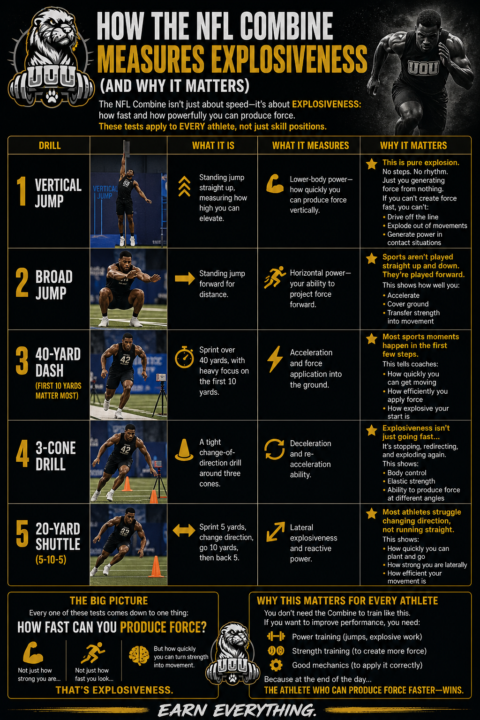
How The NFL Combine Measures Explosiveness(And Why It Matters)
How the NFL Combine Measures Explosiveness (And Why It Matters) When people think of the Combine, they think of speed and highlights… But what teams are really evaluating is explosiveness — how fast and how powerfully you can produce force. And the truth is… these tests apply to every athlete, not just skill positions. 1. Vertical Jump What it is: Standing jump straight up, measuring how high you can elevate. What it measures: Lower-body power — how quickly you can produce force vertically. Why it matters: This is pure explosion. No steps. No rhythm. Just you generating force from nothing. If you can’t create force fast, you can’t: - Drive off the line - Explode out of movements - Generate power in contact situations 2. Broad Jump What it is: Standing jump forward for distance. What it measures: Horizontal power — your ability to project force forward. Why it matters: Sports aren’t played straight up and down. They’re played forward. This shows how well you: - Accelerate - Cover ground - Transfer strength into movement 3. 40-Yard Dash (First 10 Yards Matter Most) What it is: Sprint over 40 yards, with heavy focus on the first 10 yards. What it measures: Acceleration and force application into the ground. Why it matters: Most sports moments happen in the first few steps. This tells coaches: - How quickly you can get moving - How efficiently you apply force - How explosive your start is 4. 3-Cone Drill What it is: A tight change-of-direction drill around three cones. What it measures: Deceleration and re-acceleration ability. Why it matters: Explosiveness isn’t just going fast… It’s stopping, redirecting, and exploding again. This shows: - Body control - Elastic strength - Ability to produce force at different angles 5. 20-Yard Shuttle (5-10-5) What it is: Sprint 5 yards, change direction, go 10 yards, then back 5. What it measures: Lateral explosiveness and reactive power. Why it matters: Most athletes struggle changing direction, not running straight.
1
0
1-12 of 12

skool.com/uou-the-standard-5428
Follow the plan. Earn everything. Strength, discipline, and accountability—no shortcuts.
Powered by