
Write something
Pinned

Jan 16 •
Welcome to The Tongue Tie Parent Guide ☺️
This is a calm, supportive space to understand tongue tie and feel more confident in your next steps. If you’re comfortable, introduce yourself in My Child’s Journey with: 1️⃣ Your child’s age (or due date) 2️⃣ What brought you here 3️⃣ Where you’re at right now No pressure to post straight away, many parents like to read first, and that’s completely okay. We’re glad you’re here 🤍

14d •
✨ Under the Tongue Release – Parent Homework
This is a simple technique you can do at home to help improve tongue mobility and reduce tension under the tongue. In this video, you’ll see a mum working on her little girl.There is a tender spot — but notice how her daughter actually draws her mum’s hand back in for more. This is really important. Even when there is some tenderness, children will often seek the input because it helps release the restriction and improve movement. How to do it: - Wash your hands thoroughly - For babies, use your little pinky finger - For older children, use your index finger - (Some parents find gently cooling the fingertip helpful) - Place one finger under the tongue inside the mouth - With your opposite hand, place a finger under the chin on the outside - Gently press the fingers toward each other, supporting the tissue between them Then: - Slowly work from one side to the other - You may feel small, pea-sized tight spots — these are areas of tension - Gently work to soften and flatten these areas - Work each side a few times using gentle downward pressure The goal is not to stretch forcefully, but simply to work through and relax the tissues under the tongue. What to expect: - If the tongue is moving freely, this usually isn’t uncomfortable - If there is restriction, the area may feel tender or sensitive This tenderness reflects tightness in the muscle layers — and is often where the most benefit can occur. Your focus: Consistency is key. Keep working gently and regularly until: - The tissue feels less tight and less sore - The tongue begins to move more freely A Gentle Reminder This kind of support is not a replacement for professional assessment, especially if there are feeding difficulties. However, understanding how the muscles under the tongue work together can help you better support your child’s feeding, oral function, and development.


Feb 28 •
Meat Broth and Methylation Results
Hey everyone, Major big wins this past week! Daphne is 6 months so I’ve officially started making oxtail bone broth and following Which Foods When sequence. The chiropractor has noticed more room in the roof of her mouth when adjusting. I have also got my Methylation results back: MTHFR Gene Mutation C677T and A1298C - both heterozygous and associated with increased risk of thromboembolism. Vitamin B12 (378 nmol/L), Serum Folate (54.4 nmol/L), Homocysteine (12.5umol/L). Would methylated B complex tablets be a good start? Overall feeling so relieved and grateful to prioritise the health of me and my family 💕

Mar 5 •
Tongue Tie Dilema
Hi there, we have a 5 week old baby which was diagnosed with a type II tongue tie the day she was born and we were recommended to have it cut. We are a chiropractic couple and knew there had to be other options before that, so that's when our journey started. We cancelled our tongue tie intervention which was programmed 2 weeks after birth. breastfeeding was painful specially on my left breast, I have one mastittis and nipple soreness which came and went, but she was gaining weight well and after a breastfeeding consultant it improved. The main issue now was that she was constaly regurgitating milk and vomiting almost every feed, as well as being terribly uncomfortable with trapped wind also after every feed. She is constañy restless, highly alert and hardly sleeps. She also has a constantly white lining on her toungue, she is a mouthbreather and has a little rash in her face and neck which we feel is slowly extending lightly over her legs.... We started adjusting our baby from day one, but we are considering now cuttig the tongue tie on top of the adjutsments as we feel our baby will always have some issues unless we adress it. I would really like to know your thoughts, what are we doing wrong?
14d •
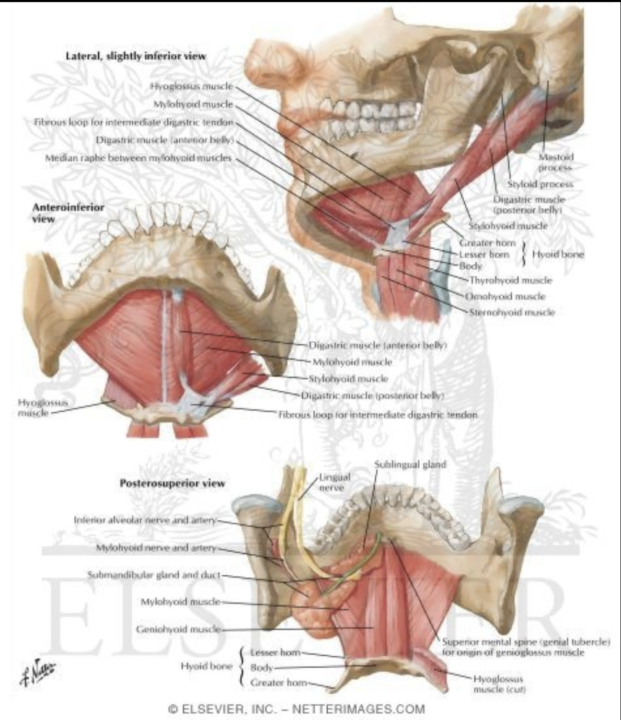
Understanding What’s Under the Tongue (This helps you visualise the technique I just shared)
After watching the technique I just posted, these images can really help you understand what your fingers are actually working on. Under the tongue isn’t just a single piece of tissue (like a frenulum) — it’s a layered network of muscles and fascia that all work together. Key muscles you’re influencing: - MylohyoidForms the floor of the mouth and provides a supportive “sling” for the tongue - GeniohyoidHelps lift and stabilise the tongue and plays a role in swallowing - Digastric musclesSupport jaw movement and coordinate with tongue function - Genioglossus & HyoglossusThese are deeper tongue muscles that control tongue movement and positioning Why this matters: When these muscle layers are tight or restricted, it can impact: - Tongue mobility - Feeding and latch - Swallowing patterns - Oral development - Even breathing patterns over time Bringing it back to the technique: When you’re gently working under the tongue: - You’re not just “stretching” tissue - You’re helping these muscle layers relax and coordinate better - You’re improving how the tongue can move, lift, and function This is why you may feel those pea-sized tight spots — they’re often small areas of tension within this system. The takeaway: This work is gentle… but powerful. Understanding the anatomy helps you: - Be more confident - Be more precise - And be more consistent with your child’s care
4
0
1-22 of 22

skool.com/the-tongue-tie-parent-guide
We help parents understand tongue tie and feel confident making decisions without fear or pressure.
Leaderboard (30-day)
1
+6
2

+4
3

+2
4
+2
5

+1
Powered by