
Write something

1d •
The Vacation Re-Entry Reset
Coming back from vacation is where your system shows. Most owners come back and immediately get pulled into whatever is loudest: - inbox - CRM tasks - team questions - follow-ups - random content ideas - unfinished work from before they left That is how you lose the first 2-3 days after a trip. What helped me today was having a simple re-entry reset: 1. Keep the morning routine. Before touching the business, get grounded. For me that means personal development, reading, and setting the tone for the day. 2. Clear the open loops I caught up on CRM follow-ups first because follow-up is one of the easiest places to lose momentum. 3. Pick one main lever. Today the lever was content. Not 12 random priorities. Content. 4. Map the next 30 days I made sure the content schedule was mapped out and my editor had enough direction to keep moving. 5. Attack! Monday with the plan already visible The win is not just doing more work. The win is removing the guessing so you can execute faster. If you are coming back from a trip, weekend, or just a messy few days, do not start with random tasks. Start with the reset. Question: what is the one open loop you need to clear first today?
0
0

15d •
When The Bottleneck Changes, Your Focus Has To Change
One of the biggest operator lessons I am thinking about right now: The bottleneck changes as the business gets stronger. At one stage, the problem might be survival. Then it might be systems. Then capacity. Then team standards. Then customer experience. Then demand. If you keep solving yesterday's bottleneck, you can work hard and still stay stuck. That is why I try to ask: What is the actual constraint right now? For The Institute, there were seasons where the biggest issue was structure, systems, or getting the machine more stable. Now the facility is more ready. The standards are higher. The experience is cleaner. The machine is stronger. So the next question becomes: How do we get more qualified people to see it? That changes the work. Content is not just posting. Marketing is not just likes. Attention is not the scoreboard by itself. The path is: Qualified eyes -> assessments -> trials -> starts -> memberships. That is the type of thinking every operator needs. Do not ask, "What should I do more of?" Ask, "What is the constraint right now, and what work directly attacks it?"

18d •
A Community Still Needs A Customer Journey
One thing I am realizing as I build this Skool community: Even if you have been in business for years, every new offer or community forces you back to the basics. I am looking at Skool the same way I look at The Institute Corona. It needs a customer journey. Not just random posts. Not just good ideas. Not just trainings sitting in a library. A real journey: 1. Someone joins. 2. They understand what the community is for. 3. They know the first quick win to chase. 4. They get a simple tool, template, Loom, or agent they can use right away. 5. They get a result. 6. They know the next step. That is what makes a community valuable long-term. The question I keep asking is: What is the simplest deliverable I can give someone that helps them implement immediately? Because information is not enough. The win is implementation. For your own business or offer, ask this: When someone first comes in, what is the first result they should get as fast as possible?
0
0
24d •
Your Community Promise Needs A Quick Win
I’m rebuilding how I explain my Skool community right now, and the question I keep coming back to is simple: If I were the ideal customer, would this feel tangible fast? Not just interesting. Not just motivational. Not just “good content.” Tangible. When someone looks at your offer, community, course, or program, they are quietly asking: 1. What is this actually going to help me do? 2. How fast can I implement it? 3. Will I get a quick win that proves I’m in the right place? That last one matters more than people think. A quick win is not about promising overnight success. It is about giving someone enough traction early that they believe: “Okay, this is useful. I can actually apply this.” That is what keeps people engaged. A lot of owners try to scale content before the promise is clear. But more content does not fix a vague promise. Before you post more, tighten this: Who is this for? What do they get? How fast can they use it? What is the first win? What happens after that? That is what I’m obsessing over right now. Not just building more. Building clearer. Quick audit: If someone joined your world today, what is the first tangible win they would get in the first 24-72 hours?
28d •
Stop Guessing And Let The Numbers Talk
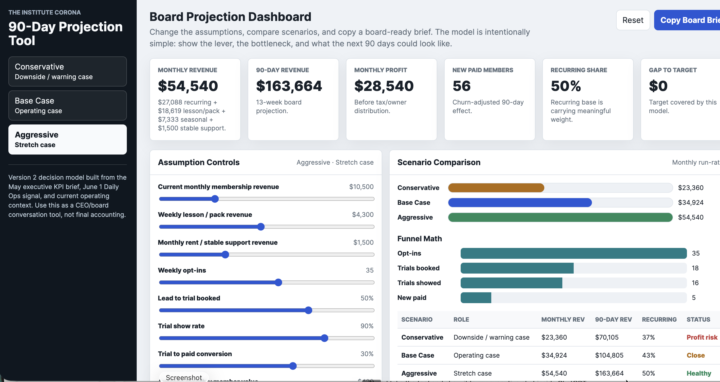
The other night I built a 90-day revenue projection tool with my Codex executive assistant. The tool lets me look at projected income and revenue for the business over the next 90 days. But the important part is not just that AI built a tool. The important part is why the tool is useful. It has context. Codex is already helping me operate the business: - it helps with transactions - it updates KPI workflows - it understands my Notion structure - it sees the numbers I track - it knows the operating rhythm of the business So when I ask it to build a projection tool, it is not starting from a blank prompt. It is building from real context. Then I take the tool and show it to my executive chat inside ChatGPT. That chat gives me feedback on how to make the tool better. So now the loop looks like this: Business data -> Codex builds the tool -> ChatGPT critiques the tool -> Codex improves the tool -> I make better decisions. That is the part most people are missing with AI. They are still using it like a one-off answer machine. But the leverage is when AI has enough context to help you see the business more clearly. At some point, you have to stop guessing. Look at the numbers. Build the tool. Improve the tool. Make the decision cleaner. I attached screenshots of the tool so you get an idea what it looks like. Quick question: What is one decision in your business that you are still making mostly off feel instead of data?
1-30 of 30
powered by

skool.com/the-institute-6909
For service business owners tired of running your business from memory. In 7 days install your Notion Command Center + AI Executive Assistant.
Suggested communities
Powered by