
Write something
Pinned

⭐
16h •
🤔 WE WANT YOUR HONEST OPINION!
We want to better understand what people are TRULY trying to accomplish when it comes to AI so we can make our products better. We know it’s broad and there are so many different lanes, but if you had to pick one of the 2 options below, which one would you choose?
Poll
392 members have voted
Pinned

19h •
⚖️ You're Saving Time With AI. So Where Is It Going?
Research published in early 2026 found that the average small business worker saves 5.6 hours per week using AI tools, with managers saving closer to 7 hours. Those are meaningful numbers. Across a year, 5.6 hours per week is over 280 hours: roughly seven full working weeks returned to professionals who use AI consistently. Most people who see those numbers nod in recognition. The time savings feel real. There's less friction on specific tasks, drafts come faster, research compresses, routine work moves quicker. And then someone asks where those 280 hours actually went, and the conversation gets complicated. ------------- Context ------------- The productivity paradox of AI is one of the least discussed aspects of the current wave of adoption. Time saved on tasks and felt experience of having more time are different things, and for a significant number of professionals, they're not converging the way the numbers suggest they should. The explanation isn't mysterious. Time savings don't automatically translate into felt margin unless the saved time has somewhere deliberate to go. If the work expands to fill the capacity AI creates, if new obligations emerge to absorb the recovered hours, if the time savings get distributed across thirty small tasks rather than accumulating into meaningful blocks, the felt experience of the week doesn't change even when the productivity data does. This is the absorption problem. Time savings get absorbed rather than accumulated, and the absorption is usually invisible. No single thing consumed the saved time. A hundred things each took a little. The net experience is: I'm using AI, the tasks are definitely faster, but somehow the week is just as full. A consultant described this pattern with unusual precision. She tracked her time carefully before and after adopting AI tools and found that the data confirmed the savings: about four hours per week in reduced task time. But over the same period, she had taken on two additional client projects, joined a committee she wouldn't previously have had time for, and expanded her content output to take advantage of the new production capacity. The four hours were real. They were also gone, immediately and invisibly, into expanded scope rather than into margin.

Pinned

2d •
What Success Actually Buys You
Most people think success is about money. It's not. Money is just what buys you options. I've worked hard for decades. Not because I fell in love with the grind, but because I fell in love with what the work could create. Every uncomfortable conversation. Every risk. Every time I wanted to quit but didn't. None of it was just to make more. It was to own my time. To be there for the people I love. To create memories instead of regrets. To have the freedom to say yes to what matters and no to what doesn't. Don't chase success because you want to look successful. Chase it because one day you'll realize time is the only thing you can't earn back. Work hard. Do the uncomfortable things. Become the person capable of creating the life you want. Because real success isn't measured by what you own. It's measured by how fully you get to live. Question for you: If you had complete freedom over your time one year from now, what would you spend more of it doing... and who would you spend it with?

4h •
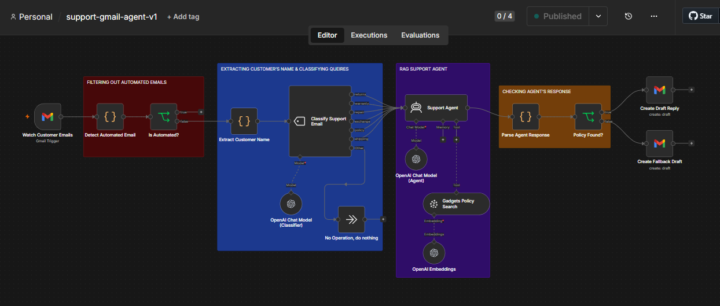
I just built this production ready 'Support Gmail Agent' with the help of Claude code
What started as a demo is now almost production ready, let me walk you through it: I built this for a Imaginary Tech company called 'Gadgets & More Electronics' (Yeah I know name is not sounding like name) First of all the workflows, There are actually Two workflows: 1.The first one is for document ingestion. Where I have converted the FAQs & The policy pdf into chunks & uploaded them into Pinecone vector database. 2.The second one is our Support Gmail agent. Now let's talk about it what it does:- ~It checks for new emails every 15 minutes, takes only unread emails ,newer than 10 minutes. ~Then it detects whether the emails are automated or not, if it is Automated then workflow will stop but if it is not automated it will continue ahead. ~Then it extracts the customer's name from the emails to make it personalized to them. ~Then it will classify the query or emails whether it is Support relevant or not if not the workflow will stop right there but if it is then the workflow will proceed ahead. ~Then comes our support Agent which has our Pinecone vector database as a tool where our policy and FAQs are stored, it knows how to handle each topic, Personalization ,Tone and brand voice ,Output formats, rules, Confidence scores based on the retrieval of data. ~Then there is Agent response checker which will see whether The agent actually found the policy or not? because sometimes you know how Agent make up and hallucinate. ~If the policy found it will create a draft so that a human can review and send it and if it does not found the policy it will create a fallback draft. This is the entire workflow, will drop demo videos today. let me know whether we can add some new features,or add some more guardrails......Just let me know i am welcoming all thoughts and perspective. Harsh Singh

1-30 of 19,884

skool.com/the-ai-advantage
Founded by Tony Robbins, Dean Graziosi & Igor Pogany - AI Advantage is your go-to hub to simplify AI and confidently unlock real & repeatable results
Leaderboard (30-day)
1

+540
2

+362
3

+214
4

+169
5

+101
Powered by